Background
Pulsed field ablation (PFA) is a novel non-thermal ablation modality for the treatment of atrial fibrillation (AF). At present, 8 applications per pulmonary vein (PV) are considered standard, with 4 in basket configuration and 4 in flower configuration. The objective of the study is to investigate whether PFA using 16 applications per PV is associated with an improved outcome compared to the standard procedure.
Methods
The prospective study included a total of 292 patients with AF who were enrolled between January 2023 and June 2024. According to the number of applications per PV, patients were assigned to group PFA-8 (8 applications per PV; 4x basket configuration, 4x flower configuration) or group PFA-16 (16 applications per PV; 6x basket, 10x flower). Efficacy and safety data were analyzed after a follow-up period of 365 days.
Results
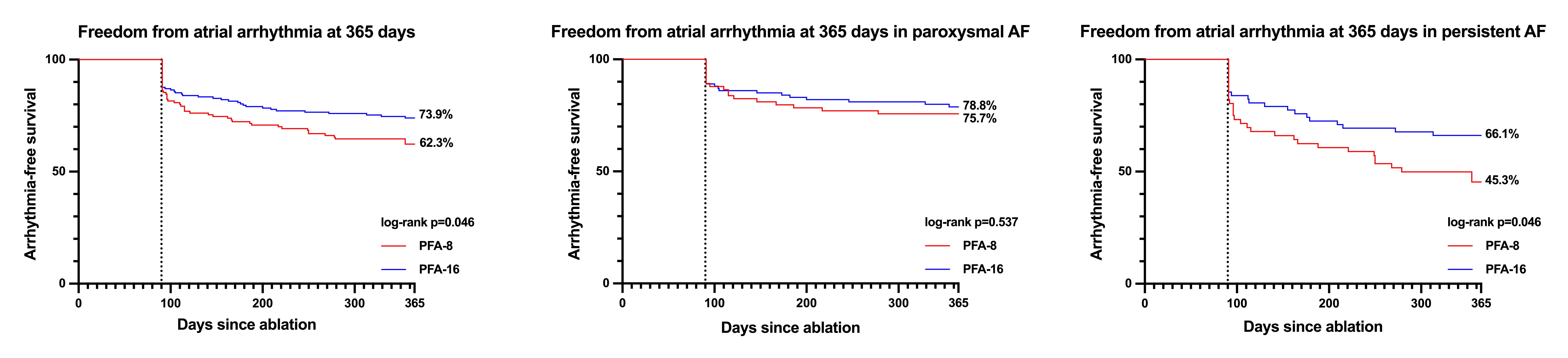
The recurrence rate of atrial arrhythmia (AF, atrial flutter, and atrial tachyarrhythmia) was significantly lower in group PFA-16 (n=42 [26%] patients) than in group PFA-8 (n=47 [36%] patients; p<0.001). The Kaplan-Meier estimates for freedom of atrial arrhythmia for group PFA-8 and group PFA-16 were 62.3% and 73.9%, respectively (log-rank p<0.05). Serious adverse effects were observed in 9 (3.1%) patients, with no significant differences between the two groups (p>0.05).
Conclusions
Patients with 16 PFA applications per PV had fewer recurrences of atrial arrhythmia than patients with 8 PFA applications. An increased number of PFA applications may improve outcome after PVI.