Background
Pulsed field ablation (PFA) is increasingly used as an energy source for cardiac ablation in patients with atrial fibrillation (AF). The lattice-tip catheter (Affera, Medtronic), capable of toggling between PFA and radiofrequency ablation (RFA), allows for focal ablation beyond pulmonary vein isolation (PVI). This study assessed long-term arrhythmia outcomes in patients undergoing their first ablation for atrial fibrillation using a substrate-guided linear ablation strategy with the lattice-tip catheter and retrospectively compared them to a PVI-only strategy using a pentaspline PFA catheter (Farapulse, Boston Scientific).
Methods
Between 07/2023 and 01/2024, 28 patients underwent first-time AF ablation using the lattice-tip catheter. Patients were selected for this procedure based on suspected left atrial substrate due to persistent AF, enlarged left atrium or high age. In addition to PVI, linear ablation (anterior line and/or roof line) was performed based on left atrial substrate.
During the same period, 214 patients underwent PVI only with the pentaspline PFA catheter. From these, a matched control group (n=28) was selected via propensity score matching (age, BMI, AF subtype). Patients were followed at 6 and 12 months with ECG and Holter monitoring.
Results
After propensity score matching, important patient baseline criteria did not differ significantly between the two groups (Lattice-tip vs Pentaspline: mean age 69.93 (7.98) vs 70.00 (10.43) years; mean BMI 28.49 (5.30) vs 28.65 (3.47); Male 71.4% vs 67.9%; Persistent AF 82.1% vs 82.1%; Arterial Hypertension 75.0% vs 74.1%; Diabetes mellitus 14.3% vs 14.3%).
Procedure time was longer with the lattice-tip catheter (98.8 vs. 31.6 minutes, p < 0.001). Linear ablation was performed in 75% of lattice-tip cases. At one year, 86.4% of lattice-tip patients were arrhythmia-free vs. 66.4% in the control group (log-rank p = 0.073, Figure 1). Median follow-up time was 462 days in the lattice-tip group and 378 days in the control group. Recurrences in the lattice-tip group included AF (50%) and atrial tachycardia (50%), whereas all recurrences in the control group were AF.
Conclusion
A substrate-guided approach using the lattice-tip PFA/RFA catheter showed a trend towards improved arrhythmia-free survival at one year in patients with persistent AF. While results are promising, the threshold for statistically significant improvement was not met and the small sample size and retrospective design without randomization are important limitations. These findings are hypothesis-generating and warrant further investigation in larger randomized studies.
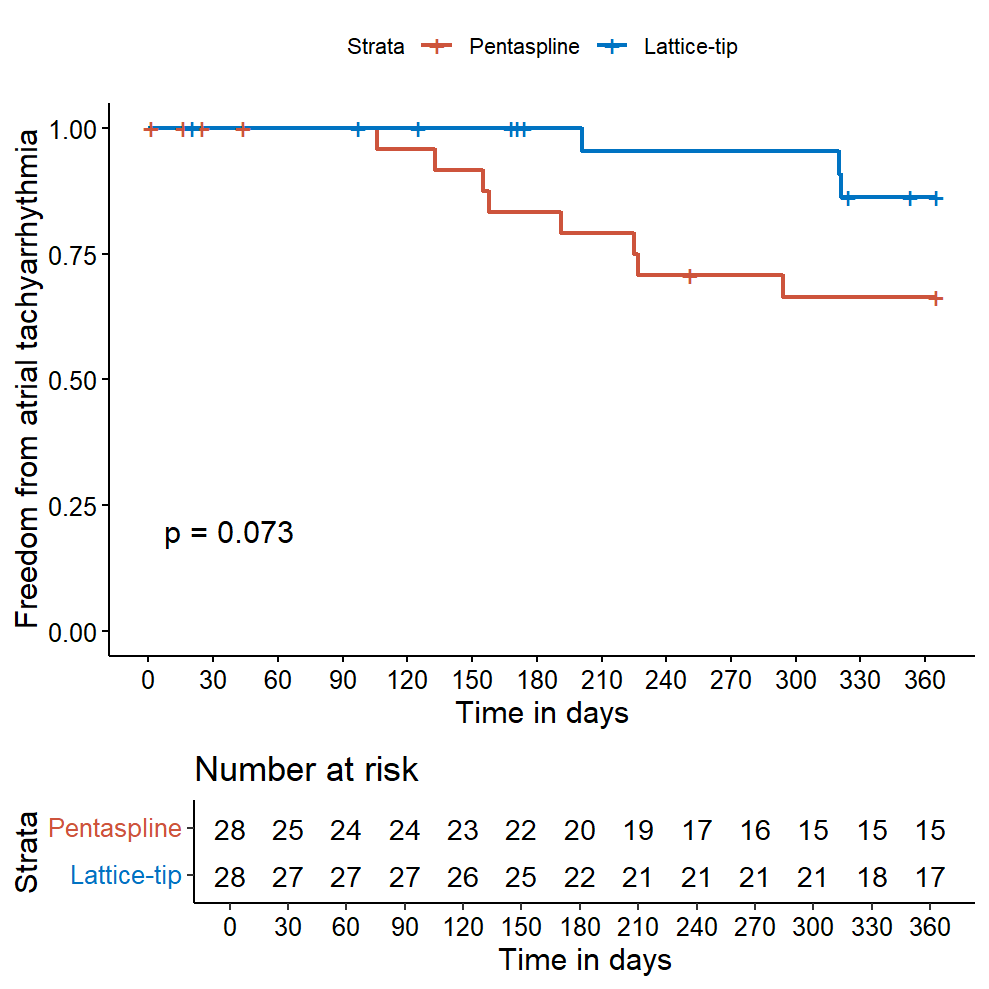 Figure 1,
 Kaplan-Meier-Plot of arrhythmia free survival.



