Background
Radiofrequency (RF) catheter ablation is an established treatment for atrial fibrillation (AF) but may lead to severe complications. Contact force (CF)-sensing catheters were developed to optimize lesion formation and procedural safety, yet their safety profile relative to non-CF catheters remains insufficiently characterised.
Objective
The aim of the TiFFANY (Total number of Fatal adverse events Following Atrial fibrillation ablatioN from an FDA mandatory reporting sYstem) CF study was to compare reported fatal outcomes following AF ablation using CF-sensing versus non-CF RF catheters in the U.S. FDA Manufacturer and User Facility Device Experience (MAUDE) database.
Methods
The MAUDE database was queried for reported death events following RF ablation for AF from 2014 to 2024. All records were independently reviewed by two investigators; discrepancies were adjudicated by a third. When available, data from referenced literature sources were extracted. Cases were categorized by catheter type (CF vs. non-CF) and compared using Fisher’s exact test.
Results
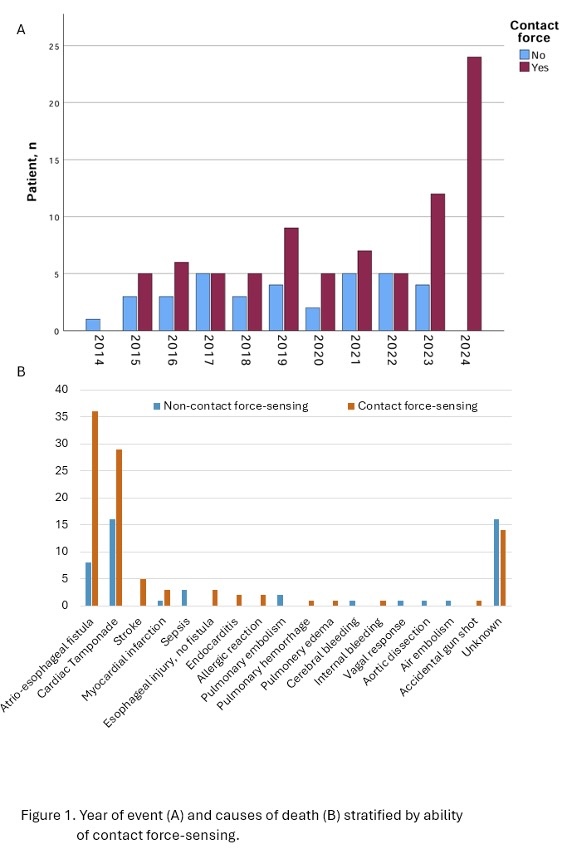
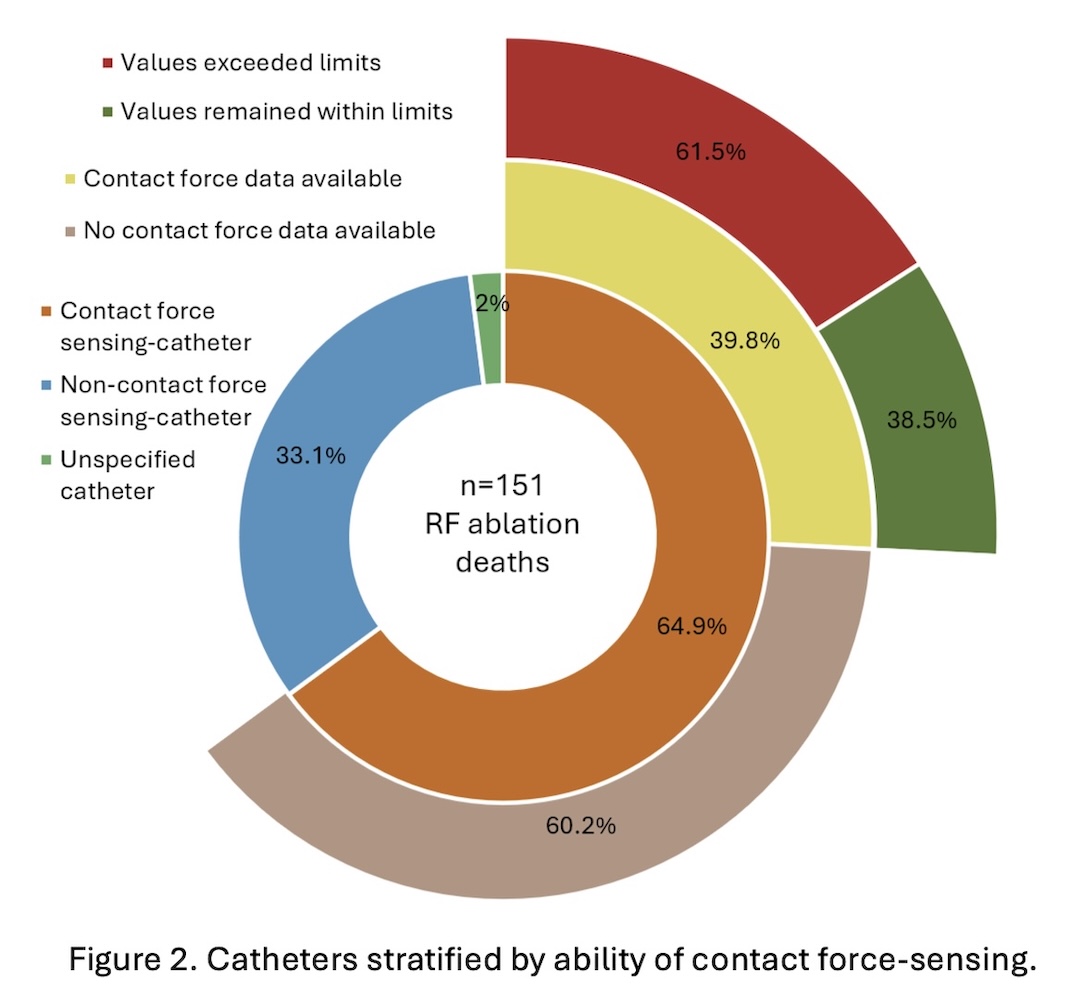
A total of 151 death reports were identified; catheter type was specified in 148 cases, of which 98 (66.2%) involved CF catheters and 50 (33.8%) non-CF catheters. Among CF-catheter reports, 32.5% occurred in the first half of the study period and 67.5% in the second half, whereas among non-CF reports, 51.4% and 48.6% occurred in the first and second halves, respectively (p=0.064).
CF values were available in 39.8% (39/98) of CF-catheter cases, and in 61.5% of these (24/39), the applied force exceeded the manufacturer-recommended limits.
The cause of death was reported in 85.7% (84/98) of CF and 70.0% (35/50) of non-CF cases. In the CF group, atrio-oesophageal fistula (42.9%; 36/84) and cardiac tamponade (34.5%; 29/84) were the leading causes of death. In the non-CF group, cardiac tamponade (45.7%; 16/35) was most common, followed by atrio-oesophageal fistula (22.9%; 8/35).
Cardiac tamponade was the cause of death in 54.2% (13/24) of CF cases associated with CF overexertion and in 13.3% (2/15) of those without CF overexertion (p=0.016), while atrio-oesophageal fistula was the cause of death in 29.2% (7/24) of those with, and in 53.3% (8/15) of those without CF overexertion (p=0.18). Among all cardiac tamponade-related deaths, CF was exceeded in 86.7% (13/15) when force data were available.
Conclusions
CF-sensing catheters accounted for approximately two-thirds of reported RF fatal events in MAUDE. However, the higher number of CF-related cases likely reflects broader adoption rather than increased intrinsic risk. Reporting bias in MAUDE, including variability in manufacturer submissions, should also be considered when interpreting these findings. Cardiac tamponade and atrio-oesophageal fistula were the leading causes of death. Excessive contact force was frequently observed in tamponade cases but less consistently in atrio-oesophageal fistula, suggesting different underlying mechanisms and highlighting the importance of adherence to force guidelines.