Background:
Acute ST-elevation myocardial infarctions (STEMIs) in patients with ≤ 40 years of age are commonly considered to be rare events that are caused by congenital risk factors. It was the purpose of the present study to analyze the rate and characteristics of very young patients with STEMI in a large homogenous “real-world” cohort.
Methods:
All consecutive patients with STEMI and revascularization therapy admitted to an overregional heart center between 2006 to 2022 were analyzed. Patients were stratified into three age groups: ≤ 40 years (very young), 41-79 years (middle-aged) and ≥ 80 years (elderly). Risk factor profile was analyzed in the three groups, focusing on the very young patients.
Results:
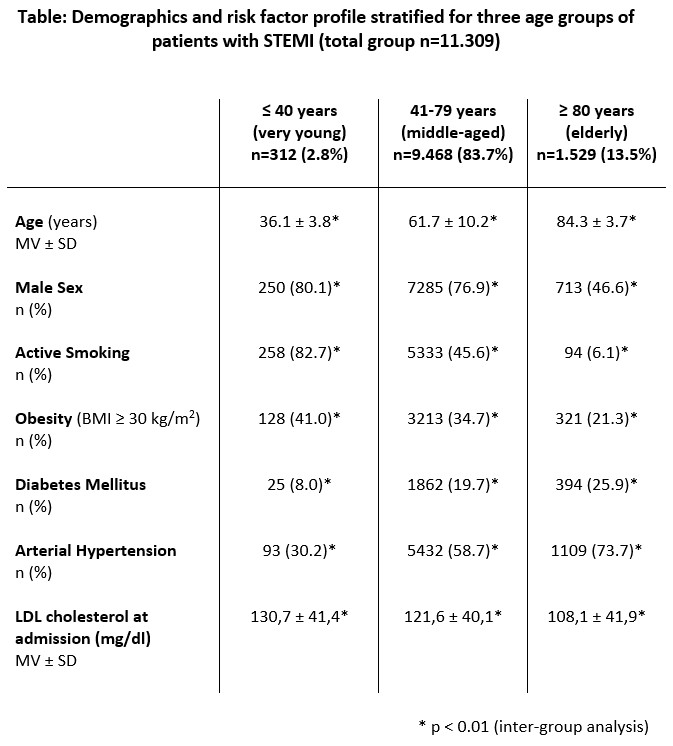
Out of 11.309 patients with STEMI, 312 (2.8%) were ≤ 40 years old. Compared to the older patients with STEMI, the cohort ≤ 40 years was characterized by a high rate of male patients (80.1% ≤ 40 years vs. 46.6% ≥ 80 years, p < 0.01).The rate of active smoking was 82.7% in the very young patients compared to 45.6% in the middle-aged and 6.1% in the elderly cohort (p < 0.01). 41.0% of the patients ≤ 40 years were obese compared to 34.7% of the middle-aged and 21.3% of the elderly patients (p < 0.01). In addition, LDL cholesterol levels were significantly higher in the very young patients (130,7 mg/dl) compared to the other two age groups at the time of admission.
In contrast, diabetes mellitus as well as arterial hypertension were diagnosed more often in older patients than in patients ≤ 40 years (see table). Only in 19 of the very young patients (6.1%) none of the modifiable risk factors smoking, obesity, diabetes mellitus, arterial hypertension was diagnosed at hospital admission.
Conclusion:
In this large STEMI-registry the rate of patients ≤ 40 years was 2.8%, about 80% of them were men. The vast majority of STEMIs at a very young age was attributable to smoking and/or obesity and higher LDL-cholesterol levels were observed; the rate of patients with no identified modifiable risk factor was lower than 10%. These results are a “call for action” to improve risk factor screening and treatment at a young age. Furthermore, effective strategies of long-term prevention after STEMIs are needed in order to reduce the prevalent modifiable risk factors.