Introduction
The duration of the cardiac action potential (AP) and its refractory period (RP
AP) are key determinants of ventricular arrhythmia risk, e.g. long- or short-QT syndromes. Therefore, drugs influencing the RP
AP can exert pro-arrhythmic effects, which must be excluded during drug development. However, determining RP
AP in adult human cardiomyocytes or even intact human myocardium is experimentally demanding. A recent study demonstrated in pig ventricular slices that contractile parameters can be used to detect and distinguish specific effects of pro-arrhythmic drugs with high specificity and sensitivity. This proposes myocardial slice culture as a platform for cardiac arrhythmia and toxicity screening
1. Yet, a direct correlation between electrophysiological and contractile parameters in cardiac slices has not been demonstrated.
Here we performed synchronized measurements of membrane potential and contraction in living pig and human left-ventricular slices to investigate the correlation between the RP
AP and the contractile refractory period (RP
C).
Methods
Minipig cardiac samples were obtained after lethal sodium pentobarbital injection. Human cardiac samples were obtained from the explanted hearts of patients undergoing heart transplantation after ethical approval and written informed consent. Using sharp electrodes, we recorded intracellular potentials in myocardial slices beating inside culture chambers to synchronously measure APs and contraction parameters, immediately after slicing or after differing periods of culture. Constant superfusion with medium guaranteed 34-35°C and oxygenation. Field stimulation was used to elicit APs and contraction. As S1 stimulus, we applied 1 Hz baseline pacing, followed by S2 stimuli with decreasing time intervals. The signals were sampled with 400 Hz (contraction) and 10 kHz (intracellular potential). We determined the RP
AP and RP
C by analysis of the S2 responses. To induce additional parameter variability and to demonstrate the respective responses to K
+ channel activators and inhibitors, we applied pinacidil and dofetilide, respectively.
Results
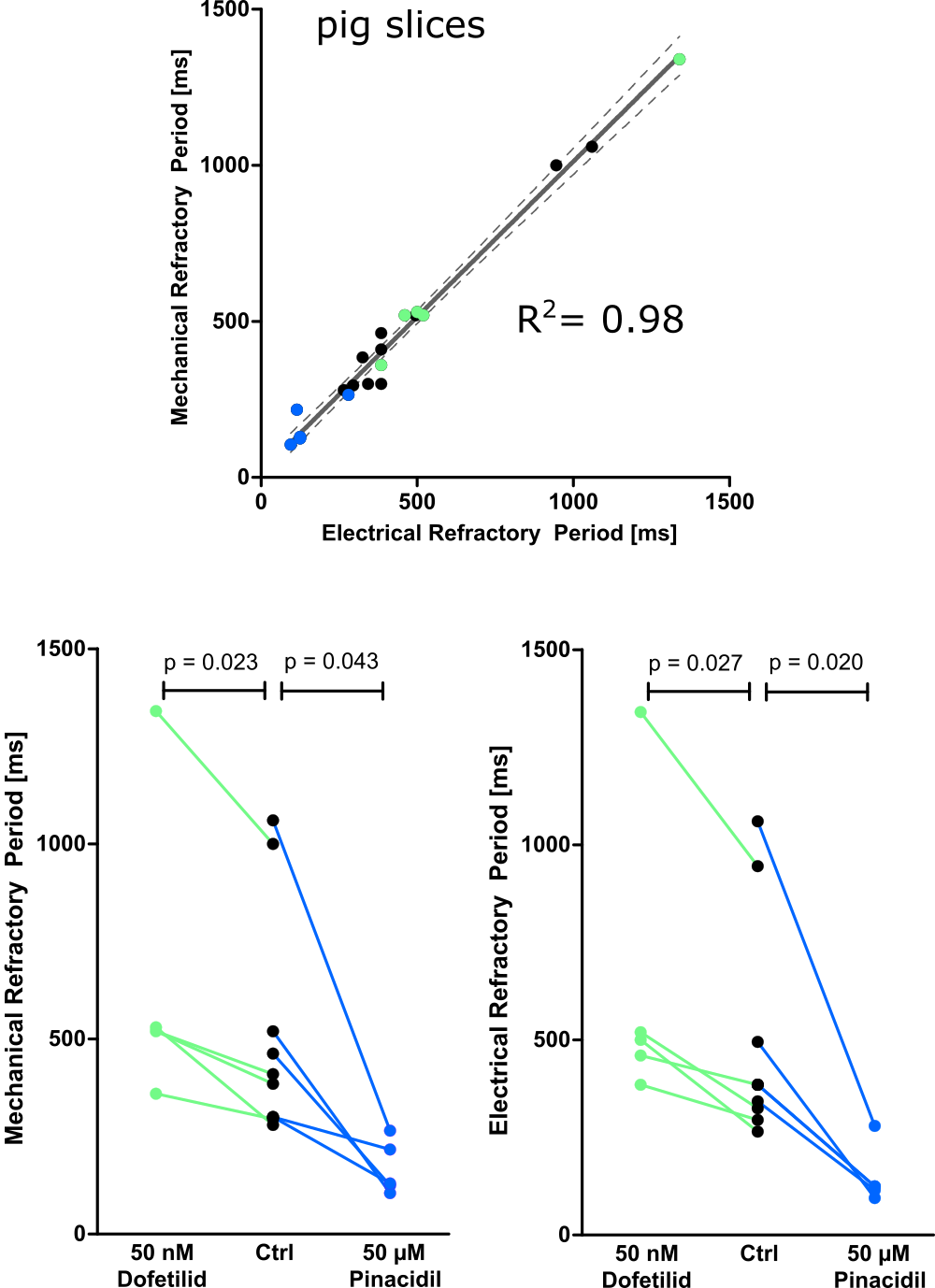
In 5 slices from 5 different animals the mean RP
AP was 533.5 ± 119.9 ms under control conditions and decreased to 148 ± 29.9 ms with 50 µM pinacidil (p<0.05, paired analysis). This was paralleled by a reduction in RP
C from of 528.5 ± 125.1 ms to 168.4 ± 27.6 ms (p<0.05, paired analysis). In 5 slices from 5 minipigs, application of 50 nM dofetilid prolonged the RP
AP from 443.0 ± 113.6 ms to 641.0 ± 157.7 ms and the RP
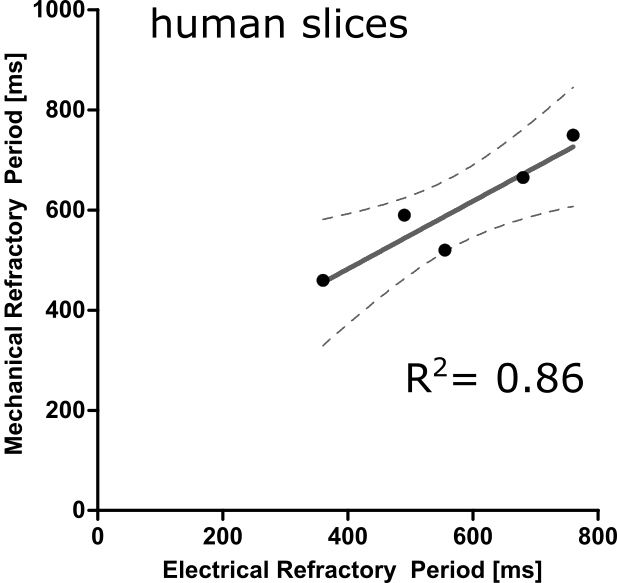
C from 474.0 ± 119.7 to 654 ± 156 ms (p<0.05 each, paired analysis). Combining all datapoints, we found a highly significant positive correlation between RP
AP and RP
C both in minipig slices (R
2 = 0.98, p < 0.0001, n = 20/5). This correlation held true in a set of human ventricular slices (R
2 = 0.86, p < 0.05, n =5/2), underscoring the translational validity of our findings.
Conclusion
Based on our findings, we suggest that changes of the action potential refractory period can be predicted by the contractile refractory period, which requires substantially less effort and allows repeated measurements over many days if used in slice culture. This could increase the throughput in drug screening, especially in human cardiac tissue.
References
1) Shi R, Reichardt M, Fiegle DJ, Kupfer LK, Czajka T, Sun Z, Salditt T, Dendorfer A, Seidel T, Bruegmann T. Contractility measurements for cardiotoxicity screening with ventricular myocardial slices of pigs. Cardiovasc Res. 2023;119:2469-2481. doi: 10.1093/cvr/cvad141



