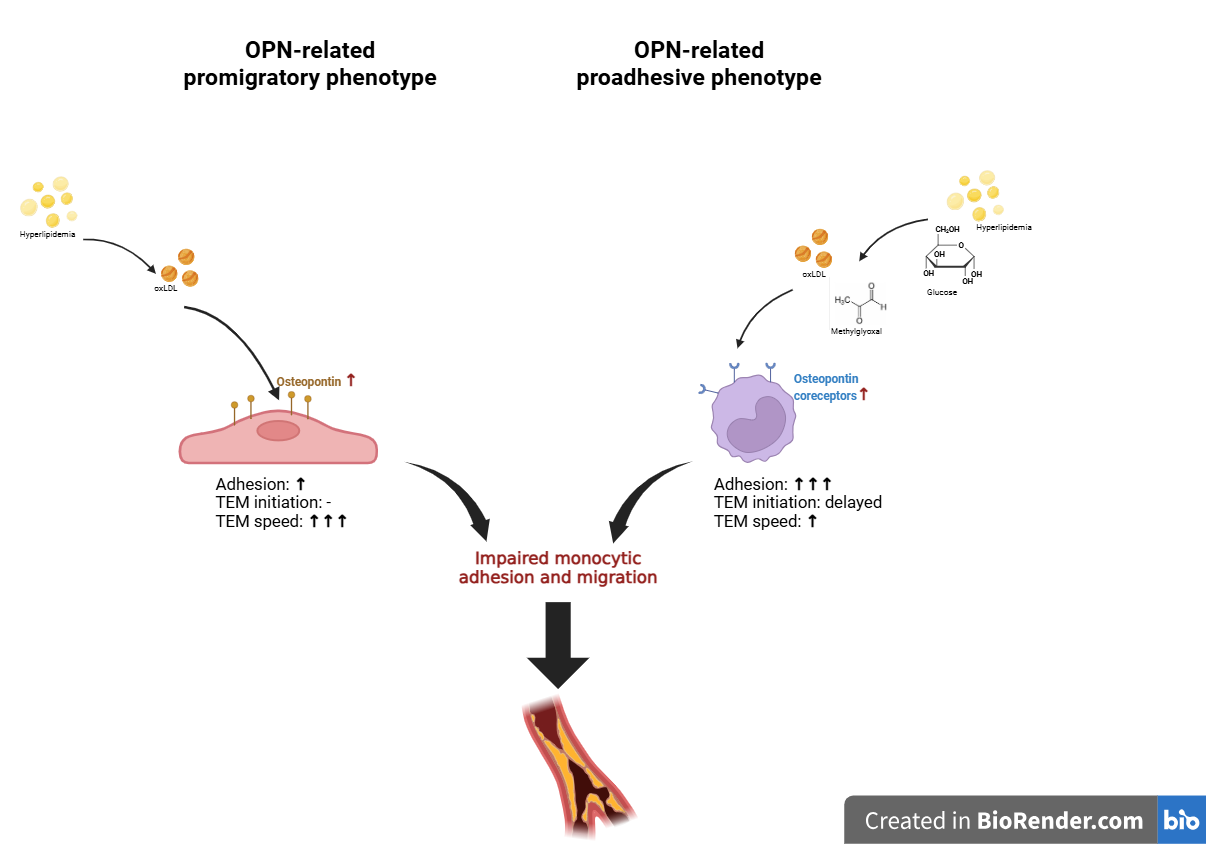
Introduction: Oxidized LDL (oxLDL) causes an inflammatory environment and is a central contributor to atherosclerosis. Atherosclerosis is driven through monocyte recruitment, sustained inflammation and endothelial dysfunction. Moreover, oxLDL is known to increase expression of osteopontin (OPN). However, the specific pathways through which the oxLDL-OPN axis regulates monocyte–endothelial interactions remain incompletely defined. Our study aimed to examine whether oxLDL directly alters monocyte diapedesis via the osteopontin (OPN)/αvβ3/CD44v6 signaling axis.
Methods: CD14+CD16- monocytes isolated from healthy individuals were pre-treated with oxLDL or recombinant human OPN (rhOPN), followed by analysis of OPN coreceptors. Endothelial cells (EC) were cultured in medium supplemented with serum from hyperlipidemic (HL) patients or oxLDL. OPN expression was quantified using flow cytometry and RT-qPCR. OPN cleavage products were determined by ELISA. Flow assays were performed to investigate the impact of oxLDL on monocytes or endothelial cells during monocytic diapedesis.
Results: OxLDL-treated monocytes showed upregulation of CD44v6 (2-fold, p = 0.042), CD51 (2.8-fold, p=0.0004) and CD61 (2-fold, p = 0.0024). Treatment with rhOPN did not further affect adhesion molecule expression. Functionally, hyperglycemic and oxLDL-conditioned (HG/oxLDL) monocytes adhered three times more strongly to endothelial monolayers; this enhancement was normalized by rhOPN pretreatment prior to the flow assay. HG/oxLDL also delayed the onset of transendothelial migration (TEM) (2.2-fold delay, p = 0.048) but accelerated the migration process once initiated (1.7-fold faster TEM, p = 0.024). The acceleration of TEM was attenuated when monocytes were pre-treated with rhOPN (1.8-fold slower TEM, p = 0.024), returning to levels similar to controls. Exposure of EC to hyperlipidemic serum significantly increased surface OPN expression (43% increase, p = 0.01), while total serum OPN levels did not differ between serum samples.. Endothelial OPN surface expression rose markedly after oxLDL treatment (1.6-fold, p = 0.009).In contrast, endothelial preconditioning with oxLDL had no significant impact on monocyte adhesion or initiation of TEM, although the duration of the TEM phase was shortened (1.5-fold faster TEM, p < 0.0001). This effect disappeared when monocytes were simultaneously exposed to oxLDL.
Conclusions: These findings demonstrate that oxLDL exerts a dual effect on monocyte trafficking by enhancing adhesion while modulating transendothelial migration through alterations in the endothelial OPN/CD44v6 pathway. This study provides novel insights into the role of dyslipidemia in vascular inflammation and identifies the OPN pathway as a potential therapeutic target in atherosclerosis. Further investigation is required to elucidate upstream signalling mechanisms linking oxLDL to OPN regulation.