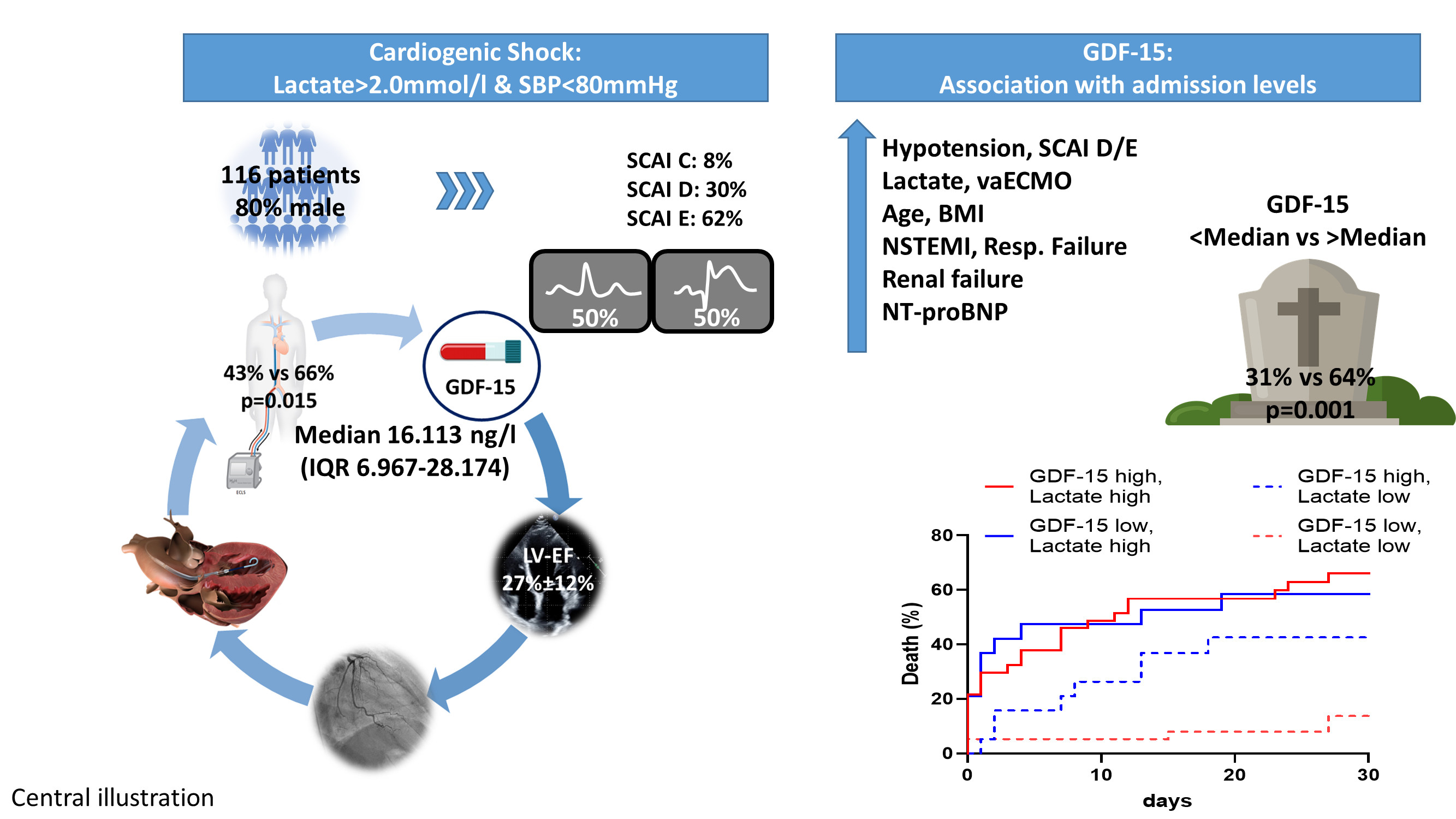
Aims: Early prediction of unfavourable outcome in patients with cardiogenic shock is important to guide resource allocation during acute and intensive care. Shock-specific biomarkers are not yet available. We evaluated whether stress-inducible growth differentiation factor 15 (GDF-15) measured immediately on admission is useful to estimate mortality in any type of cardiogenic shock patients (acute coronary syndrome as well as non-ischemic) based on its pathophysiological importance as a marker for acute stress and hypoperfusion.
Methods: GDF-15 was measured in patients receiving mechanical circulatory support with an Impella microaxial flow pump for acute cardiogenic shock enrolled in the HAnnover Cardiac Unloading REgistry (HACURE). GDF-15’s association with 30-day mortality alone and in combination with admission lactate were evaluated.
Results:A total of 116 patients were analysed. Mean age (±SD) was 58±13 years, and 80% were male. Of the whole population, 44% died within 30-days. GDF-15 concentrations were higher in deceased patients than in survivors (25,555 ± 21,851 ng/l vs. 17,364 ± 15,176 ng/l; p=0.025). In multivariate analysis, elevated GDF-15 emerged as an independent predictor for mortality (HR=4.182; 95% CI 1.316-13.289; p=0.015). Elevated GDF-15 had high prognostic performance in the subgroup with lower lactate levels (HR 4.85 (95% CI 1.45-16.20)).
Conclusions: GDF-15 measured on admission is an independent marker of mortality in patients with cardiogenic shock receiving a microaxial flow pump for mechanical circulatory support particularly in those with low lactate levels. GDF-15’s usefulness for informed management decisions in these highly vulnerable patients should be further explored.