Background Cardiac computed tomography angiography (CCTA) represents a non-invasive imaging method, which enables detailed evaluation of the cardiac anatomy and, depending on the CCTA protocol, the assessment of coronary artery disease (CAD). The improved diagnostic quality and availability have led to increased use of CCTA, while data on current use of CCTA is sparse. Therefore, we aimed to evaluate CCTA utilization and related diagnoses and procedures in all hospitalized patients in Germany in recent years.
Methods For this analysis data from the Federal Statistical Office of Germany on all in-hospital CCTA cases between 2005 and 2023 were used, classified via the Operation and Procedure Classification code 3-224. Clinical diagnoses, procedures, and in-hospital outcomes were analyzed. In subgroup analyses we evaluated the use of CCTA among all patients with the primary diagnosis of CAD using logistic regression analyses.
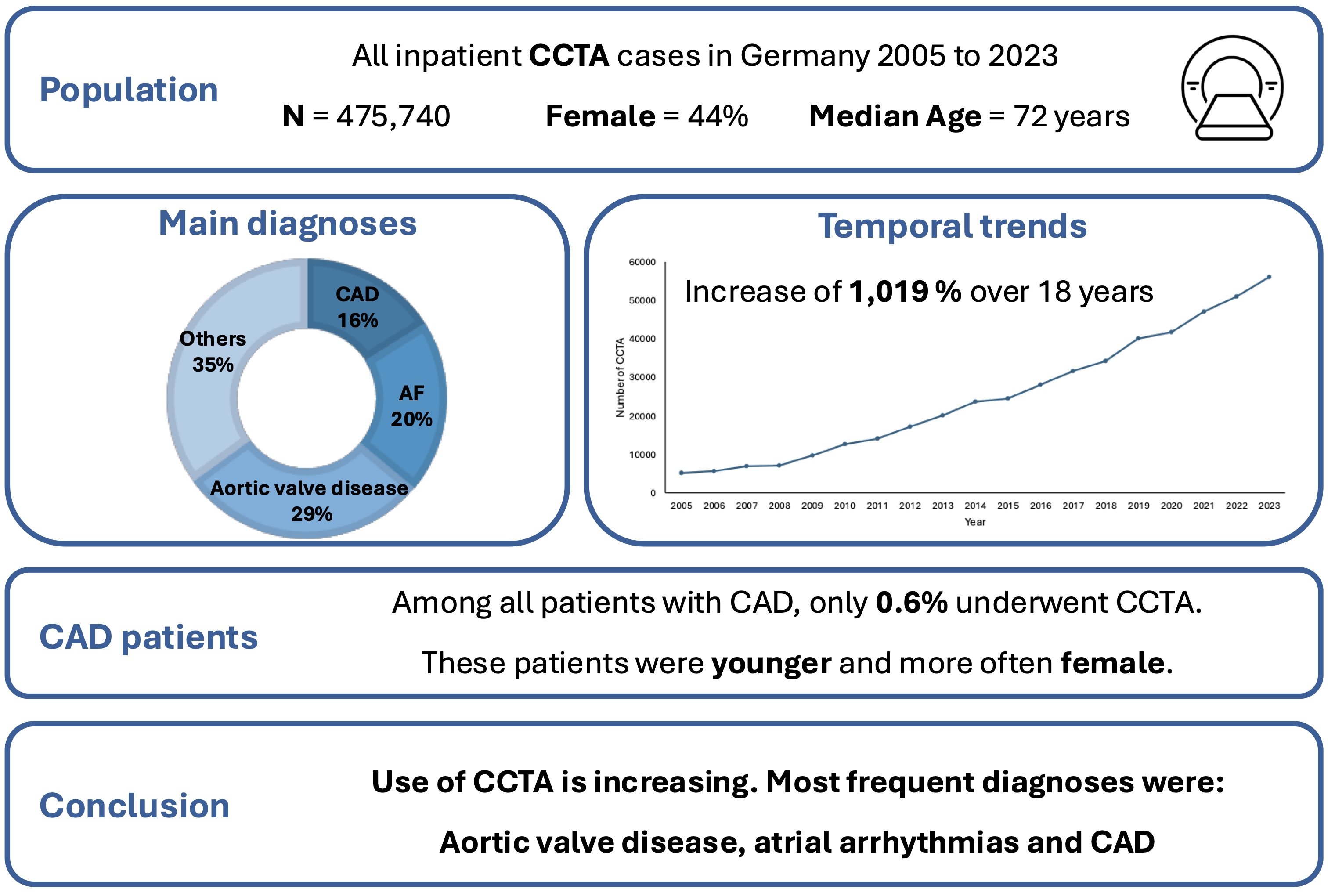
Results Between 2005 and 2023 CCTA was performed in 475,740 patients (median age 72 years; 43.8% females). In this cohort the most common primary diagnoses were aortic valve diseases (28.7%), atrial fibrillation and flutter (19.5%), and CAD (16.4%). The majority of CCTA scans was performed in hospitals in urban regions (59.3%). Over time, the number of CCTA substantially increased by a factor of 11 from 5,011 cases in 2005 to 56,063 cases in 2023. 57.0% of the patients were referred by a physician, whereas 34.7% CCTA scans were performed on emergency patients. After treatment 80.3% of the patients were discharged in a regular way, 6.9% were transferred to another hospital, and 2.3% died. In the CCTA cohort 44.6% of the patients received an electric cardioversion, ablation, or electrophysiological examination, 36.2% an invasive coronary angiography (ICA), 17.5% a coronary intervention, and 17.7% a TAVR implantation. Only 78,199 (0.6%) inpatients from 12,153,473 patients with the primary diagnosis CAD underwent CCTA scans. Among CAD patients, younger patients and more females received a CCTA scan, and in these patients less ICA and interventions such as PCI were performed (Graphical Abstract).
Conclusions CCTA is increasingly used in cardiovascular care. Patients receiving an inpatient CCTA scan were primarily diagnosed with aortic valve diseases, atrial fibrillation and flutter, and CAD. In CAD patients CCTA was performed in younger patients and more often in female patients, whereas the number of ICA and PCI was significantly lower in patients with CCTA examination. Our data underline the increasing usability of CCTA as a non-invasive imaging method for excluding CAD, but also for guiding and improvement of cardiac interventions in Germany in accordance with the current guidelines.