Background and Aim
The secreted and atrial-specific growth factor bone morphogenetic protein 10 (BMP10) is associated with incident, prevalent and recurrent atrial fibrillation (AF) and with AF-related complications. Recent clinical trials, including ARTESIA and NOAH-AFNET6, in device-detected AF and controlled trials of anticoagulation after AF ablation (ALONE-AF, OCEAN), suggest that stroke risk is modulated by AF burden. Quantifiable estimates of AF burden could therefore improve anticoagulation decisions and AF screening strategies. To investigate the association of AF burden and secreted BMP10, we evaluated BMP10 secretion in response to different burdens and its relation to atrial function in a 3D human atrial engineered heart tissue model.
Methods
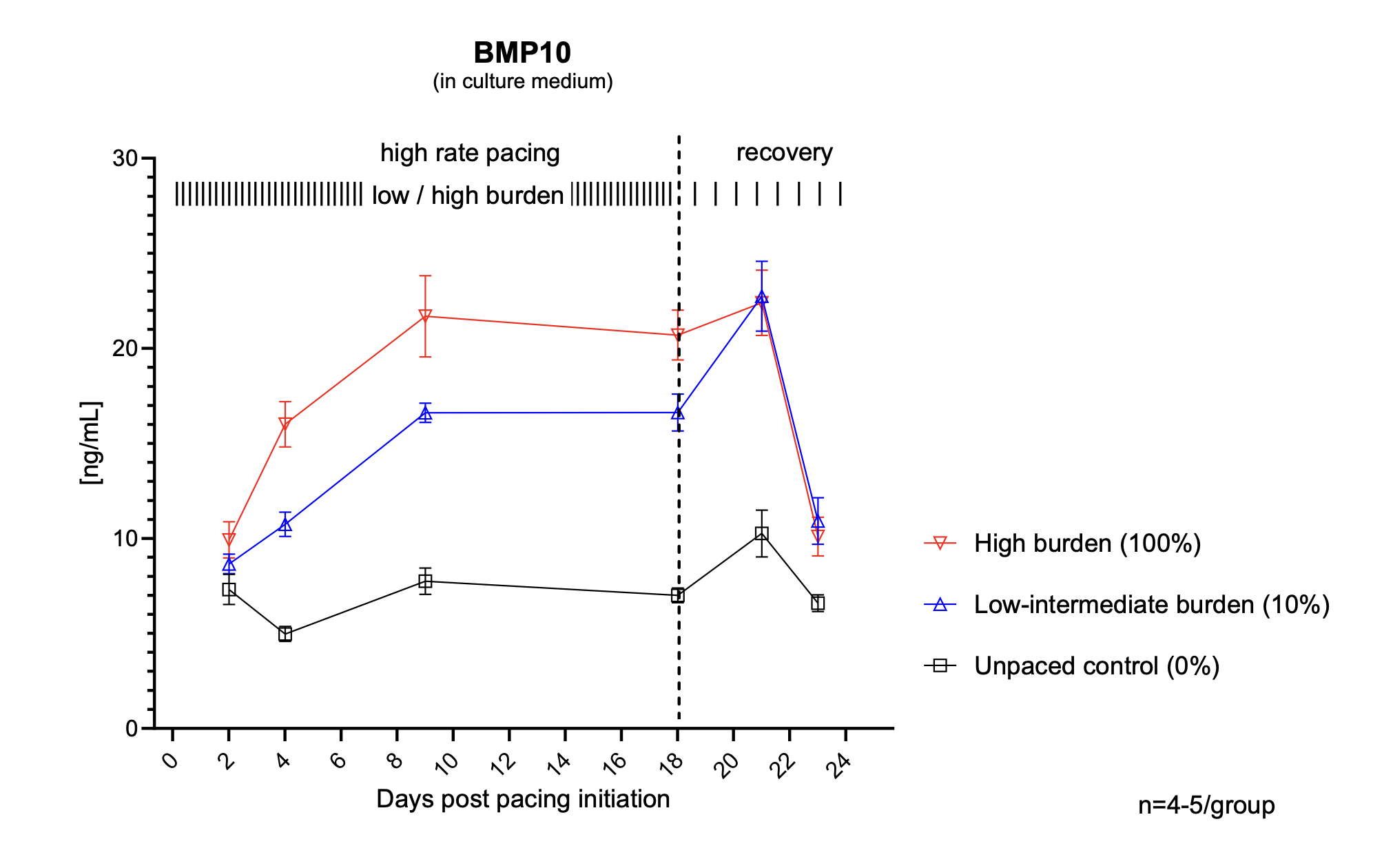
Atrial engineered heart tissue (aEHT) was generated in a 24-well format from human iPSC-derived atrial cardiomyocytes embedded in a fibrin matrix and matured for ~1 month. Mature EHTs were optogenetically paced at 4 Hz using AAV-mediated expression of the light-sensitive cation channel CheRiff2.0, at twice the intrinsic rate (~2 Hz at initiation). AEHTS were either not paced (0% burden), paced 10% of the time (low-intermediate burden), or continuously paced (100% burden) for 18 days, followed by a recovery phase without pacing (n=16-22/burden group). Every 48-72 h, contractile function was analyzed by video-based motion tracking, and conditioned media were collected for ELISA-based quantification of secreted BMP10 (n=4-5/burden group).
Results
Contractile force increased during maturation, plateauing after ~1 month in parallel with BMP10 release. Chronic pacing at 4 Hz caused a marked decline in contractile force, which partially recovered within 6 days of pacing cessation, indicating reversible functional impairment and arguing against sole cardiomyocyte death. Compared to unpaced controls, BMP10 secretion increased with low-intermediate burden (10%) and high burden (100%), reaching highest concentrations at high AF burden (~22 ng/mL versus control ~7 ng/mL) within 9 days. Elevated BMP10 concentrations persisted for 2-3 days after cessation of pacing and normalized within 4 days.
Conclusions
BMP10 secretion tracks with functional maturation of human aEHT and responds dynamically to atrial high-rate burden. Both, high-rate pacing for 10% and 100% of the time leads to a marked increase in BMP10 release.