Background: Physical activity (PA) is a key factor in cardiovascular health, and perceived mental stress is an established cardiovascular risk factor. Yet, their relationship requires further clarification.
Methods: A cross-sectional survey was conducted using a 36-item questionnaire covering lifestyle and psychosocial factors. Participants were categorized as having low physical activity (PA) (<3.5 hours/week) or high PA (≥3.5 hours/week). Correlations between PA and stress were assessed using Spearman's rank correlation. Regression modeling and matched analyses were employed to estimate independent effects and reduce confounding. Prism (version 9) and Stata (version 19) were used.
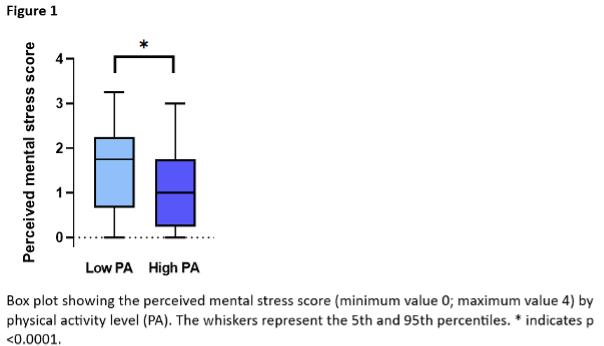
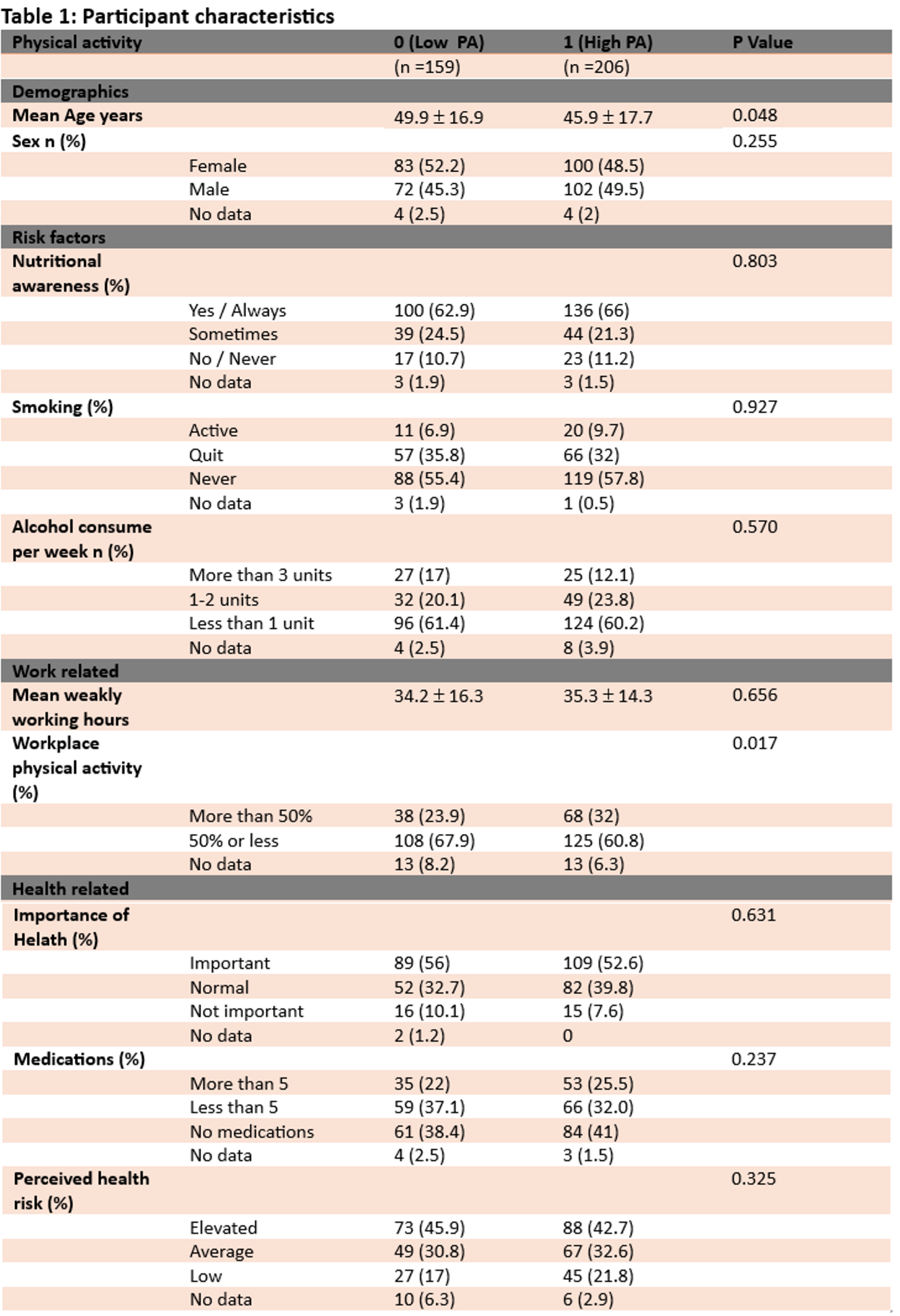
Results: A total of 365 participants (mean age 47.7 ± 17.5 years; 51.5% female) completed the questionnaire. Of these, 206 (56.4%) were classified as having high PA. The high PA group was 4 years younger and were also more active at work, see Table 1 for participant characteristics. Participants in the high PA group reported significantly lower mental stress levels than those in the low PA group (Figure 1). Further, mental stress score inversely correlated with physical activity (r = -0.226; 95% confidence interval (CI) -0.325, -0.123; p <0.001). A regression model including the parameters listed in Table 1, revealed that PA was an independent predictor of lower perceived mental stress (coefficient -0.145, 95% CI -0.516, -0.084; p = <0.007). Propensity-matched analyses confirmed the association between mental stress and PA, showing an average treatment effect of -0.45 (95% CI -0.69, -0.21; p <0.001).
Conclusion: PA activity was inversely correlated with perceived mental stress, showing that these important lifestyle factors interact closely. Therefore, promoting PA may improve well-being and reduce cardiovascular risk by influencing mental stress.