Background: Exercise is vital for the prevention and treatment of cardiovascular disease, and many individuals listen to music during workouts. However, evidence regarding its influence during maximal exertion remains limited. This study aimed to investigate the effects of music on the maximal cardiopulmonary performance and perceived exertion in healthy adults.
Methods: In a prospective randomised crossover trial at the University Hospital Leipzig, 102 healthy adults completed three maximal treadmill tests under three conditions: no music (nm), preferred music (pref), and non-preferred standardised music (120 bpm; Figure A). Tests were separated by at least 48 hours. Cardiopulmonary parameters were measured via breath-by-breath spiroergometry. The primary endpoints were maximal oxygen uptake (VO₂max) and maximal oxygen pulse; perceived exertion was a secondary outcome. Data were analysed using repeated-measures one-way ANOVA.
Results: VO₂max was comparable across conditions (nm: 42.7 ± 7.3; 120 bpm: 42.7 ± 7.4; preferred: 42.6 ± 7.7 mL·kg⁻¹·min⁻¹; Figure B). Maximal oxygen pulse also showed no significant differences (nm: 17.0 ± 3.5; 120 bpm: 17.2 ± 3.9; preferred: 17.0 ± 3.7 mL/beat). The perceived exertion scores did not differ significantly between conditions. The mean respiratory exchange ratio (1.1 ± 0.1) confirmed that participants achieved maximal exertion, with no significant differences between conditions. The heart rate recovery after one minute was also comparable (no music: 82.7 ± 5.9%; 120 bpm: 82.9 ± 4.9%; preferred music: 82.3 ± 6.3%).
Post-hoc analyses revealed total time to exhaustion was significantly longer during preferred music compared with nm (+11.8 s / +50.8 m; p < 0.05) and 120bpm (+9.7 s / +40.2 m; p < 0.05; Figure C). This effect was more pronounced among participants who regularly listened to music during exercise (vs. nm +15.2 s / +65.5 m, p < 0.01; vs. 120 bpm +11.0 s / +49.0 m, p < 0.05), those in the youngest quartile (vs. nm +27.6 s / +133.6 m, p < 0.01; vs. 120 bpm +21.6 s / +103.8 m, p < 0.01), and those selecting music with a tempo exceeding 120 bpm (vs. nm +16.4 s / +69.0 m, p < 0.01; vs. 120 bpm +11.8 s / +51.1 m, p < 0.01). Listening to 120bpm music did not differ significantly from no music.
Conclusion: Preferred music does not enhance maximal cardiopulmonary capacity or alter perceived exertion but significantly prolongs endurance at maximal effort, likely via psychological mechanisms. This effect was pronounced among younger participants, habitual exercisers who regularly trained with music, and those who selected music with higher tempos. The endurance improvement (~2%) parallels known ergogenic effects such as caffeine intake.
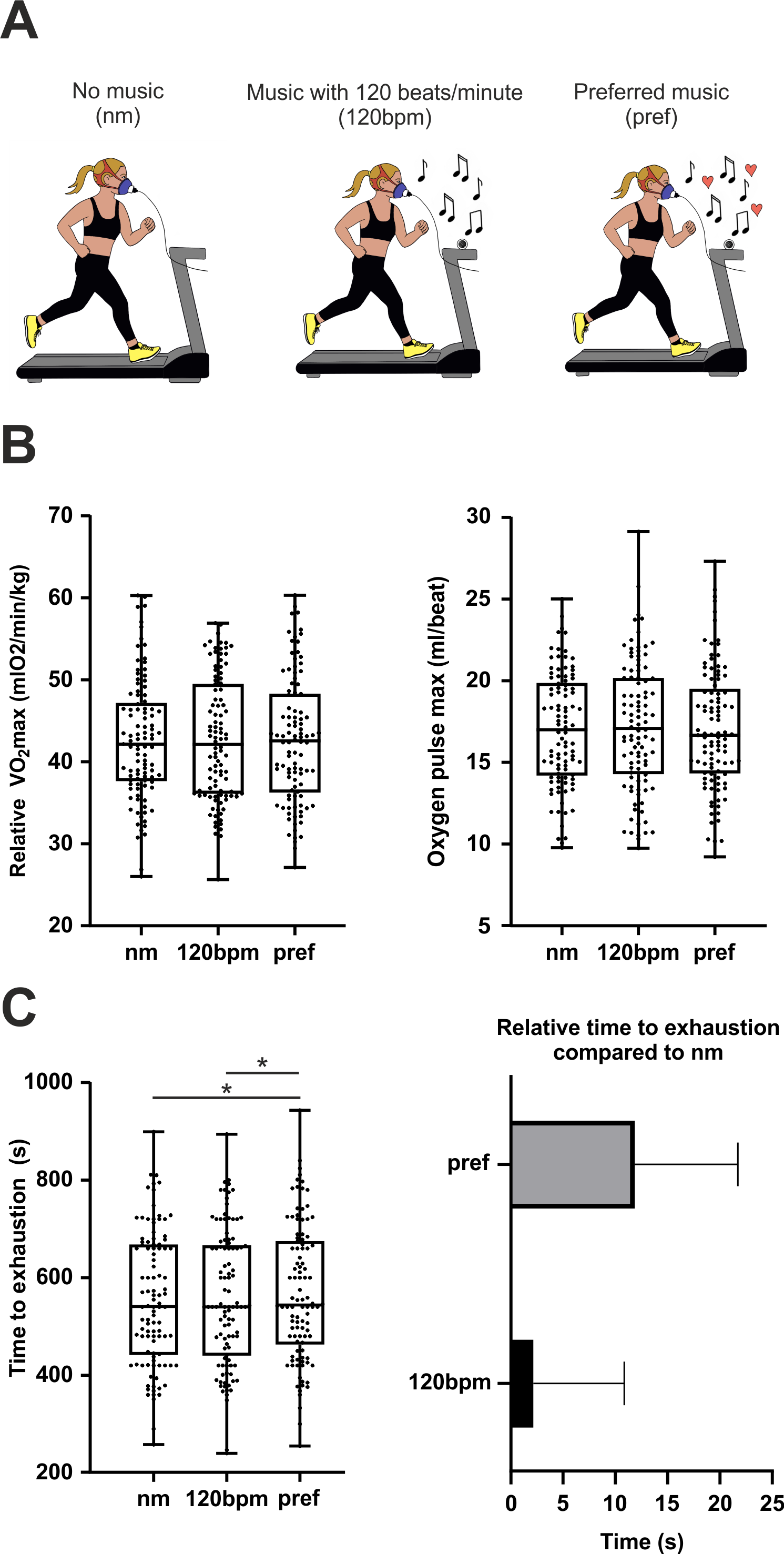
Figure:(A) Summary of the study conditions. (B) Box plots depicting the primary endpoint of maximum relative VO2 and maximum oxygen pulse max. (C) Post-hoc analysis of the time to exhaustion and differences between the conditions. * p <0.05. Groups were compared using repeated-measures one-way ANOVA and Tukey’s multiple comparison post-hoc test.



