Background: A novel cryoballoon (n-CB) with variable sizing (28–31 mm) aims to improve anatomical fit, catheter stability and procedural efficiency compared with the conventional cryoballoon (c-CB). This study compared safety, procedural characteristics and 12-month clinical outcomes of n-CB versus c-CB.
Methods and results: We analyzed 250 consecutive patients undergoing CB-based PVI (c-CB n=100; n-CB n=150). A novel cryoballoon (n-CB) with variable sizing (28–31 mm) aims to improve anatomical fit, catheter stability and procedural efficiency compared with the conventional cryoballoon (c-CB). This study compared safety, procedural characteristics and 12-month clinical outcomes of n-CB versus c-CB. Baseline and procedural parameters as well as 12-month follow-up were compared between groups.
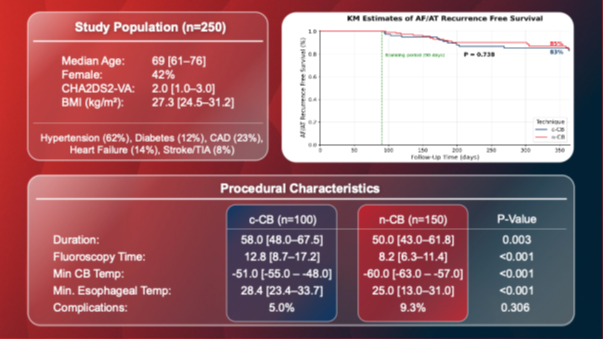
Patients treated with n-CB had more persistent AF (57.3% vs. 1%; p<0.001), and higher rates of heart failure (20% vs. 4%; p<0.001) and diabetes (16% vs. 6%; p=0.029). Acute PVI success was 100% in both groups.
The n-CB showed significantly shorter procedure times (50.0 vs. 58.0 min; p=0.003), shorter fluoroscopy times (8.2 vs. 12.8 min; p<0.001) and lower contrast use (p=0.015). Minimal CB temperatures were lower with n-CB (–60°C vs. –51°C; p<0.001), as were minimal esophageal temperatures (25.0°C vs. 28.4°C; p<0.001). Total freezing time was longer in the n-CB cohort (p<0.001).
Complication rates were comparable between groups (any complication 9.3% vs. 5.0%; p=0.306). At 12-month follow-up, arrhythmia-free survival did not differ significantly.
Conclusion:
Despite treating a more complex AF population, the n-CB achieved similar acute efficacy and comparable 12-month outcomes relative to the c-CB. The n-CB was associated with markedly shorter procedure and fluoroscopy times, reduced fluoroscopy dose and lower CB and esophageal temperatures while maintaining a comparable safety profile. The variable-size design appears technically advantageous without compromising effectiveness.
Graphical Abstract: