Importance:
Heart failure remains a major public health burden worldwide. In Germany, it is the leading cause of hospital admissions. However, long-term trends in nationwide heart failure hospitalization rates and medication treatment patterns remain unknown.
Objective:
To examine 10-year trends in the incidence of heart failure hospitalizations and heart failure pharmacotherapy from 2015 through 2024.
Design, Setting, and Participants:
This population-based cohort study used nationwide German claims from over 10 million individuals (BARMER). Adults with an incident hospitalization for heart failure between January 1, 2015, and December 31, 2024, were included. Annual age- and sex-adjusted rates were calculated per 100,000 person-years, and outpatient medication use was examined for common heart failure therapies.
Main Outcomes and Measures:
The primary outcome was the annual incidence rate of heart failure hospitalization. Secondary outcomes included outpatient medication use prior to hospitalization, including angiotensin-converting enzyme inhibitors, angiotensin receptor blockers, angiotensin receptor neprilysin inhibitors, beta-blockers, mineralocorticoid receptor antagonists, loop diuretics, sodium-glucose cotransporter 2 (SGLT2) inhibitors, and glucagon-like peptide-1 (GLP-1) receptor agonists.
Results:
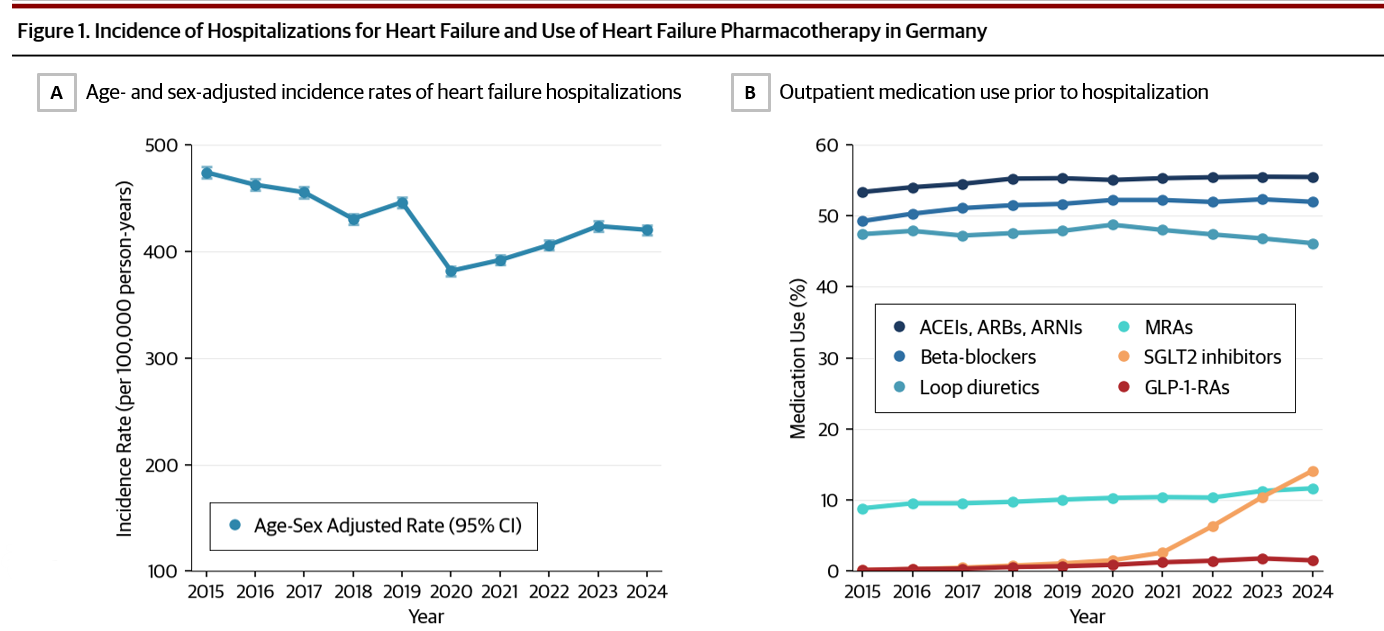
A total of 303,953 incident HF hospitalizations were identified over 78.9 million person-years. The age- and sex-adjusted incidence rate declined from 473.9 (95% CI, 468.5 to 479.4) per 100,000 person-years in 2015 to 381.6 (377.1 to 386.1) in 2020, coinciding with the onset of the COVID-19 pandemic, before rising to 420.0 (415.4 to 424.7) in 2024. Medication utilization remained stable across most drug classes, except for an increase in SGLT2 inhibitor use from 0.2% in 2015 to 14.1% in 2024 and a modest uptake of GLP-1 receptor agonists from 0.2% to 1.5%.
Conclusions and Relevance:
From 2015 to 2024, the incidence of heart failure hospitalizations in Germany declined during the COVID-19 pandemic and increased thereafter. While the use of established heart failure medications remained unchanged, the rapid adoption of SGLT2 inhibitors reflects evolving clinical practice in response to emerging evidence in heart failure management. Continued efforts are needed to ensure that advances in heart failure therapeutics translate into population-level benefits.