Background:
Although regular physical activity exerts anti-inflammatory and anti-atherogenic effects, the cellular mechanisms that mediate these benefits are not fully understood. The CCR2 receptor plays a key role in the migration of monocytes to sites of inflammation and injury, but also in the development of atherosclerotic plaques. Since monocytes are involved in inflammation and disease, inhibiting CCR2 signaling pathways in them is a potential therapeutic strategy for various diseases. In this study, we investigated the impact of voluntary exercise on atherosclerosis progression and immune modulation in a PCSK9-AAV8 mouse model.
Methods:
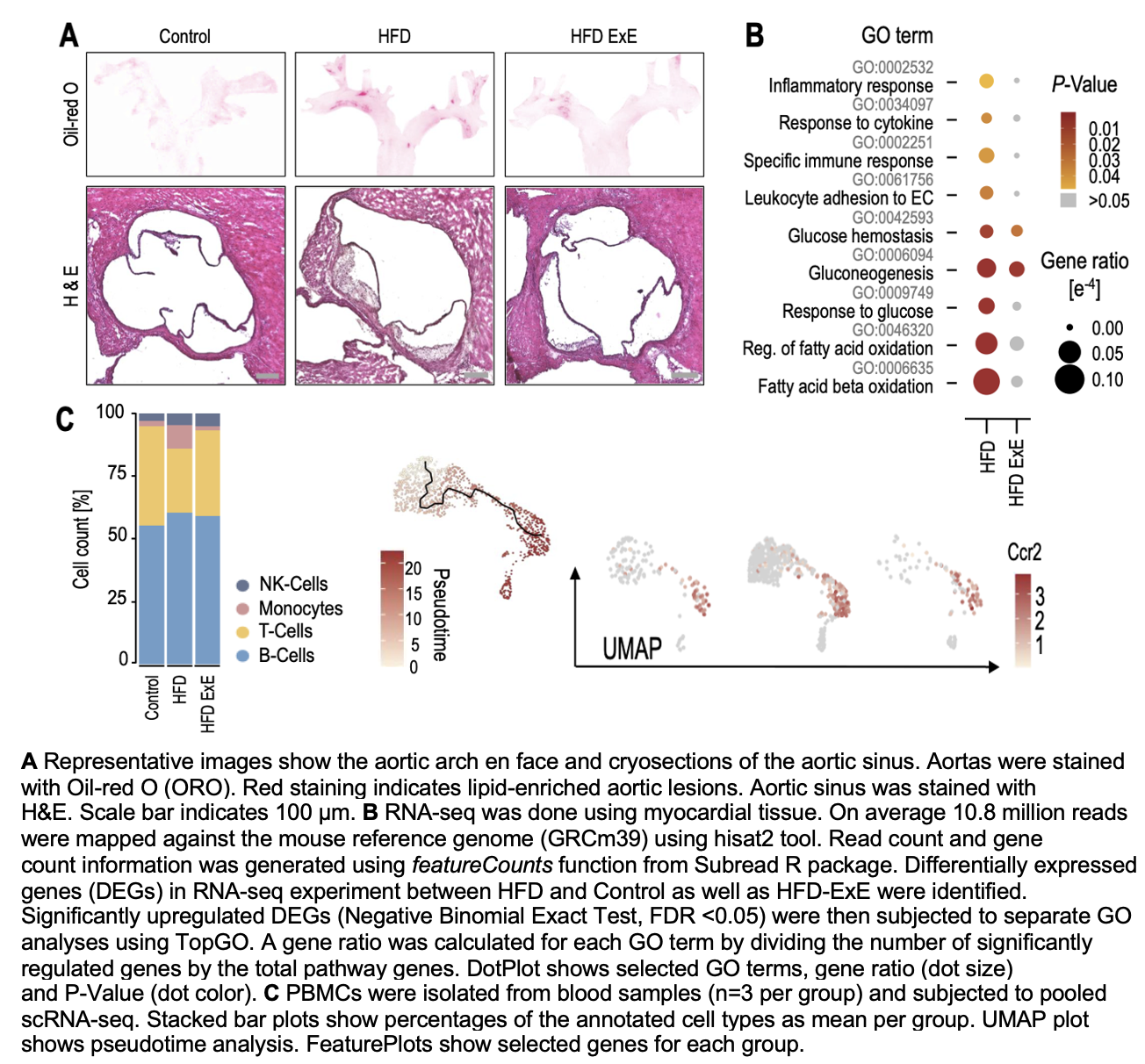
Eight-week-old male C57BL/6J mice were intravenously injected with a gain-of-function mutant rAAV8-PCSK9D377Y (PCSK9-AAV8; 1.0 ×10¹¹ viral genomes per mouse) viurs and fed a high-fat diet (HFD; 21% fat and 0.21% cholesterol) for 20 weeks (group HFD; n = 6). Saline-injected mice fed a standard diet were used as controls (group CON; n = 7). Mice in the HFD-ExE group (n = 8) were provided with a running wheel for voluntary exercise four weeks after PCSK9-AAV8 injection and the start of the HFD. Running wheel activity was continuously monitored and documented as wheel counts per 24 hours. After 20 weeks, the characteristics of atherosclerotic plaques in the aorta and aortic sinus were assessed using H&E, Oil Red O and CD68 staining. Bulk RNA sequencing (bulk RNA-seq) was performed on myocardial tissue. Peripheral blood mononuclear cells (PBMCs) were isolated from blood samples (n = 3 per group), and the immune cell profiles were characterised using pooled single-cell sequencing (scRNA-seq). Monocyte-specific pseudotime trajectory analyses were performed using Monocle3.
Results:
While total cholesterol level were not different, exercised animals displayed significantly reduced plaque burden and macrophage infiltration in the aortic sinus and aorta compared to mice on an HFD only without exercise. Bulk RNA-seq of myocardial tissue revealed normalization of lipid metabolism and dampening of broad inflammatory signaling in HFD-ExE group compared to the HFD group. Analysis of scRNA-seq data from immune cells revealed that inflammatory activation was present in monocytes, T cells and NK cells. Exercise reduced inflammation in all immune cells, with monocytes being the most responsive. This was characterised by the downregulation of inflammatory genes, including Il1b and Ccl2 (MCP-1). Exercise further decreased the proportion of CCR2⁺ inflammatory monocytes and altered their transcriptional profile towards a less inflammatory phenotype.
Conclusion:
In the early stages of atherosclerosis, even if cholesterol level are not reduced, voluntary exercise has robust atheroprotective and immunomodulatory effects in a PCSK9-AAV-induced model of the condition. Exercise reduces systemic and myocardial inflammation, restricts plaque development and encourages a less inflammatory CCR2⁺ monocyte phenotype. These findings emphasize the impact of monocyte modulation on the anti-atherogenic effects of exercise, offering insight into potential mechanisms by which physical activity contributes to cardiovascular prevention.