Background
Post-implantation syndrome (PIS) is a well-recognized clinical entity after procedures involving large tissue surfaces, such as thoracic endovascular aortic repair (TEVAR) or transcatheter aortic valve replacement (TAVR). It is characterized by fever, leukocytosis, and elevated inflammatory biomarkers in the absence of overt infection. Its occurrence following heterotopic bicaval valve implantation has not been systematically investigated. The TricValve® system comprises two self-expanding biological prostheses implanted in the superior and inferior vena cava to reduce venous backflow in patients with severe tricuspid regurgitation. We aimed to describe the incidence and inflammatory response pattern of PIS compared with systemic infection after TricValve® implantation.
Methods
We retrospectively analyzed 52 consecutive patients treated with TricValve® implantation at the West German Heart and Vascular Center. Inflammatory biomarkers including leukocyte count, C-reactive protein (CRP), procalcitonin (PCT), and interleukin-6 (IL-6) were assessed at baseline and 48 h after the procedure. Based on microbiological testing, imaging, and urine analysis, 27 patients were classified as infected and 25 as non-infected (PIS). Time-matched group means were compared using paired t-tests.
Results
The mean age was 80.5 ± 6.3 years, 50 % were male, and mean BMI was 25.4 ± 4.1 kg/m². All patients presented with massive or torrential tricuspid regurgitation. Baseline characteristics were similar between groups. Across the entire cohort, inflammatory markers increased within 48 h following implantation. When comparing infected and PIS patients, no significant differences were observed for leukocyte count (p = 0.87), CRP (p = 0.077), or IL-6 (p = 0.29). In contrast, PCT showed a statistically significant difference (p = 0.025), with a rapid decline in patients without infection, whereas persistently elevated PCT levels indicated systemic infection. These findings are illustrated in the accompanying figure, which demonstrates the temporal evolution of the four inflammatory parameters.
Conclusion
PIS occurred in all patients following heterotopic bicaval TricValve® implantation, characterized by transient, non-infectious increases in leukocytes, CRP, and IL-6. Only persistently elevated PCT levels distinguished infection from PIS. Recognizing this biomarker pattern may refine early post-implantation management and prevent unnecessary antibiotic use. Further multicenter studies are warranted to validate these findings and explore their clinical implications.
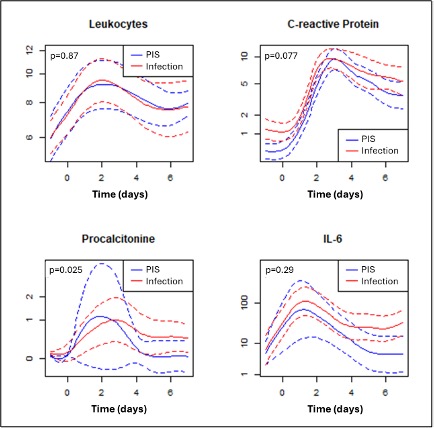
Figure.
Post-implantation syndrome (PIS) associated inflammatory response and infection after TricValve implantation. Temporal course of leukocytes, CRP, IL-6 and PCT in patients with infection (red) vs. with (blue)PIS.



