Background: Real-world data from French and US databases show a dramatic shift towards greater use of transcatheter aortic valve replacement (TAVR) for aortic valve replacement in all age groups, but particularly in younger patients. A corresponding analysis for Germany including the most recent years is missing. Particularly in the light of the recent results from the randomized, multicenter DEDICATE trial from Germany comparing SAVR and TAVR in low-risk patients and the new 2025 ESC/EACTS guidelines for the treatment of valvular heart disease.
Aims: To analyse age- and sex-specific aortic valve replacement (AVR) trends in Germany from 2011 to 2022 using nationwide hospital data.
Methods: We conducted a retrospective observational study using the nationwide database query of the DRG statistics database provided by the Research Data Center of the Federal Statistical Office (years 2011 to 2022). All in-hospital cases with an aortic valve replacement procedure from 2011 to 2022 were identified by hierarchical filtering and use of defined OPS codes.
Results: We identified a total of 446361 hospital cases undergoing AVR procedure. Cases increased from 28677 in 2011 cases to 42959 cases in 2022, driven by a rise of endovascular TAVR procedures from 4914 cases in 2011 to 27229 cases in 2022. SAVR and transapical TAVR procedures declined over the years.
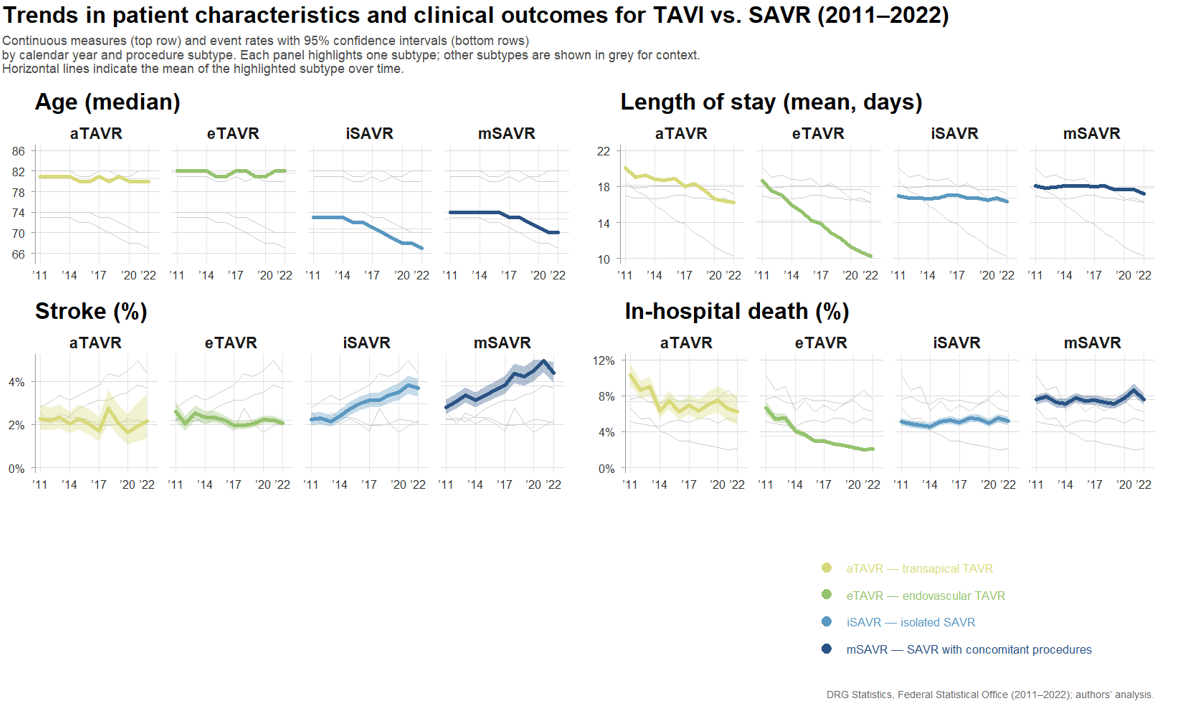
In 2022, endovascular TAVR was the most frequently used procedure in patients older than 75 years of age, notably with an expansion in even younger patients (e.g. 38% of patients aged 70-74 years and 19% of patients aged 65-69 years). The median length of hospital stay for endovascular TAVR declined from 15 to 8 days (IQR: 6-12), stroke rates related to endovascular TAVR procedure declined from 2.6% to 2.1%, in-hospital mortality related to endovascular TAVR procedure declined from 6.6% to 2.0%.
Self-expanding prostheses were more frequently used in women in all age categories. Among men, younger patients were predominantly treated with balloon expandable valves, while patients older than 80 years with self-expanding prostheses.
Conclusions: This nationwide analysis offers the most recent overview of the German AVR landscape. Total AVR procedures increased, mainly driven by TAVR procedures. In-hospital outcomes of TAVR showed favourable trends for stroke rates and in-hospital death.