Background: High-risk percutaneous coronary intervention (PCI) is increasingly performed in heart failure (HF) patients. Sensitive assessment of myocardial function is essential for evaluating outcomes. Global longitudinal strain (GLS) enables early detection of functional changes and allows differentiated follow-up after PCI. This study aimed to evaluate temporal GLS changes across HF groups undergoing high-risk PCI.
Methods: Between 2018 and 2022, 500 patients undergoing high-risk PCI were screened; 318 HF patients were included. Those with echocardiography at ≥2 time points (pre-/post-intervention or including follow-up) were analyzed. GLS was calculable in 153 patients. Three groups were defined by LVEF per ESC guidelines: HFrEF (<40%), HFmrEF (40–49%), and HFpEF (≥50%). Statistical analyses compared groups and changes over time (pre à post à follow-up).
Results: Across all patients, GLS improved from −11.9 ± 4.8 pre- to −14.7 ± 4.3 post-intervention (p = 0.093) and −14.4 ± 4.1 at follow-up (p < 0.001). In HFrEF, GLS improved from pre −6.9 ± 2.7 to post −9.4 ± 2.6 (p = 0.002) and follow-up −11.1 ± 2.1 (p < 0.001). HFmrEF improved from pre −12.7 ± 3.0 to post −15.9 ± 3.4 (p = 0.028) and at follow-up −15.8 ± 4.8 (p = 0.004). HFpEF showed only minor, non-significant change from pre, to post and at follow-up (−13.9 ± 4.6 to −16.7 ± 3.9; p = 0.949; −15.9 ± 3.7; p = 0.061). Before intervention, GLS differed among HF groups (p < 0.001). After intervention and at follow-up, differences between HFrEF and HFmrEF, and between HFrEF and HFpEF, remained significant (post: p = 0.004 and < 0.001; follow-up: p = 0.003 and < 0.001).
Conclusion: After high-risk PCI, myocardial function improves across HF groups, most prominently in HFrEF. GLS is a sensitive marker for monitoring functional recovery after PCI.
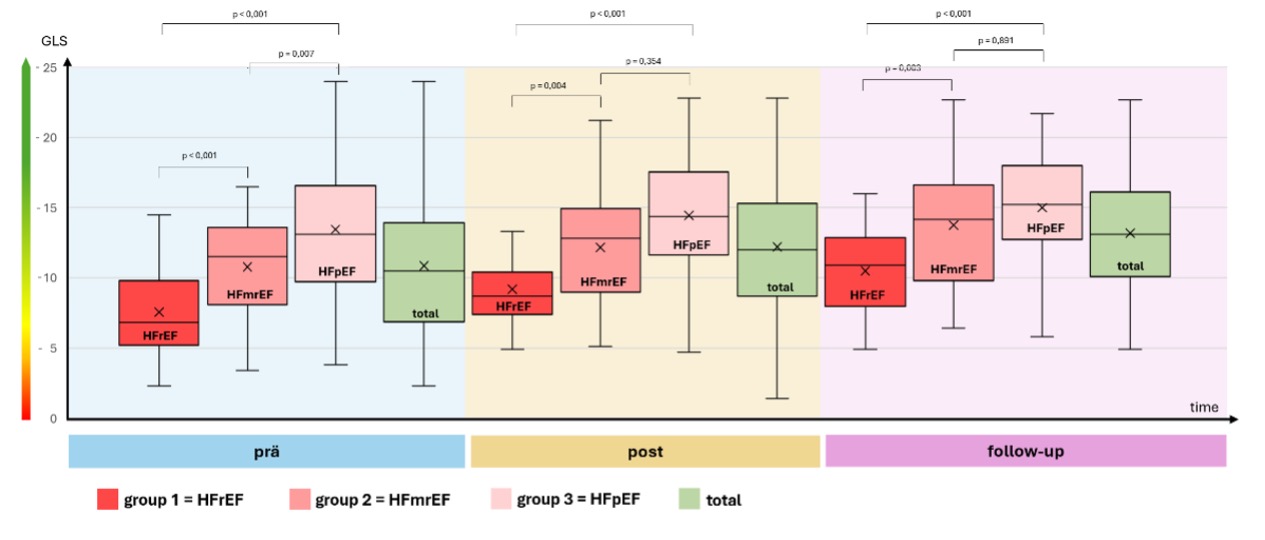
Figure 1: Change in Global Longitudinal Strain (GLS) from pre- to post to follow-up intervention in the heart faliure groups HFrEF, HFmrEF, HFpEF and overall.
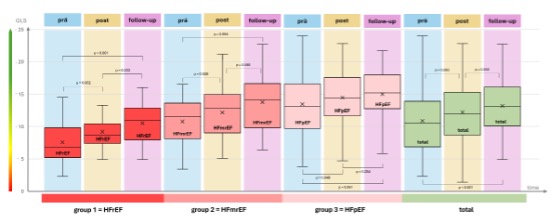
Figure 2: Change in Global Longitudinal Strain (GLS) from pre- to post to follow-up intervention in the heart faliure groups HFrEF, HFmrEF, HFpEF and overall.



