Background: Job loss is a major socioeconomic stressor with financial and psychological effects, and growing evidence suggests that unemployment has significant implications for physical health. Concerns exist regarding its potential impact on cardiovascular outcomes; however, studies are rare and based on small cohorts. This study investigated the short- and mid-term impacts of job loss on the incidence of major adverse cardiovascular events (MACE) and all-cause death in a large, unselected German cohort based on claims data.
Methods: This was a retrospective study based on the German Analysis Database for Evaluation and Health Services Research, which currently encompasses the years 2013-2023 and comprises data from approximately 4.4 million individuals. The analysed individuals were required to have one baseline year, a reporting year, and three follow-up years or death after the baseline year observable in the database. Job loss was defined as being employed throughout the baseline year and receiving welfare due to unemployment at some point in the reporting year. MACE includes acute coronary syndrome, stroke, and incident heart failure. A 1:1 exact matching for age, gender and reporting year, and propensity score matching for traditional CAD risk factors and overall morbidity (Charlson Comorbidity Index (CCI)) were used to generate a control cohort. Odds ratios (OR) were calculated using the Baptista-Pike method, and significance was tested using Fisher’s exact test.
Results: Of the 57,203 individuals with job loss, 2% could not be matched and were excluded from the analysis. Both the job loss and control cohorts had a mean age of 50 ± 11 years, and 47.2% were women. Additional baseline characteristics are shown in Table 1.
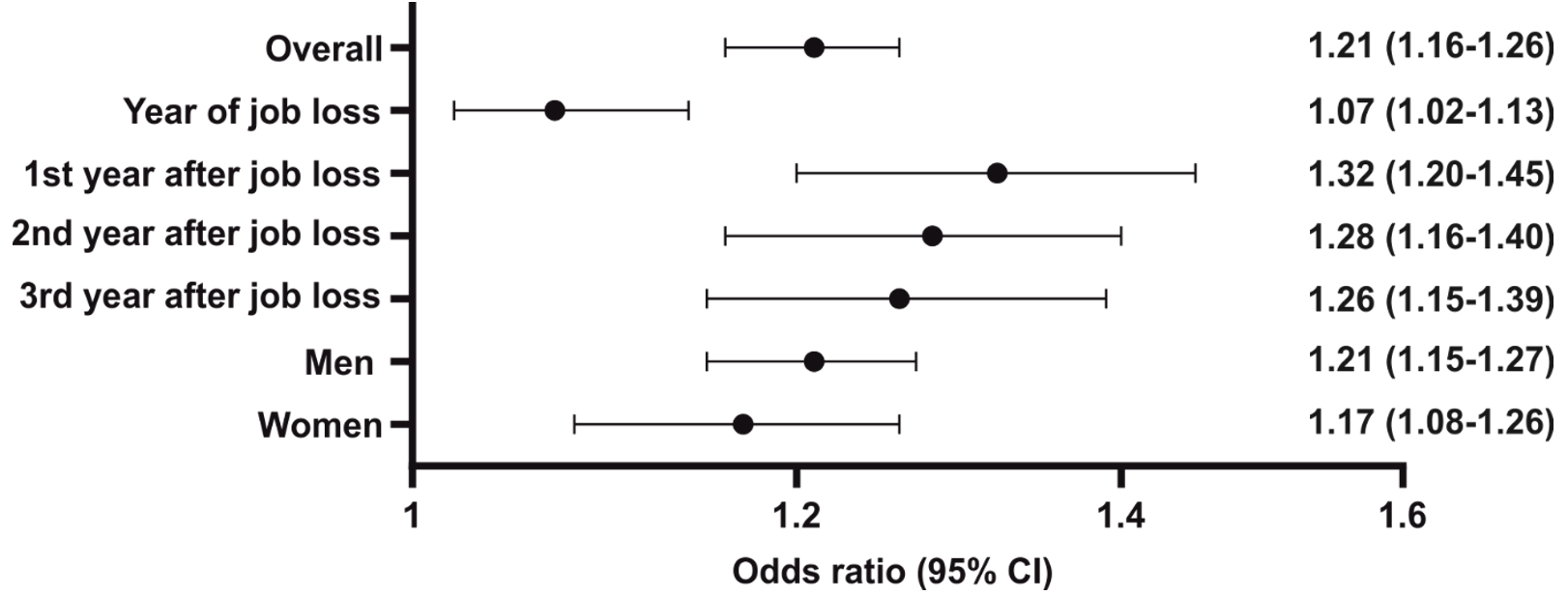
During follow-up, 3,899 MACE occurred in the job loss cohort and 3,310 in the control cohort. Individuals who lost their jobs had a 21% higher risk of MACE (OR 1.21, 95%CI 1.16-1.26, Figure 1). The risk of MACE was only slightly increased in the year of the job loss (OR 1.07, 95%CI 1.02-1.13) but peaked in the first year of follow-up (OR 1.32, 95%CI 1.20-1.45), and gradually declined thereafter (year 2: OR 1.28, 95%CI 1.16-1.40; year 3: OR 1.26, 95%CI 1.15-1.39).
Men had a slightly higher risk of MACE (OR 1.21, 95%CI 1.15-1.27) compared to women (OR 1.16, 95%CI 1.08-1.24). Notably, all-cause mortality was also higher among individuals with job loss (OR 1.17, 95%CI 1.08-1.26) during the observation period.
Conclusion:
These findings show that job loss increases the risk of MACE and all-cause mortality, particularly within the first year following unemployment. These findings highlight the need to recognize job loss as a cardiovascular risk factor and to implement preventive strategies aimed at mitigating its adverse effects on cardiovascular health.
Table 1: Baseline characteristics of the job loss and the control cohort
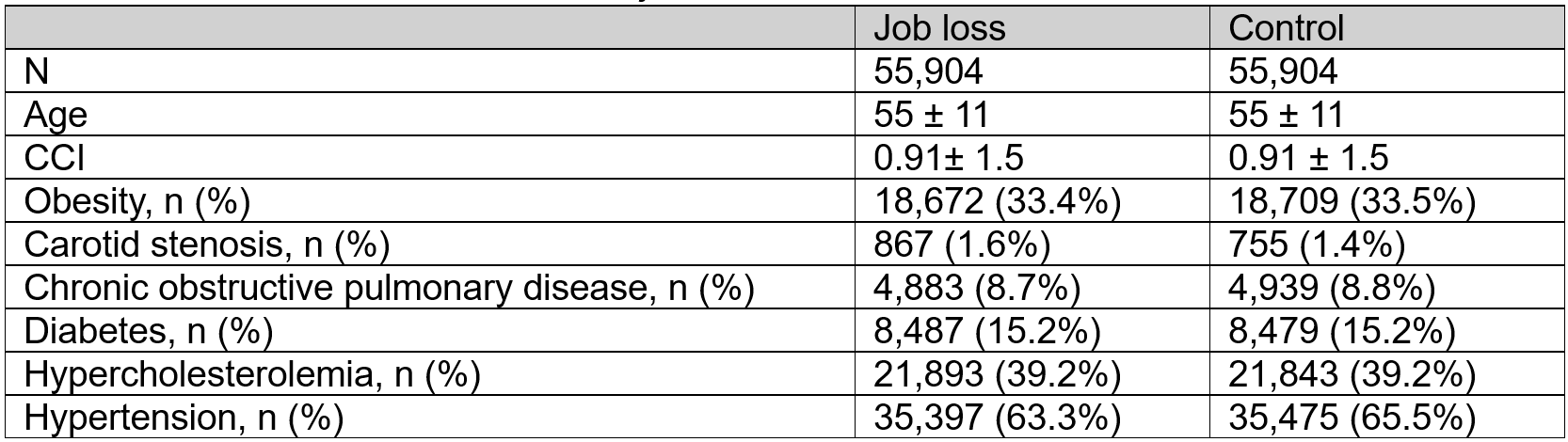
Figure 1: Odds Ratios for MACE overall for all individuals experiencing job loss as well as for each year of the study and for men and women separately