Background: Transcatheter aortic valve implantation (TAVI) emerges as an alternative to surgical aortic valve replacement for selected patients with severe aortic regurgitation (AR). Recent studies on patients undergoing TAVI for aortic valve stenosis reveal conflicting data concerning procedural complications and mortality rates in both genders. However, data on sex differences in baseline characteristics, the incidence of complications, and outcome data are scarce for patients with AR undergoing TAVI.
Methods: This retrospective observational study includes patients from three high-volume sites across Germany. Ninety-six patients with severe AR underwent transfemoral TAVI treatment using the JenaValve Trilogy System [JenaValve Technology, Irvine, CA]. Outcomes are reported according to the Valve Academic Research Consortium (VARC)-3 criteria.
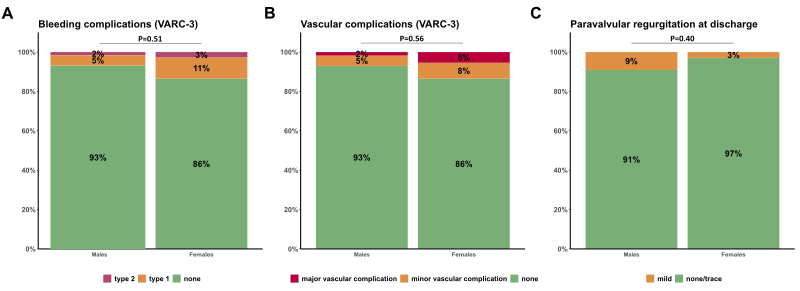
Results: Overall, the mean age was 77±3 years, with 38.5% of patients being female. Age (78.0±8.2 vs. 76.9±9.6; P=0.74), body-mass-index (25.7±5.0 vs. 26.2±4.2; P=0.24), and the need for chronic renal replacement therapy (3% vs. 5%; P=0.99) showed no significant differences between females and males. Women had a greater prevalence of impaired left ventricular ejection fraction (LVEF <50%) compared to men (68% in females vs. 37% in males, P<0.001). Additionally, women underwent TAVI with smaller valve sizes (23 mm: 24%, 25 mm: 35%, 27 mm: 41%) in contrast to men (23 mm: 3%, 25 mm: 15%, 27 mm: 81%; P<0.001). Outcomes did not differ in terms of vascular complications (Figure 1A), bleeding complications (Figure 1B), and need for permanent pacemaker implantations (females: 19% vs. males: 20%; P=0.87). The overall mean transvalvular aortic pressure gradient at discharge was 4.5 ± 1.9 mmHg, showing no significant difference between females (4.2 ± 1.8 mmHg) and males (4.7 ± 1.9 mmHg; P=0.37). Paravalvular regurgitation was classified as mild in 7% of patients, while the other patients showing none or trace, with no significant differences between both groups (Figure 1C). Notably, one woman experienced a stroke (3%), while no man had a stroke. Additionally, two male patients died during the hospital stay.
Conclusion: In this multicenter study, women had a higher prevalence of impaired LVEF at the time of TAVI treatment. Both genders exhibited similar rates of in-hospital outcomes at discharge.
Figure 1. Outcomes in males vs females according to Valve Academic Research Consortium-3 criteria.