Associations of age and sex with CMR-based measurements of aortic stiffness in the Hamburg City Health Study population

K. A. Riedl (Hamburg)1, E. Di Carluccio (Davos)2, M. Hüllebrand (Berlin)3, A. Hennemuth (Berlin)4, M. Frye (Hamburg)5, P. Kaufmann (Hamburg)1, M. Hazizi (Hamburg)1, E. Cavus (Hamburg)6, J. N. Albrecht (Hamburg)1, E. Tahir (Hamburg)7, J. Erley (Hamburg)7, M. Sinn (Hamburg)8, B. P. Schönnagel (Hamburg)8, G. Adam (Hamburg)8, P. Kirchhof (Hamburg)9, S. Blankenberg (Hamburg)1, G. K. Lund (Hamburg)10, A. Ziegler (Davos)2, K. Müllerleile (Hamburg)11
1Universitäres Herz- und Gefäßzentrum Hamburg Klinik für Kardiologie Hamburg, Deutschland; 2Cardio-CARE Davos, Schweiz; 3Deutsches Herzzentrum der Charité (DHZC) Institut für kardiovaskuläre Computer-assistierte Medizin Berlin, Deutschland; 4Charité - Universitätsmedizin Berlin Institut für kardiovaskuläre Computer-Assistierte Medizin Berlin, Deutschland; 5Universitätsklinikum Hamburg-Eppendorf Institut für Klinische Chemie und Laboratoriumsmedizin Hamburg, Deutschland; 6Universitäres Herz- und Gefäßzentrum Hamburg, Universitätsklinikum Hamburg-Eppendorf Klinik für Kardiologie Hamburg, Deutschland; 7Universitätsklinikum Hamburg-Eppendorf Klinik für Radiologie Hamburg, Deutschland; 8Universitätsklinikum Hamburg-Eppendorf Diagnostische und Interventionelle Radiologie und Nuklearmedizin Hamburg, Deutschland; 9Universitäres Herz- und Gefäßzentrum Hamburg Klinik für Kardiologie Lübeck, Deutschland; 10Universitätsklinikum Hamburg Eppendorf Klinik und Poliklinik für Diagnostische und Interventionelle Radiologie und Nuklearmedizin Hamburg, Deutschland; 11Kardiologische Praxis Orchideenstieg Hamburg, Deutschland

Background

Aortic stiffness (AS) can be quantified non-invasively CMR-based by aortic pulse wave velocity (PWV) and aortic distensibility (AD). This study evaluated associations of PWV and AD with age and sex in a large, population-based sample.


Methods

2D-phase-contrast-flow-measurements were performed at 3T CMR in the ascending and descending aorta in the Hamburg City Health Study (HCHS). PWV was quantified by the time-to-peak (PWV TTP), time-to-foot (PWV TTF), 50% (PWV 50%) and cross correlation (PWV XCorr) method, whereas AD was calculated by three different, recently proposed methods in the ascending (AD AoAsc) and descending aorta (AD AoDesc), analyzed by two blinded observers. 


Results and Perspectives

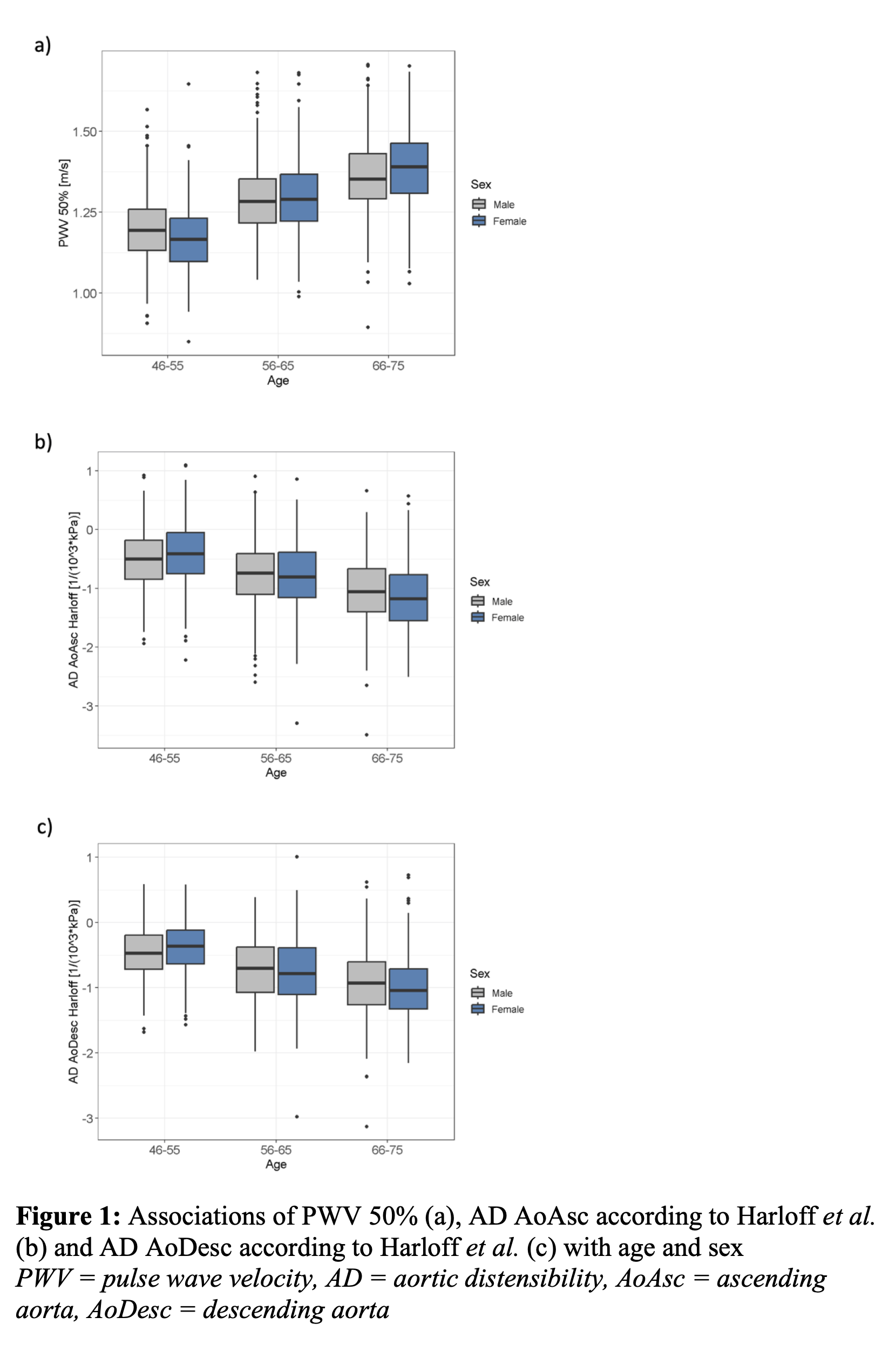
The study population consisted of 2,270 participants (41.5% females, median age 66.5 [59.0, 72.0] years). PWV 50%, AD AoAsc and AD AoDesc according to Harloff et al. correlated significantly with age (r=0.564, p<0.001; r=-0.435, p<0.001; r=-0.404, p<0.001), but there were no significant associations with sex (p=0.978; p=0.247; p=0.216) (Figure 1).


Conclusion

Aortic stiffness measurements by CMR increased with age, but not with sex. Age needs to be considered as the major influencing factor for clinical interpretation of AS values.