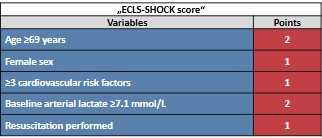
Background: Prognosis for patients experiencing acute myocardial infarction complicated by cardiogenic shock (AMI-CS) remains poor. Prompt and accurate risk stratification is essential for guiding appropriate treatment interventions. However, existing cardiogenic shock scoring systems are often based on registry data, involve parameters that are not easily accessible or lack specificity for AMI-CS patient populations.
Purpose: This study aimed to develop a simple, accessible risk prediction model for estimating 30-day mortality in severe AMI-CS patients, based on data from the ECLS-SHOCK (Extracorporeal Life Support in Infarct-Related Cardiogenic Shock) trial.
Methods: A backward stepwise regression analysis was conducted across 43 centres in two countries to create the risk score.
Results: Five variables were identified as independent predictors of 30-day mortality and integrated into the scoring tool: age ≥69 years, female sex, three or more cardiovascular risk factors (such as hypertension, dyslipidaemia, diabetes, smoking, or known vascular disease), baseline arterial lactate ≥7.1 mmol/L, and prior resuscitation. Each variable contributed 1 to 2 points to the score, categorising patients into three risk groups: low (0-1 points), intermediate (2-3 points), and high (4-7 points). Mortality rates at 30 days were observed at 23%, 50%, and 80% for the respective risk categories (p<0.001), with an area under the curve (AUC) of 0.75, indicating good discriminatory ability. Kaplan-Meier analysis demonstrated a significant stepwise increase in mortality across the categories (p<0.001 for all pairwise comparisons).
Conclusion: The ECLS-SHOCK risk score is straightforward to use in clinical settings, correlates well with 30-day mortality in severe AMI-CS patients, and may support timely risk stratification and clinical decision-making.