Background:
Takotsubo syndrome (TTS) occurs predominantly in postmenopausal women, suggesting that loss of estrogenic signaling may increase disease susceptibility; however, direct clinical evidence remains limited. We therefore compared hormone replacement therapy by oral systemic estrogen treatment with vaginal estrogen therapy. Using vaginal estrogen as an active comparator mitigates confounding related to healthcare-seeking behavior, treatment indication, and the general propensity to receive menopausal hormone therapy, while isolating differences in systemic estrogen exposure.
Methods:
Using electronic health records within the TriNetX Global Collaborative Network, we identified women aged ≥50 years receiving oral systemic estrogen or vaginal estrogen and performed 1:1 propensity-score matching for demographics, cardiovascular and metabolic risk factors, cardiovascular disease, psychiatric and stress-related comorbidity, renal function, baseline medication use, and prior healthcare utilization. The primary endpoint was incident TTS within 3 years. Prespecified contextual secondary endpoints were acute myocardial infarction (AMI), stroke, and osteoporosis.
Results:
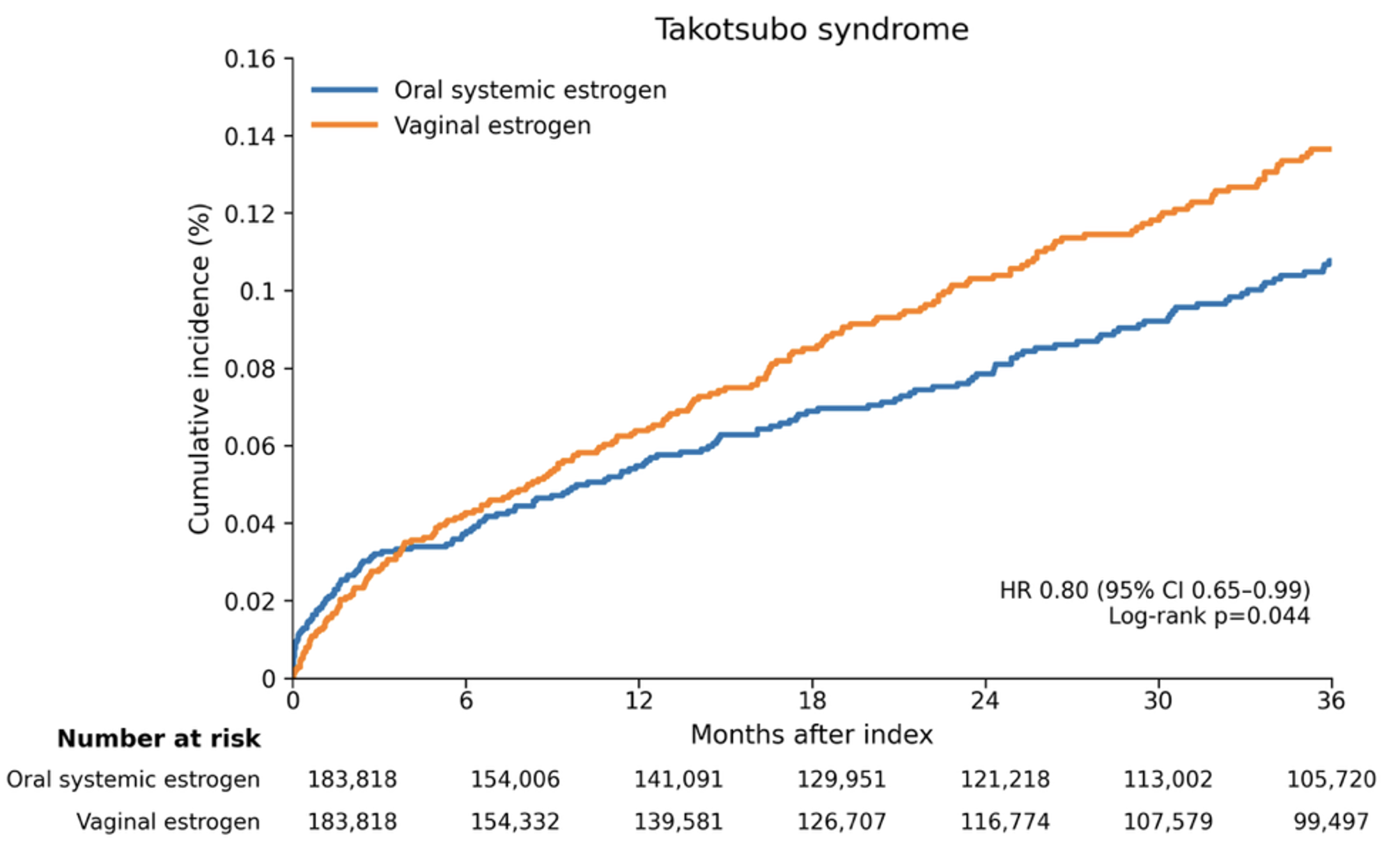
After matching, 183,818 women were included in each cohort (mean age 59.4 years), with excellent balance across baseline variables. Oral systemic estrogen was associated with a lower 3-year cumulative incidence of TTS than vaginal estrogen (153 (0.108%) vs 188 events (0.136%); HR 0.80, 95% CI 0.65–0.99; log-rank p=0.044). In a prespecified sensitivity analysis comparing oral systemic estrogen users with propensity-matched women not receiving any hormone replacement therapy, oral systemic estrogen remained associated with a lower incidence of TTS (HR 0.81, 95% CI 0.66–0.98; p=0.032). AMI risk was similar between groups (1.14% vs 1.20%; HR 0.97, 95% CI 0.90–1.04; p=0.338). In contrast, stroke was modestly more frequent with oral systemic estrogen (1.81% vs 1.64%; HR 1.12, 95% CI 1.06–1.19; p<0.001), whereas osteoporosis was less frequent (4.36% vs 5.75%; HR 0.76, 95% CI 0.74–0.79; p<0.001).
Conclusions:
In this large propensity-matched analysis, oral systemic estrogen therapy was associated with a significantly lower incidence of TTS. This association was observed both in the primary active-comparator analysis against vaginal estrogen therapy and in a sensitivity analysis using propensity-matched women without hormone replacement therapy as the comparator. To our knowledge, this is the first large-scale comparative analysis to evaluate systemic estrogen exposure in relation to subsequent TTS risk. The increased stroke and reduced osteoporosis risk were directionally concordant with established systemic estrogen effects, supporting the biological plausibility and internal coherence of the findings. These data strengthen the hypothesis that systemic estrogenic milieu modulates susceptibility to TTS and warrant mechanistic studies and external validation in independent cohorts.