Background:
GLP-1–based therapies improve symptoms for overweight patients with heart failure (HF) and preserved left ventricular ejection fraction (LVEF), but their impact on clinical events across the LVEF spectrum remains uncertain.
Purpose:
To evaluate the effectiveness and safety of semaglutide and tirzepatide versus DPP-4 inhibitors (proxy placebo) in patients with HF and type 2 diabetes (T2D), overall and stratified by LVEF.
Methods:
We conducted new-user, active-comparator target trial emulations within an international, federated, electronic health record network. Adults with HF, T2D and documented LVEF were included. Those initiated on semaglutide (from January 2020) or tirzepatide (from May 2022) were 1:1 propensity-score matched to those contemporaneously initiated on DPP-4 inhibitors (sitagliptin/linagliptin). A head-to-head emulation compared tirzepatide versus semaglutide (from May 2022). The primary endpoint was 12-month time-to-first acute HF event or all-cause mortality. Prespecified LVEF strata included HFrEF (≤40%), HFmrEF (41–49%), and HFpEF (≥50%).
Results:
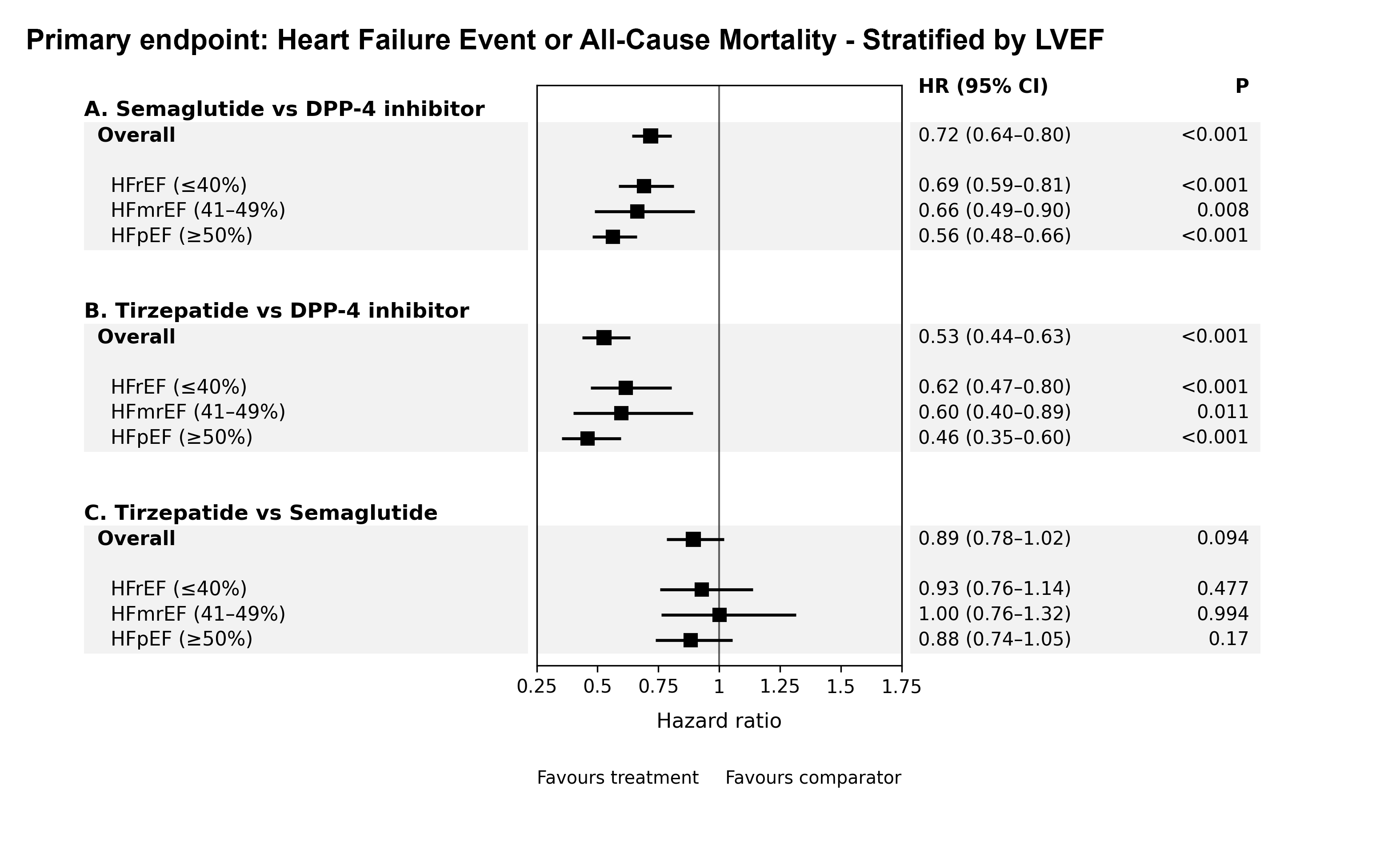
For LVEF matched cohorts, semaglutide (n=3.135 per group) was associated with a lower risk of the primary endpoint compared to DPP-4 inhibitors (19.3% vs 25.0%; HR 0.72, 95% CI 0.64–0.80; p<0.001) as was tirzepatide (n=1.523 per group; 14.7% vs 25.3%; HR 0.53, 0.44–0.63; p<0.001). Associations were consistent across LVEF strata. Both semaglutide and tirzepatide were associated with lower risks of broader MACE composites and progression to end-stage kidney disease. Rates of severe ventricular arrhythmias did not differ. In head-to-head comparison (n=4.394 per group), event rates for tirzepatide did not differ significantly from semaglutide (HR 0.89, 0.78–1.02; p=0.094).
Conclusions:
In patients with HF and T2D, initiation of semaglutide and tirzepatide was associated with a substantially lower risk of acute HF events or death. These findings were consistent across HFrEF, HFmrEF, and HFpEF, supporting the need for randomised trials for patients with HF regardless of LV phenotype, comparing various GLP-1-based interventions to placebo and within this class.