Background
Although pulsed field ablation (PFA) has emerged as an alternative energy modality for pulmonary vein isolation (PVI) in patients with atrial fibrillation (AF), comparative data on its safety and efficacy remain limited. This study compared real-world outcomes between a circular multielectrode array catheter (CMAC) system and conventional radiofrequency (RF) ablation.
Methods
Consecutive patients undergoing initial PVI using the CMAC were prospectively enrolled, while patients undergoing first-time RF ablation were retrospectively identified. Atrial arrhythmia (AA) recurrence was defined as any documented episode of any atrial tachyarrhythmia lasting ≥30 seconds. Freedom from AA recurrence was evaluated by electrocardiography or Holter monitoring at 3, 6, and 12 months; thereafter, follow-up was continued according to routine clinical practice.
Results
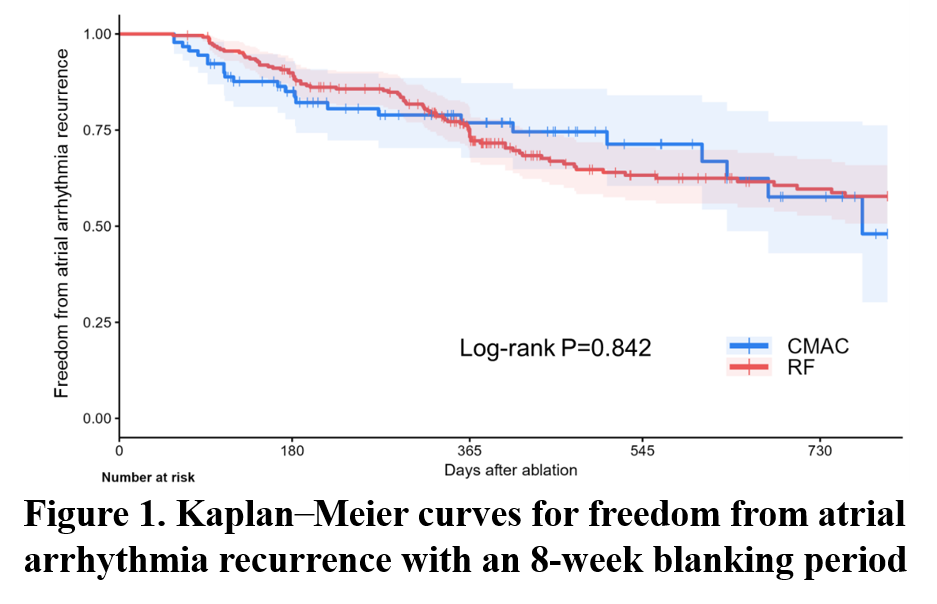
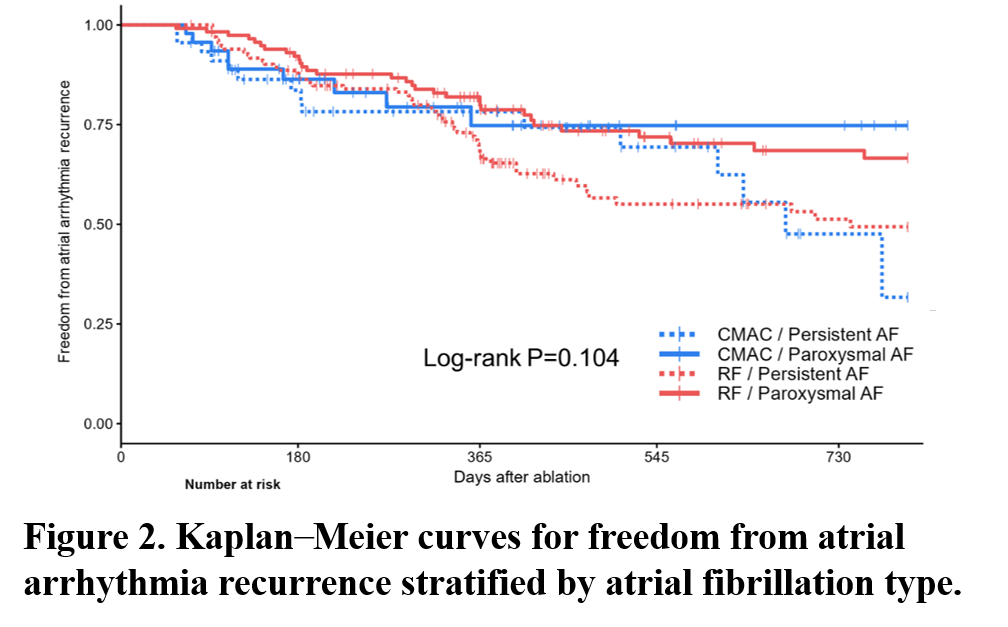
Of 340 included patients (91 CMAC, 249 RF), all achieved acute PVI. The median age was 69 years, 61.8% were male, and 47.6% had paroxysmal AF. Post-ablation 3D electroanatomical mapping was performed in 50 patients (54.9%) in the CMAC group. Procedure time was longer with RF ablation than with CMAC-guided PFA (76.0 vs 67.0 minutes; p < 0.01), as was left atrial dwell time (60.0 vs 51.0 minutes; p < 0.01). In contrast, fluoroscopy time and dose area product were higher in the CMAC group (17.7 vs 6.0 minutes; p < 0.01, 196 vs 60.5 µGy·m²; p<0.01). During a mean follow-up of 542.6±478.3 days, 12-month freedom from AA recurrence was comparable between groups (CMAC:76.9% vs RF:73.2%; p=0.84). In adjusted multivariable Cox regression, ablation modality was not associated with AA recurrence (HR 1.07; 95% CI 0.66–1.75; p = 0.781). Major complications were infrequent and comparable between groups (CMAC:1.1% vs RF:1.2%; p = 1.00).
Conclusion
In this real-world study, CMAC-guided PFA and RF ablation demonstrated comparable efficacy and safety for PVI, although their procedural profiles and workflow characteristics differed substantially.