Background:
Contemporary risk assessment before transcatheter aortic valve implantation (TAVI) increasingly recognizes the limitations of traditional surgical risk scores. While the Society of Thoracic Surgeons (STS) score remains an established tool for peri-procedural risk estimation, it does not incorporate objective measures of frailty, such as sarcopenia or skeletal muscle quality, which are important determinants of outcome in TAVI populations.
Purpose:
This study aimed to evaluate whether automated artificial-intelligence (AI)-derived body composition (BC) parameters obtained from routine pre-procedural computed tomography (CT) provide incremental prognostic value beyond the STS score in TAVI patients.
Methods:
Consecutive TAVI patients at a German tertiary center (between 2019-2023) with available pre-procedural CT imaging were included. Automated three-dimensional (3D) body and organ analysis (BOA) software quantified skeletal muscle and adipose tissue compartments. Incremental prognostic value of BC parameters beyond STS score for 30-day and 3-year mortality was assessed using Cox regression and likelihood ratio tests (LRT). Predicted survival across BC deciles within STS risk strata was estimated using multivariable regression.
Results:
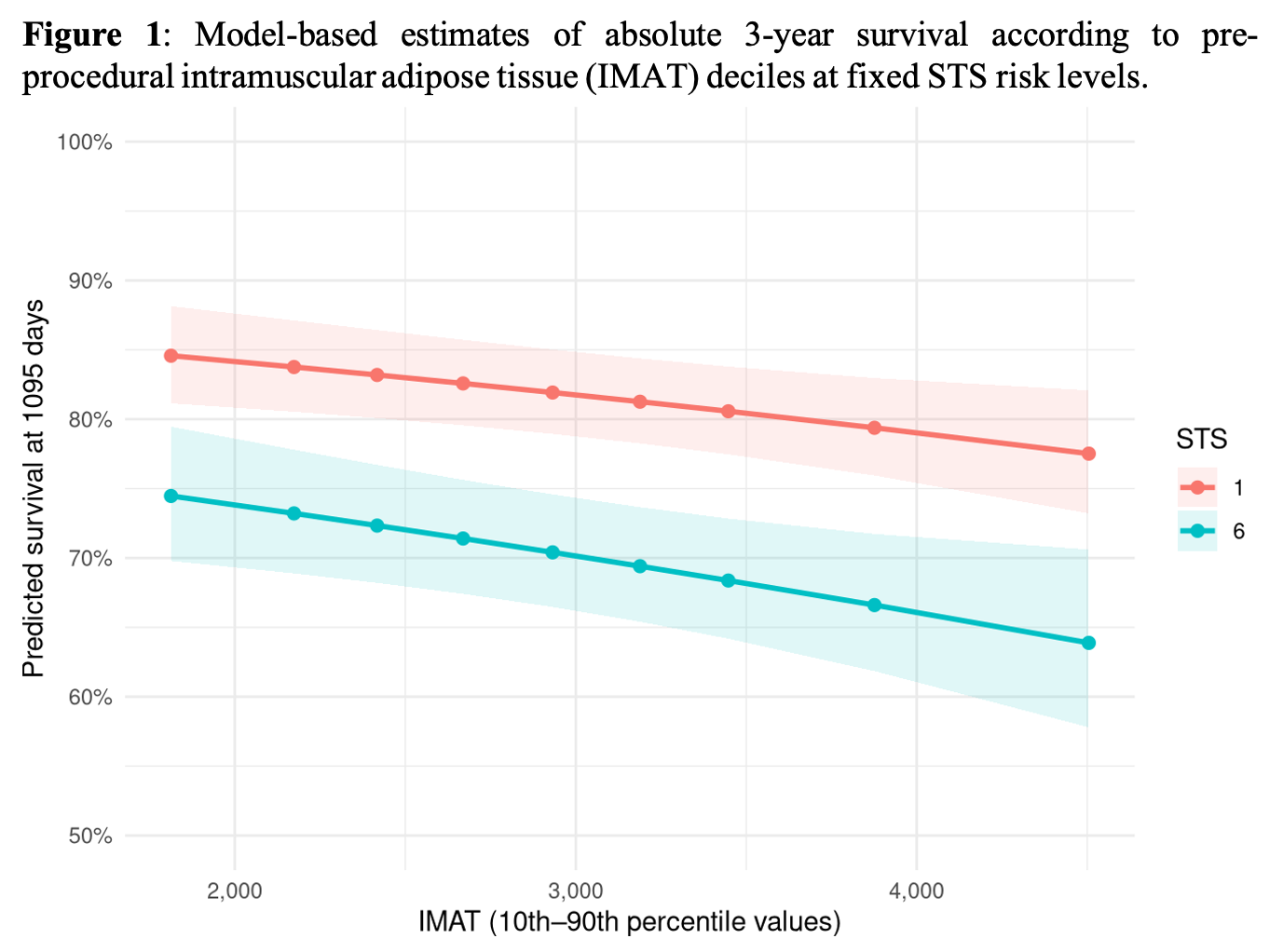
A total of 1,418 TAVI patients were included in the analysis. Median age was 82 years (interquartile range [IQR] 78-85), and 42.3% were female. Median effective orifice area was 0.8cm² (IQR 0.6–0.9), and median transvalvular gradient was 41.0mmHg (IQR 30.0–56.0). Coronary artery disease was present in 64.3% and median STS score was 2.5% (IQR 1.7-4.0). The STS score was significantly associated with mortality across all follow-up periods. Among pre-procedural BC parameters, lower psoas muscle volume was associated with increased 30-day mortality beyond STS (hazard ratio [HR]=0.57, 95% confidence interval [CI] 0.36–0.89; p=0.013) and significantly improved model fit (χ²(1)=6.26, p=0.012). Total skeletal muscle volume showed a similar association (HR=0.62, 95%CI 0.40–0.98; p=0.040; χ²(1)=4.49, p=0.034). Higher intramuscular adipose tissue (IMAT) was independently associated with increased 3-year mortality beyond STS (HR=1.19, 95%CI 1.05–1.35; p=0.006) and significantly improved model performance (χ²(1)=6.85, p=0.009), whereas psoas and total skeletal muscle volume were not. Predicted 3-year survival declined progressively across increasing IMAT deciles within comparable STS risk categories (Figure 1).
Conclusion:
AI-based CT-derived BC analysis provides incremental prognostic information beyond established clinical risk scores such as STS in TAVI patients. Lower skeletal and psosas muscle volume were primarily associated with early mortality, whereas higher IMAT, reflecting impaired muscle quality, predicted mid-term mortality. Assessment of sarcopenia and muscle quality may therefore serve as a complementary component of contemporary risk stratification and support individualized Heart Team decision-making.