Background
Atrial linear lesion ablation is commonly performed as an adjunct to pulmonary vein isolation (PVI) in patients with persistent AF and/or atrial tachycardia (AT). However, long-term success of redo AF ablation remains challenging and long-term durability of linear lesions remains suboptimal with conventional single-tip radiofrequency (RF)- catheters.
Aim
To access arrhythmia-free survival and lesion durability following redo ablation using the novel AfferaTM mapping and ablation system.
Methods
Consecutive patients undergoing redo AF ablation using the Affera™ system and it’s dual-energy, lattice-tip catheter between January 2025 and January 2026 were included in the analysis. One-year arrhythmia recurrence, procedural characteristics, and safety were assessed. In patients undergoing repeat invasive remapping, pulmonary vein and linear lesion durability was evaluated.
Results
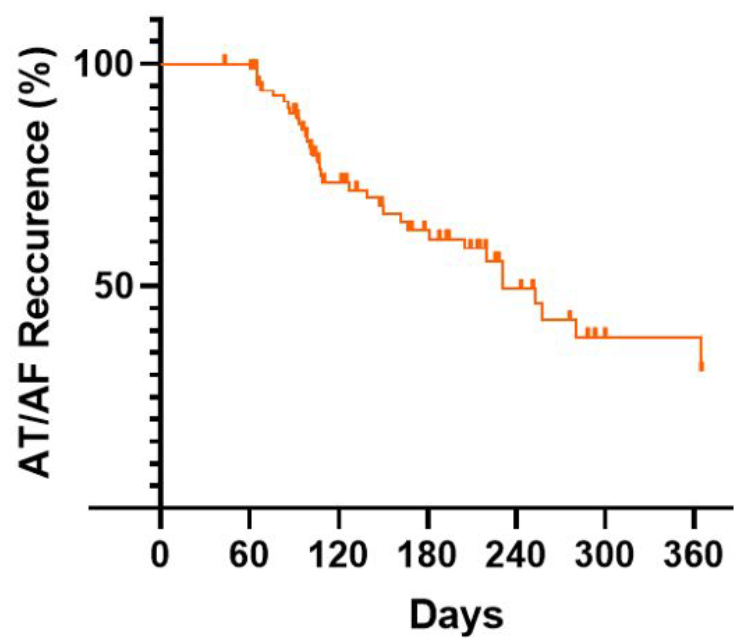
A total of 113 patients were analysed (Table 1). In 50 patients (44.2%), at least one pulmonary vein (PV) was reisolated at index procedure. Additional lesion sets included posterior box ablation (n=48), posterior wall isolation (n=9), roof lines (n=27), anterior lines (n=35), mitral isthmus lines (n=3), and cavotricuspid isthmus (CTI) ablation (n=20). No periprocedural complications occurred. Follow-up was available in 86/113 patients (76.1%; median follow-up duration in days 126 days). Arrhythmia recurrence occurred in 35 (41%) of patients during 1-year follow-up, after a blanking-period of 8 weeks (Figure 1). Repeat invasive remapping was available in 12 (13.9%) patients. At repeat procedure, 15/21 PVs (71.4%) remained isolated, including 3/4 left superior PVs (75%), 3/4 left inferior PVs (75%), 5/7 right superior PVs (71.4%), and 4/6 right inferior PVs (66.7%). Posterior box isolation
persisted in 3/3 patients (100%), roof line block in 1/1 (100%), anterior line block in 0/6 (0%), and CTI block in 3/4 patients (75%).
Conclusion
Affera™-guided redo AF ablation demonstrated favorable procedural safety and 1-year arrhythmia recurrence rates comparable to contemporary redo AF ablation cohorts. Invasive remapping revealed substantial durability of PVI, mitral annulus, posterior wall lesion sets and CTI, whereas anterior lines showed limited long-term durability.
Table 1. Baseline characteristics
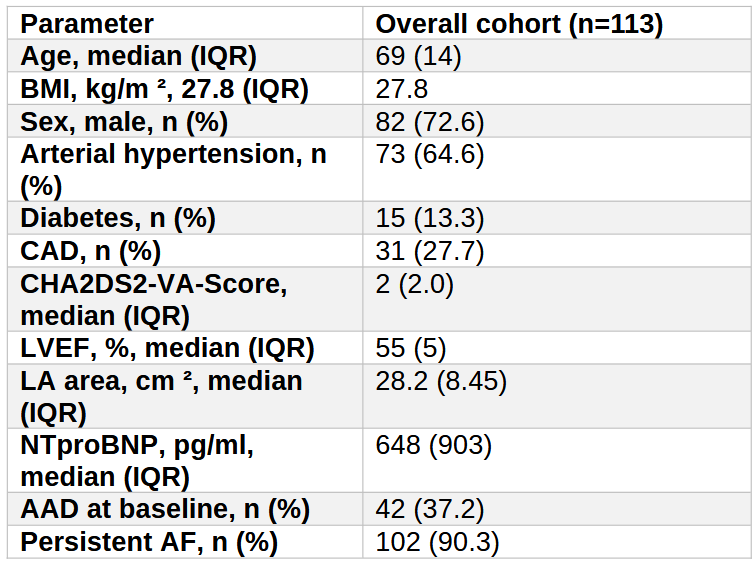 Figure 1.
 1-year AT/AF recurrence-rate