Introduction
Pulmonary vein isolation (PVI) remains a cornerstone of atrial fibrillation (AF) treatment. Pulsed field ablation (PFA) offers tissue-specific effects that, in contrast to traditional methods, result in fewer complications such as esophageal fistula or persistent phrenic nerve paralysis. The new Sphere 9™ catheter allows to toggle between PFA for left atrial regions with specific risk of esophageal damage and radiofrequency ablation (RFA) for other regions. The aim of the study was to evaluate acute safety of this new catheter with special focus on esophageal safety and hemolysis.
Methods
Patients undergoing their first AF ablation where included. All were treated using the Sphere 9™ / Affera catheter. All received wide antral circular ablation under sufficient anticoagulation; additional lesions were placed depending on operator descicion in case of low voltage. Posterior and inferior regions were ablated using PFA. Anterior parts of the upper PV could be ablated using RFA depending on operator decision. Erythrocyte count, LDH, haptoglobin and indirect bilirubin were measured before and after the procedure. The following day, esophageal endoscopy and cerebral MRI were performed.
Continuous variables were tested for normality (Shapiro-Wilk) and are given as mean ± SD or median (IQR); paired comparisons used the paired t-test or Wilcoxon signed-rank test. Categorical data are n (%).
Results
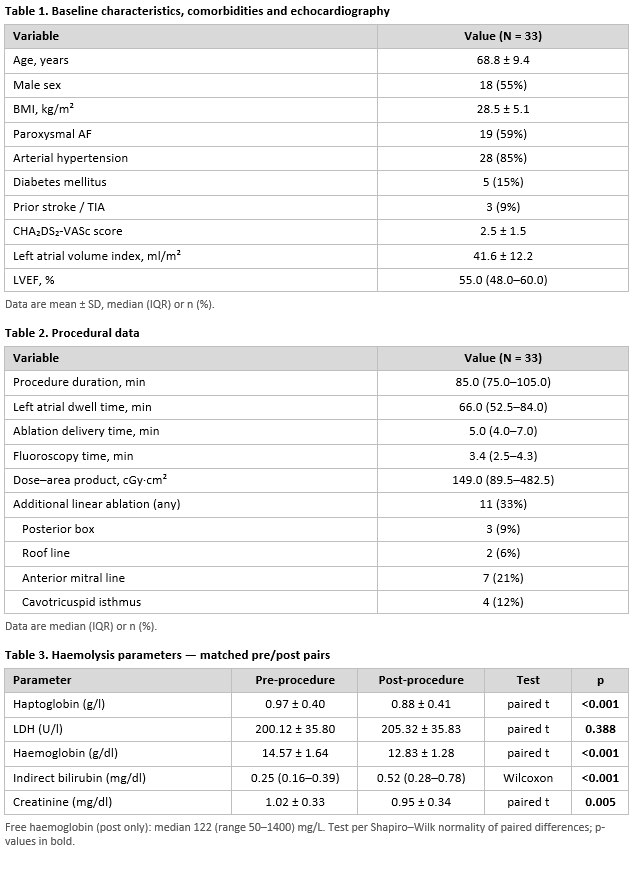
We included 33 consecutive patients who underwent their first ablation because of AF. All PV were successfully isolated in the entire cohort. Additional substrate modification was performed in 11 (33%) of patients. Median procedure duration was 85.0 (75.0–105.0) min and median fluoroscopy time 3.4 (2.5–4.3) min.
No oesophageal thermal lesions were seen (0/31). Cerebral MRI was performed in 12 patients, of whom 6 (50%) had silent cerebral lesions. Severe intravascular haemolysis (free Hb > 500 mg/L) occurred in 1 (3%). Haemolysis markers showed a mild pattern: haptoglobin fell slightly and indirect bilirubin rose, while LDH was unchanged. Creatinine did not increase, arguing against haemolysis-associated renal injury.