Background: In Wolff-Parkinson-White (WPW) syndrome, accurate localization of accessory pathways before catheter ablation can improve procedural planning and efficiency. Several 12-lead electrocardiographic (ECG) algorithms have been proposed, but their diagnostic performance has not been consistently established. We performed a systematic review and meta-analysis to assess the accuracy of ECG-based algorithms for accessory pathway localization in manifest WPW.
Methods: Following PRISMA-DTA recommendations, PubMed, EMBASE, Cochrane CENTRAL, Web of Science, and Scopus were searched from January 1990 to January 2026 (Figure 1). Studies enrolling adult or pediatric patients with manifest pre-excitation who underwent electrophysiological study (EPS) and catheter ablation were included. Successful localization during EPS/ablation served as the reference standard. Random-effects models were used to calculate pooled diagnostic accuracy, sensitivity, specificity, and diagnostic odds ratios (DOR). Summary receiver operating characteristic and leave-one-out sensitivity analyses were also performed.
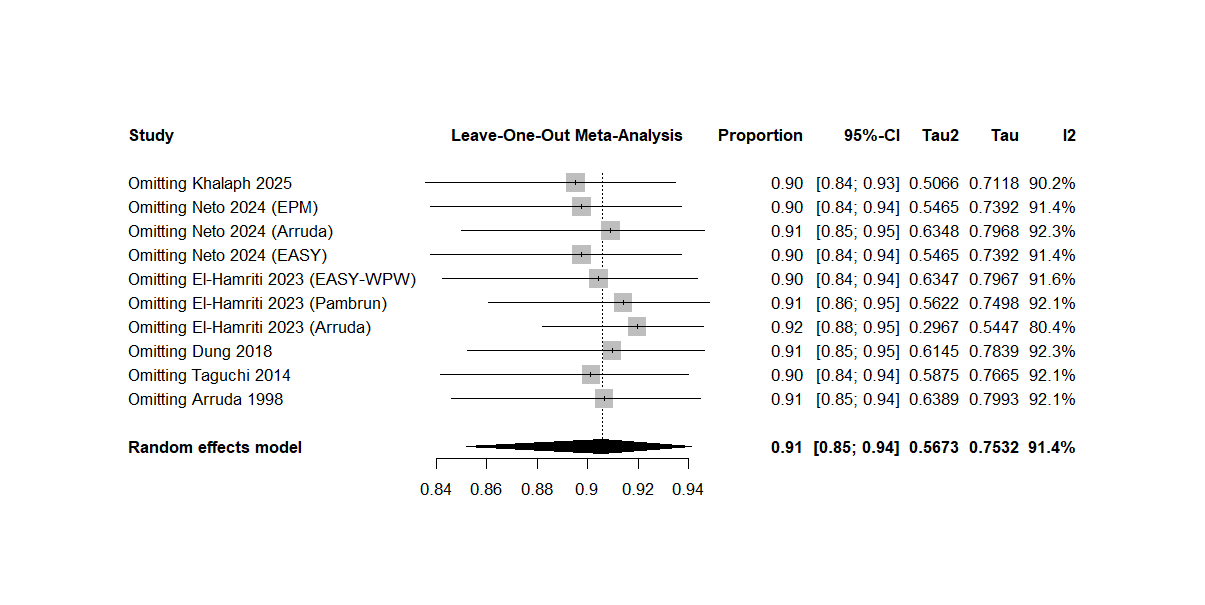
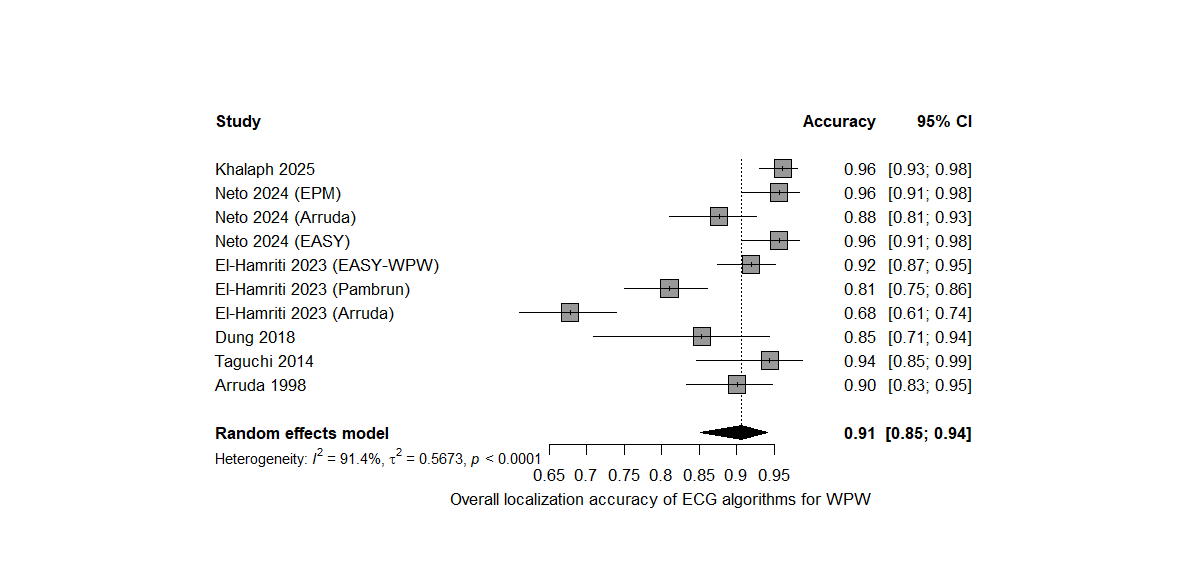
Results: Seventeen studies involving 3,159 patients met inclusion criteria. The pooled diagnostic accuracy of ECG algorithms was 0.91 (95% CI 0.85–0.94) (Figure 2), although heterogeneity was substantial (I²=91.4%). Pooled sensitivity was 0.87 (95% CI 0.73–0.94), and pooled specificity was 0.98 (95% CI 0.95–0.99; I²=0%). The pooled DOR was 297.17 (95% CI 46.33–1906.19; p<0.0001). Sensitivity analyses showed stable results after sequential exclusion of individual studies. (Supplementry figure 1)
Conclusion: Twelve-lead ECG algorithms provide high diagnostic performance for accessory pathway localization in manifest WPW and may be useful adjuncts for pre-ablation planning, although invasive electrophysiological mapping remains essential.
Figure 1
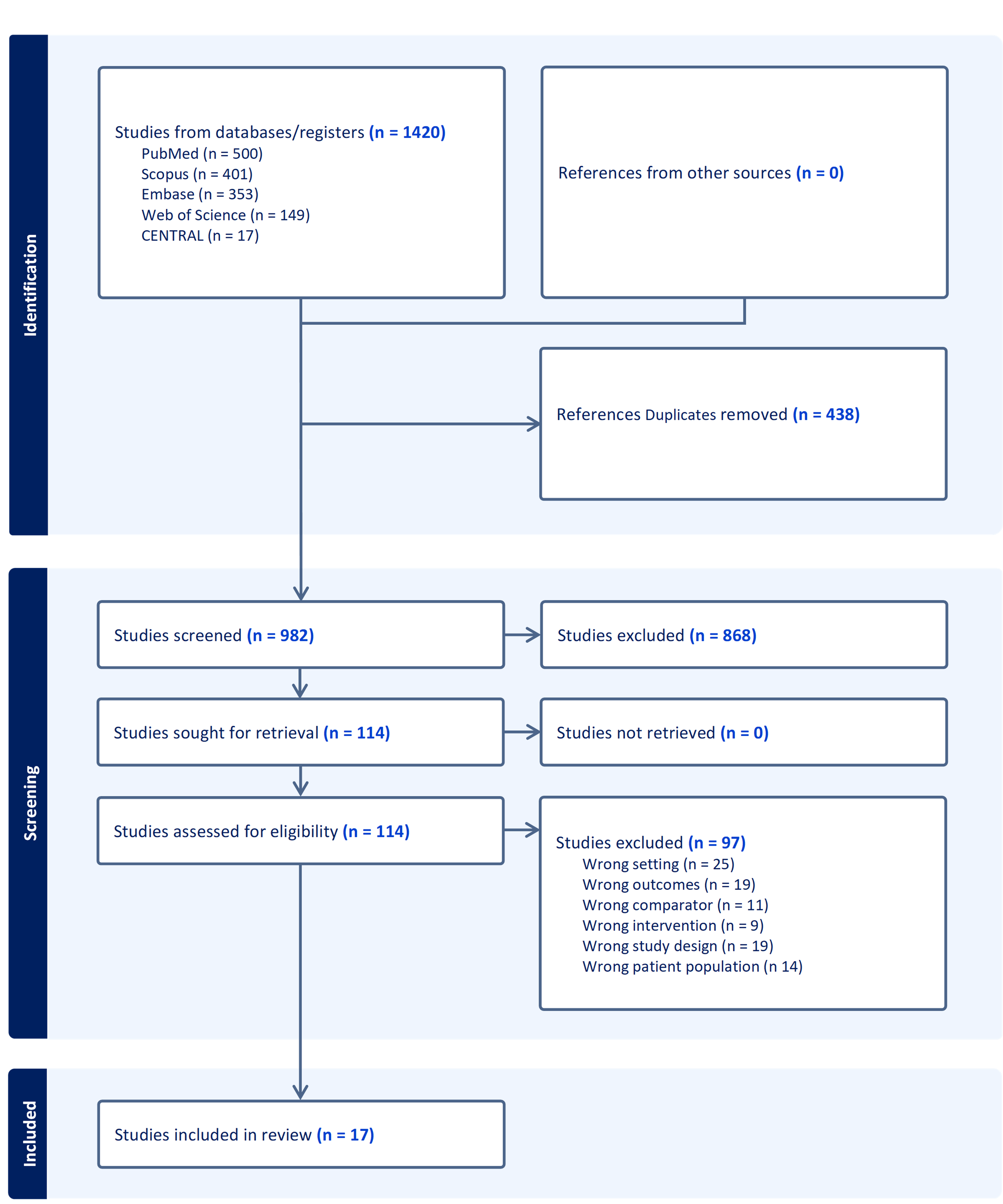
Figure 2:
Supplementry figure 1: