Background:
An increased number of premature atrial contractions (PACs) has been associated with an increased risk of atrial fibrillation (AF) and ischemic stroke. Prior studies used 24-hours or 48-hours of ECG monitoring and thresholds of ≥720 PACs/24 hours to define excessive supraventricular ectopy (ESVEA).
Purpose:
To determine whether shorter durations of ECG monitoring (e.g. one hour) would suffice to identify most patients who have ≥720 PACs/24 hours.
Methods:
FIND-AF 2 is a multicenter trial including patients ≥60 years with recent ischemic stroke and no prior AF. Patients are randomized to enhanced, prolonged and intensified ECG monitoring or usual care. All patients received a 24-h Holter-ECG prior to randomization to exclude AF and to quantify the number of PACs. In this analysis, 5,231 patients with complete 24-h Holter-ECGs and without AF were evaluated. Holter-ECGs were divided into hourly intervals. PAC positivity was defined as ≥30 PACs in at least one hour. The ≥720 PAC/24h criterion served as reference standard. Sensitivity, specificity, and the Youden index were calculated across cumulative monitoring durations. Distributional analyses were performed among PAC-positive recordings.
Results:
A total of 1,054 recordings met the ≥720 PAC/24h criterion. Overall, 2,147 Holter-ECGs were classified as PAC-positive. Among PAC-positive recordings, patients with ≥720 PAC/24h exhibited a substantially higher number of hours with ≥30 PACs compared with <720 PAC/24h (median 17 vs 2 hours, p<0.001), demonstrating near-complete separation of distributions (Figure 1). After 1 hour, the ≥30 PAC threshold showed high specificity (96%) and moderate sensitivity (70%) for identifying ≥720 PAC/24h. Sensitivity increased while specificity declined with longer monitoring, with optimal discrimination after 7 hours (Youden index 0.801; sensitivity 94%, specificity 86%) (Figure 2).
Conclusion:
High daily PAC burden reflects sustained hourly PAC activity rather than isolated peaks. A single-hour threshold provides a highly specific early rule-in approach, while 7-hour monitoring achieves optimal balance. Short ECG monitoring for a few hours may be used to risk-stratify ischemic stroke patients for prolonged ECG monitoring.
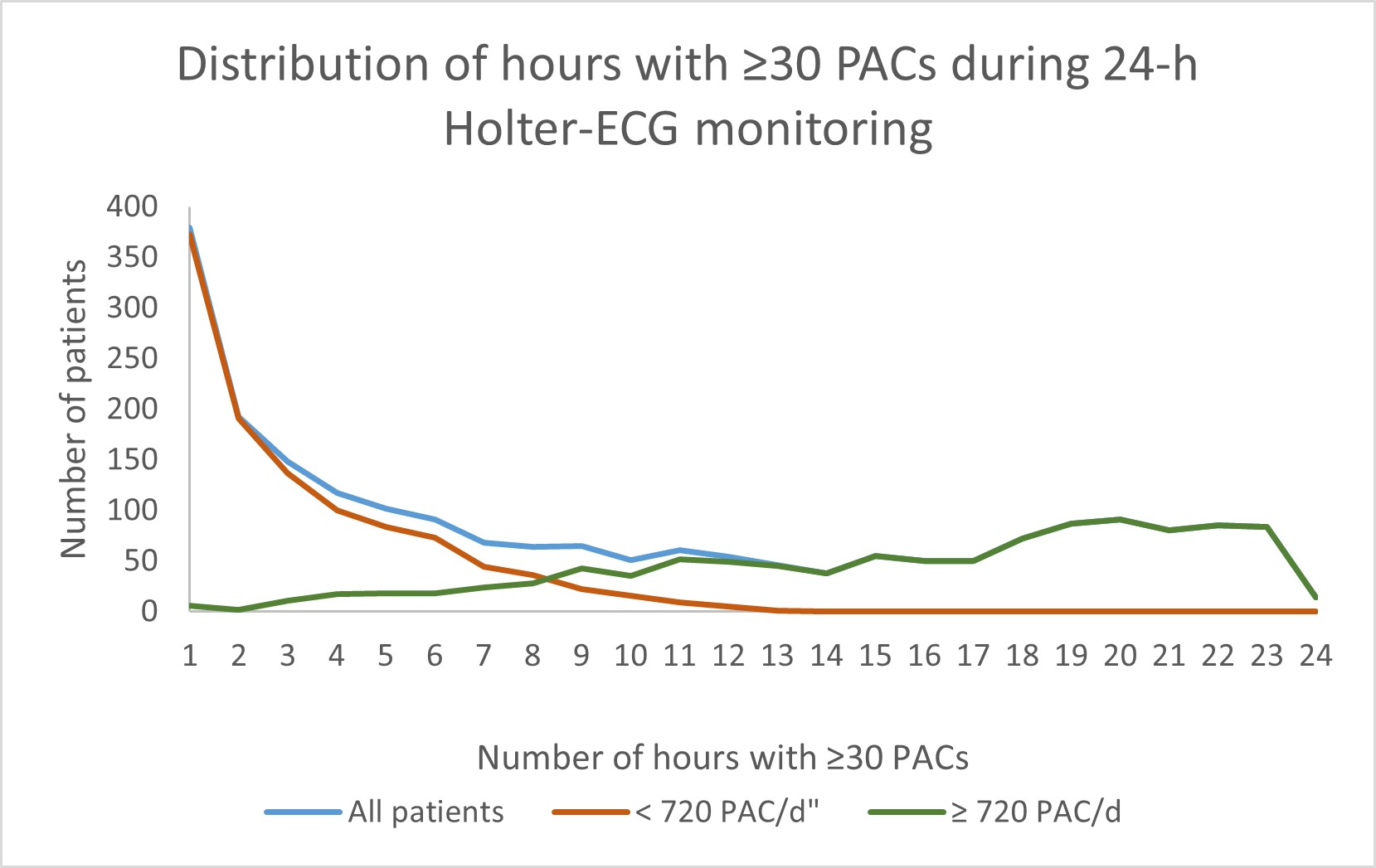
Figure 1. Distribution of the number of hours with ≥30 PACs during 24-hour Holter monitoring among patients with at least one hour ≥30 PACs. The overall PAC-positive population is shown in blue. Patients with ≥ 720 PACs/24h are shown in green, and patients with < 720 PACs/24h in red.
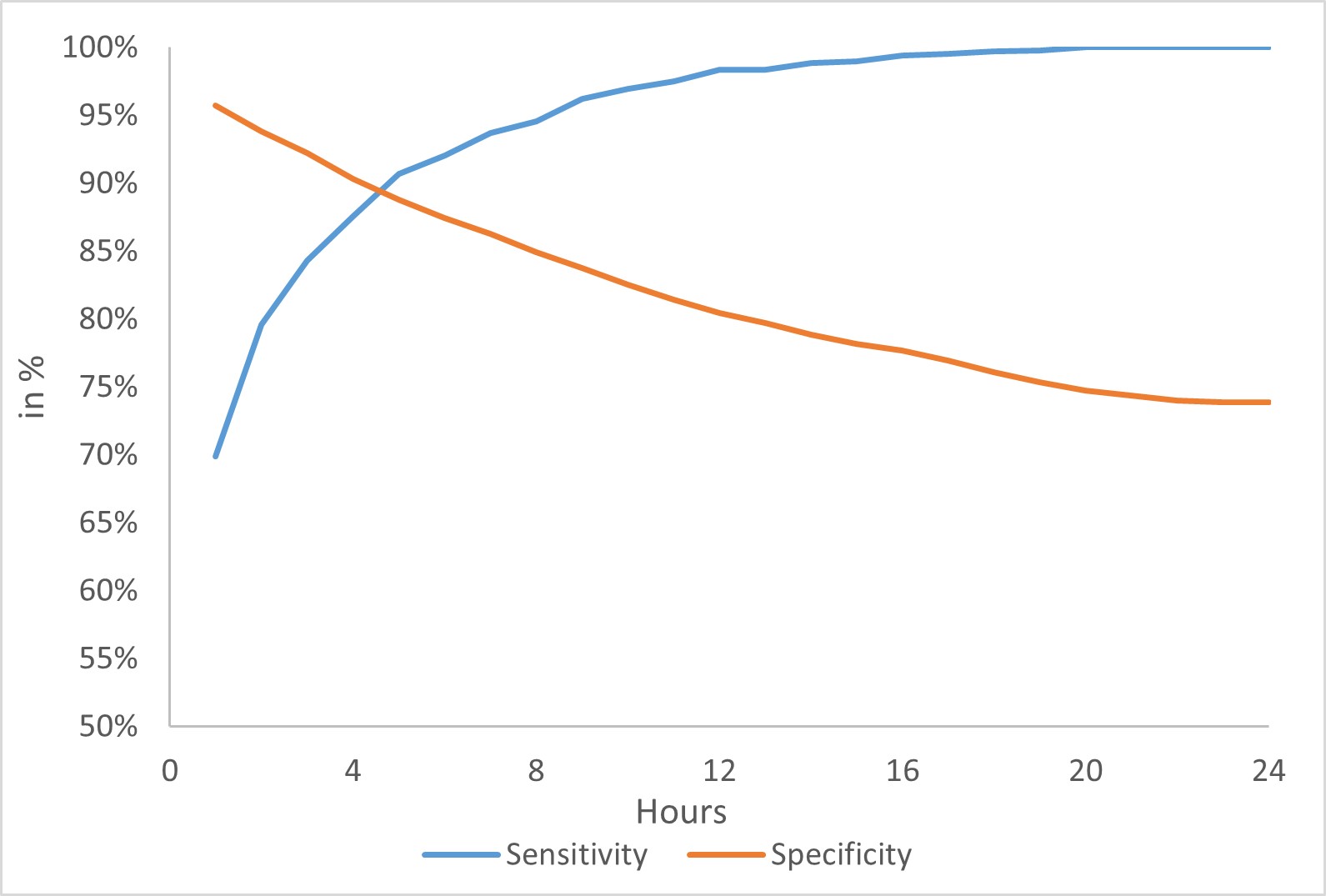
Figure 2. Sensitivity and specificity of the ≥30 PACs/hour criterion over 24 hours. Sensitivity is shown in blue and specificity in orange, with their intersection indicating the optimal monitoring duration based on the Youden index.



