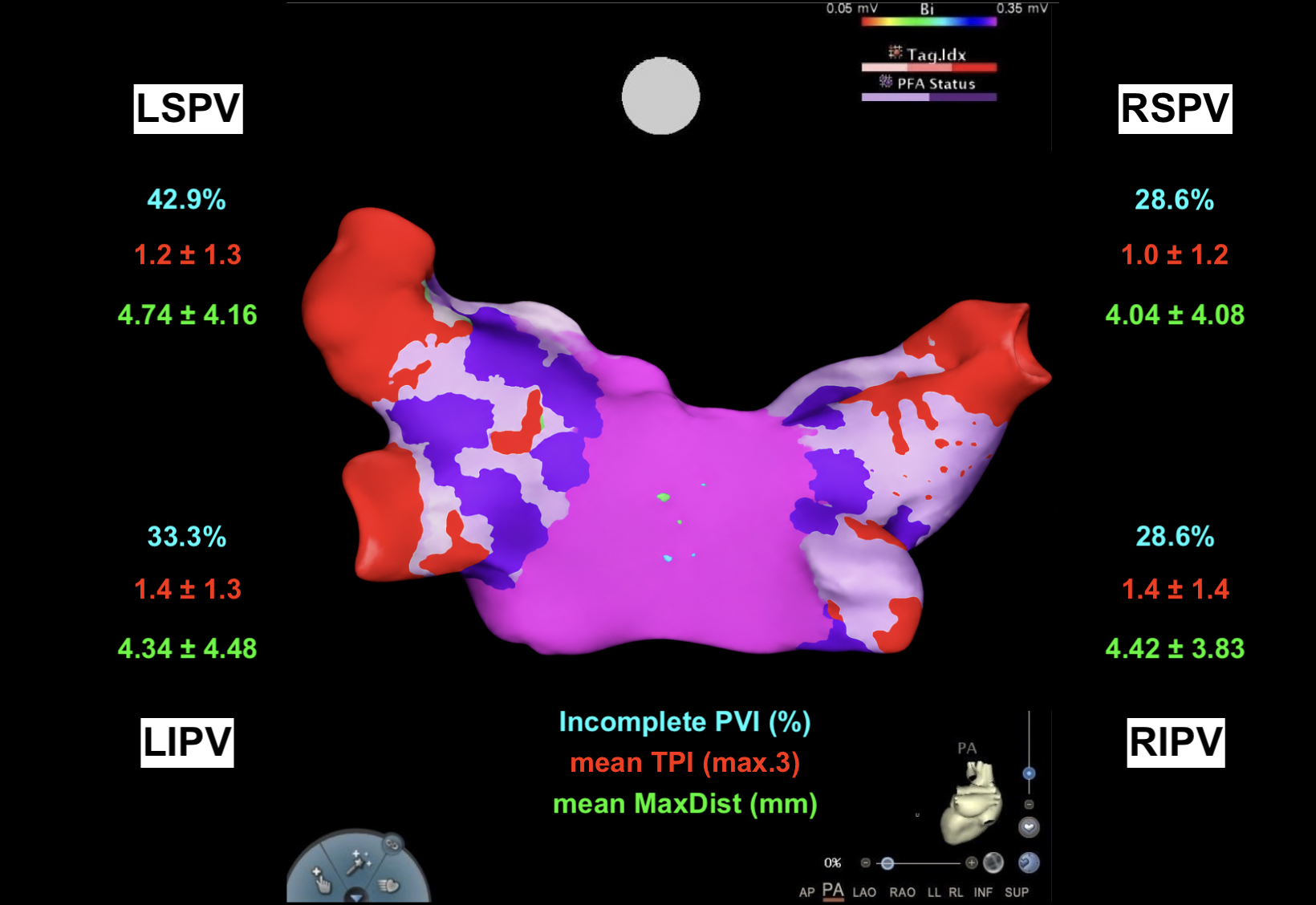
Background: Durable lesion formation remains a key determinant of procedural efficacy during pulmonary vein isolation (PVI). However procedural predictors of effective lesion formation during pulsed field ablation (PFA) are incompletely understood. The novel variable-loop circular catheter (VLCC) allows real-time, three-dimensional visualization of the catheter position, tissue contact and lesion delivery. This analysis from the VARI-RUHR registry aimed to evaluate the role of tissue contact on procedural success.
Methods: Patients with symptomatic AF undergoing PVI using the VLCC with integration of three-dimensional mapping were enrolled. Novel PFA metrics related to procedural success, including tissue proximity indicator (TPI) and maximum intra-electrode distance (MaxDist), were analyzed on a per-lesion basis and correlated with first-pass isolation (FPI).
Results: Patients undergoing PFA with the VLCC (n=21; 68.8±9.3 years of age; 33.3% female; 52.4% paroxysmal AF, mean CHA2DS2VA 2.6±1.4 points) with available ablation metrics were included in this analysis. Acute procedural success was recorded in 90.5 % of patients, while FPI was achieved in 67.0 % of treated PVs (15.8 ± 1.8 applications/patient). A total of n=3165 ablation points (mean TPI 1.3±1.3/3, mean MaxDist 4.39±1.08 mm) were analyzed. Applications at the RSPV showed the lowest values of TPI (1.0±1.2/3), while applications at the LSPV demonstrated the highest values of MaxDist (4.74±4.16 mm). Ablation points with a complete TPI (3/3) had a significantly lower MaxDist (3.10±2.75 vs. 4.89±4.39 mm; p<0.001). Applications resulting in FPI were associated with higher rates of complete TPI (29.1 vs. 24.6%; p=0.008) as well as lower MaxDist (3.94±3.68 vs. 5.32±4.67 mm; p<0.001).
Conclusion: Real-time catheter-tissue contact metrics derived from the VLCC identified applications associated with successful pulmonary vein isolation. Monitoring of catheter-tissue contact could prove a crucial determinant of procedural efficacy, underscoring the need for deeper understanding of lesion formation during PFA.



