Background: Mechanical rotational sheaths are routinely used for transvenous lead extraction (TLE) during cardiac implantable electronic devices (CIEDs)-related complications. However, data directly comparing different extraction systems remain limited. The aim of this study was to analyze and compare the two most commonly used mechanical rotational sheaths, TightRail™ (Philips) and Evolution® (Cook Medical), with regard to their utilization and procedural outcomes.
Methods:
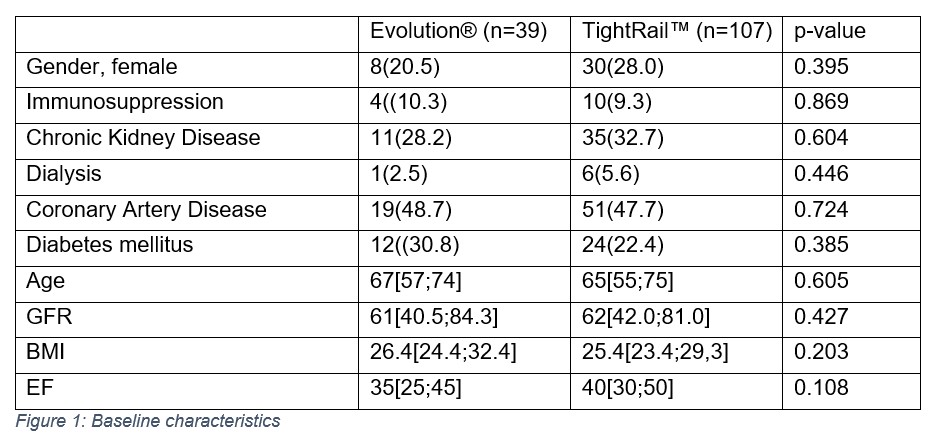
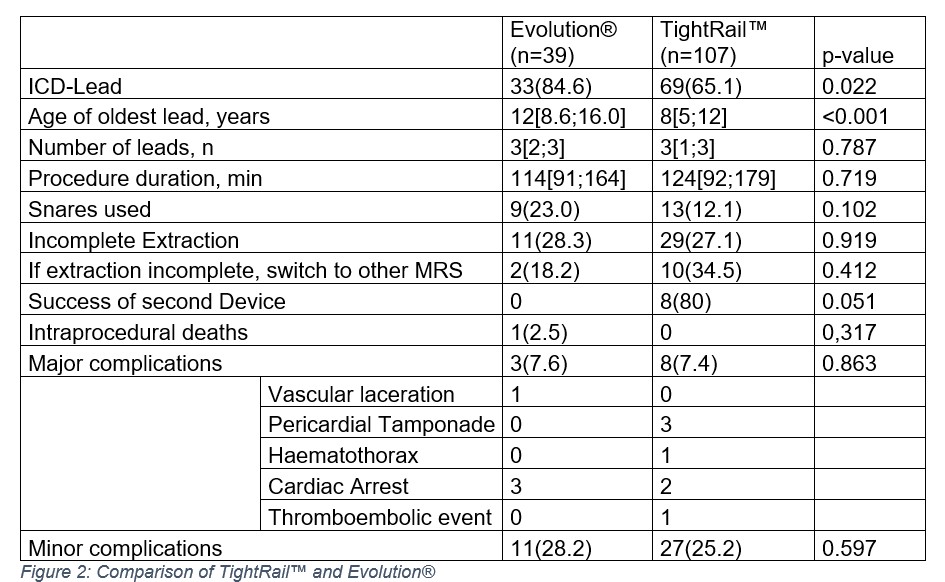
This retrospective single-center study included 356 patients undergoing transvenous lead extraction (TLE) at the Universitätsklinikum Schleswig-Holstein, Campus Lübeck, between 2016 and 2025. The cohort was stratified according to the mechanical rotational sheath used, enabling a direct comparison of two sheath systems. Demographic and procedural baseline characteristics were assessed for group comparability (Fig. 1). Sheath utilization, procedural outcomes, and sheath-specific failure rates were compared between groups (Fig. 2). Categorical variables were analyzed using Fisher’s exact test. Continuous variables were tested for normality using the Shapiro–Wilk test and compared using either the independent samples t-test or the Mann–Whitney U test, as appropriate.
Results: Of all TLE procedures performed, a mechanical rotational sheath was required in 146 cases (42.8 %). Among the 146 TLE procedures requiring a mechanical rotational sheath, TightRail™ was used in 107 cases and Evolution® in 39 cases. Baseline characteristics were largely comparable between the two groups. However, Evolution® was used significantly more often in patients with ICD leads than TightRail™ (84.6% vs. 65.1%; p = 0.022) and in procedures involving significantly older leads, as reflected by a higher median age of the oldest extracted lead (12 [8–16] vs. 8 [5–12] years; p < 0.001). Despite this more complex lead profile, failure of the initially selected mechanical rotational sheath occurred at a comparable rate in the Evolution® and TightRail™ groups (28.3% vs. 27.1%; p = 0.919).
When extraction with the initially selected sheath was unsuccessful and crossover to the alternative mechanical rotational sheath was performed, Evolution® enabled successful lead extraction in 8 of 10 cases after TightRail™ failure. In contrast, TightRail™ did not achieve successful extraction in the two cases in which it was used after Evolution® failure. Although this difference did not reach statistical significance, likely due to the small number of crossover cases, a trend favoring Evolution® as a bailout device was observed (80% vs. 0%; p = 0.051).
Minor complications occurred in 11 patients in the Evolution® group and 27 patients in the TightRail™ group (28.2% vs. 25.2%; p = 0.597). Major complications were observed in 3 and 8 patients, respectively (7.6% vs. 7.4%; p = 0.863), with no significant difference between sheath systems.
Conclusion:
Despite being used in patients with significantly older leads and a higher proportion of ICD leads, Evolution® showed comparable failure rates and safety outcomes to TightRail™. In crossover cases after failed TightRail™ extraction, Evolution® enabled successful lead removal in 8 of 10 patients, suggesting a potential role as an effective bailout strategy. However, this finding did not reach statistical significance, likely due to the small sample size, and should be confirmed in larger cohorts.