Background:
The His-ventricular (HV) interval reflects conduction through the His-Purkinje system and is a key parameter in invasive electrophysiological diagnostics. It is routinely assessed in patients with syncope with bifascicular block, or suspected high-grade atrioventricular or infra-Hisian conduction disease, guiding therapeutic decisions such as permanent pacemaker implantation. However, its measurement requires an invasive electrophysiological study (EPS), which carries procedural risks, as well as substantial personnel and financial costs. In contrast, routine surface electrocardiography is widely available and non-invasive. This study investigated whether abnormal HV intervals can be predicted from routine surface ECG parameters using an extreme gradient boosting (XGBoost) machine learning model.
Methods:
In this retrospective, single-centre study, consecutive patients undergoing EPS with documented HV interval measurement at Charité – Universitätsmedizin Berlin were identified from the hospital information system. Patients with missing 12-lead ECG documentation or pacemaker-stimulated ECGs were excluded. All 12-lead surface ECGs recorded before and after EPS were collected and digitized, and standardized quantitative parameters were extracted, including PR interval, QRS duration, QTc interval, P-wave axis, QRS axis, T-wave axis and heart rate. Age and sex were recorded as patient characteristics. An XGBoost classifier was developed to predict abnormal HV intervals (>55 ms) based on these ECG features and patient characteristics. Missing values were imputed prior to model development. Model performance was evaluated in an independent test set using accuracy, area under the receiver-operating characteristic curve (AUC), and standard classification metrics.
Results:
A total of 177 patients (63.8% male, mean age at EPS 67.7 ± 17 years) with 464 corresponding 12-lead ECGs were included. The mean invasively measured HV interval was 56.4 ± 15.1 ms, and a pathologically prolonged HV interval (>55 ms) was present in 93 patients (52.5%). QRS duration and PR interval showed the strongest independent association with invasively measured HV interval. The XGBoost model achieved an accuracy of 75.7% in the test cohort, with an AUC of 0.823, indicating good discrimination for identifying abnormal HV intervals. Precision, recall, and F1-score for abnormal HV prediction were 0.81, 0.75, and 0.78, respectively (60 true positives, 46 true negatives, 20 false negatives, 14 false positives). Sex, QRS duration, age, and PR interval were the most influential predictors according to feature importance analysis.
Conclusions:
An XGBoost-based machine learning model using routinely available surface ECG parameters demonstrated good discriminatory performance for predicting abnormal HV intervals. These findings suggest that machine learning analysis of standard ECG data may provide a useful non-invasive screening tool for identifying patients at risk of His-Purkinje conduction abnormalities and may help guide patient selection for invasive electrophysiological evaluation. Prospective multicentre validation is warranted.
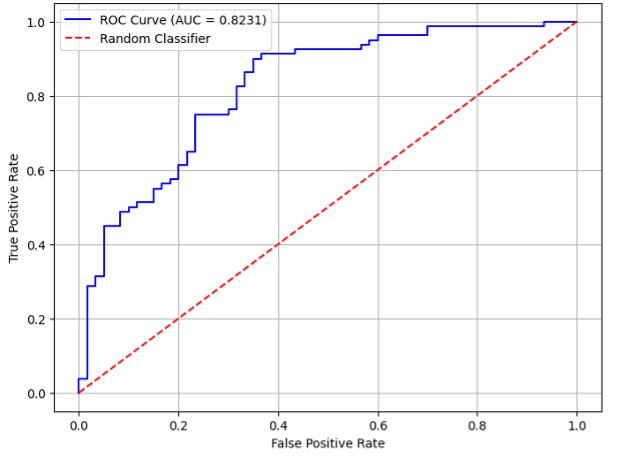
Figure 1. Receiver operating characteristic (ROC) curve of the XGBoost model for predicting abnormal HV intervals (>55 ms) from surface ECG parameters in the test cohort.



