BackgroundCardiac magnetic resonance (CMR) sequences necessitate synchronisation with the cardiac cycle. This is routinely obtained through electrocardiographic (ECG) detection of the R-wave with subsequent triggering or gating of the acquisition, depending on the type of sequence. An accepted alternative is the use of transmissive photoplethysmography using a fingerclip (fPPG) to detect the peripheral pulse wave. Remote photoplethysmography (rPPG) is an emerging video-based technique for contact-free cardiac rhythm monitoring (Figure 1).
Objectives To compare the accuracy of rPPG and fPPG against the gold standard of ECG for cardiac monitoring during CMR.
MethodsIn this prospective study (DRKS00036686), parallel tracings of ECG, fPPG and rPPG were acquired during CMR examinations. The primary endpoint was triggering accuracy, measured by true positive rate (TPR), positive predictive value (PPV) and beat detection error rate (BDER) in the rPPG and fPPG tracings compared to the ECG tracing. The rPPG algorithm was then adjusted to improve pulse wave detection in patients with skin type Fitzpatrick 5-6.
Results60 subjects were included. rPPG initially showed slightly worse measures of trigger accuracy compared to fPPG. Using the adjusted method retrospectively on the video data of all subjects significantly improved trigger accuracy for skin types Fitzpatrick 5-6 while maintaining excellent accuracy for all other skin types, leading to superior trigger accuracy of the adjusted rPPG method compared to fPPG (Figure 2).
ConclusionsContact-free rPPG is a viable alternative to ECG and fPPG for cardiac monitoring during CMR, irrespective of skin type.
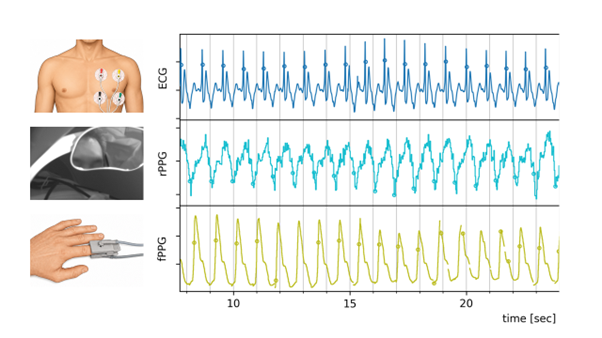 Figure 1.
 Exemplary tracings of ECG, remote photoplethysmography (rPPG) and fingertip photoplethysmography (fPPG) during a cardiac magnetic resonance (CMR) scan.
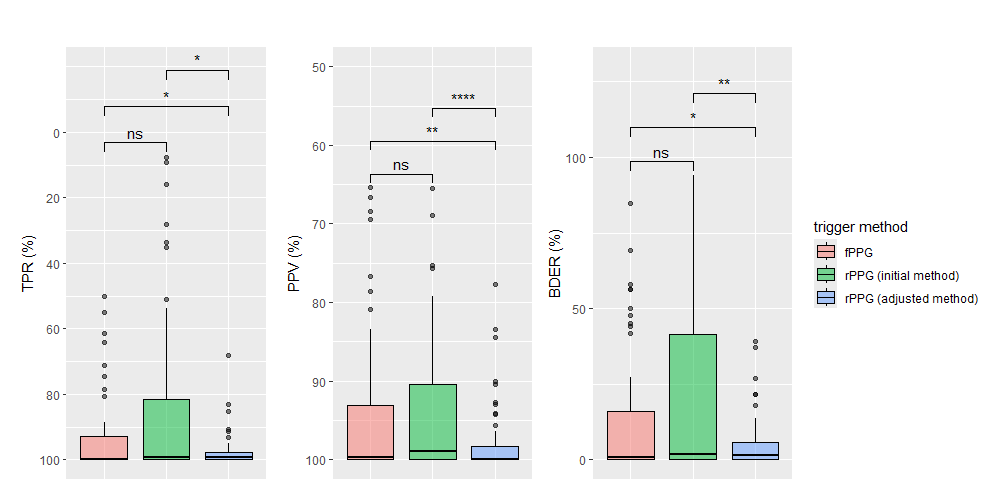 Figure 2.
 Intra-individual comparison of true positive rate (TPR), positive predictive value (PPV) and beat-detection error rate (BDER) for fingertip photoplethysmography (fPPG) and remote photoplethysmography (rPPG, initial and adjusted method). Significance levels (Wilcoxon signed-rank test): ns p > 0.05, * p ≤ 0.05, ** p ≤ 0.01, *** p ≤ 0.001, **** p ≤ 0.0001



