Background:
Valvular heart diseases are associated with significant individual morbidity and mortality, often leading to heart failure and a diminished quality of life. Beyond the clinical burden, the high cost of late-stage surgical and transcatheter interventions creates a substantial socio-economic strain on healthcare systems, underscoring the urgent need for early identification. Additionally, demographic changes might further increase incidence of valvular diseases. Currently, epidemiological data in Germany remain fragmented; available insights are largely derived from clinical registries of already treated patients or older, phenotype-specific cohorts, leaving the true community prevalence of asymptomatic disease poorly defined. Aim of this project is therefore to establish validated, population-based prevalence rates for major valve diseases in Germany, providing the essential evidence required to optimize clinical algorithms and health resource allocation.
Methods and results:
We analyzed N=204 571 individuals from the population-based, prospective, multi-center NAKO health study representing 16 study regions in Germany. Self-reported information on performed surgical treatment of cardiac valves in the past was ascertained by questionnaire. Statistical survey weights accounting for sampling design and relevant sociodemographic factors were used to calculate population prevalences for surgically treated valve disease in the NAKO study regions.
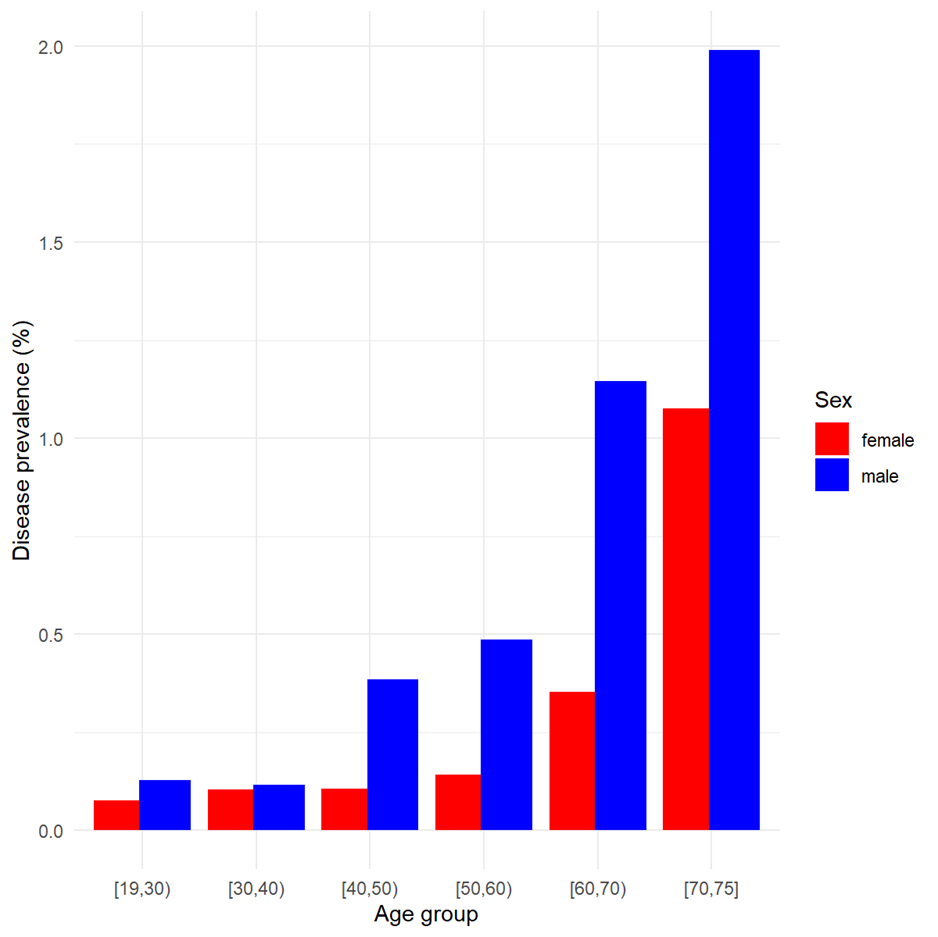
The weighted sample comprised 50.8% women and had a mean age of 45.3 years (standard deviation 14.1 years). Only 0.31% of the study individuals had a history of surgically treated valve disease (0.18% in women, 0.45% in men) with substantial increase in aged individuals (see Figure). Of all participants 12.2% self-reported a history of cardiovascular disease including myocardial infarction, angina pectoris, heart failure, arrythmias and claudicatio. In patients with prevalent treated valve disease 75.6% had a history of cardiovascular disease.
In the age groups 18 to 40 years the prevalence of surgically treated valvular heart disease was very low in both women and men with 0.08% to 0.13%. An increase in prevalence was seen in men starting with 40 years, reaching 1.99% in men older than 70 years. In women the increase in prevalence seemed to start later at 50 to 60 years, reaching 1.08% in women older than 70 years.
Conclusion:
Representative for a major part of the German population, prevalence of surgically treated valve disease is low in male and female individuals below 40 years of age. The prevalence clearly rises with age in the population-based NAKO health study. Here, prevalence in men shows an early rise compared to women. Further, men reach a higher prevalence with nearly 2.0% in older individuals. This data underscores not only the considerable public health relevance of valve disease but also the need for early identification of subclinical disease.
Figure: