Aim: Conduction system pacing (CSP) promises a more physiological stimulation in patients needing pacemaker therapy. A comparative evaluation against septal and apical positions is lacking, particularly with respect to symptomatic and echocardiographic outcomes in Heart failure with preserved ejection fraction (HFpEF). We aimed to investigate, whether CSP improves clinical outcomes in HFpEF patients (NYHA, NT-proBNP, diastolic dysfunction (DD)) in a position-dependent comparison and validate paced QRS duration (sQRS) as a simple electrocardiographic predictor of an adverse outcome.
Methods: Patients undergoing first-time pacemaker implantation at a tertiary centre (n=521; median age 79 years; 40 % female; HFpEF 43 %; atrial fibrillation 46 %; median follow-up 213 days) were retrospectively analyzed regarding RV lead position (CSP, septal, apicoseptal, apical). Electrical resynchronization was measured in patients with a native QRS ≥120 ms (n=111) by ∆QRS (sQRS − native QRS) and by the proportion with true QRS shortening on pacing (sQRS < native QRS). Efficacy analyses in the HFpEF subgroup (n=222) compared NYHA class, hospitalization rate, indication for CRT upgrade, DD grade at FU and NT-proBNP across RV lead positions. The combined endpoint of an adverse trajectory was defined as cardiovascular hospitalization or NYHA class worsening during FU. The sQRS predictor analysis was performed in HFpEF patients with paced QRS duration (n=116).
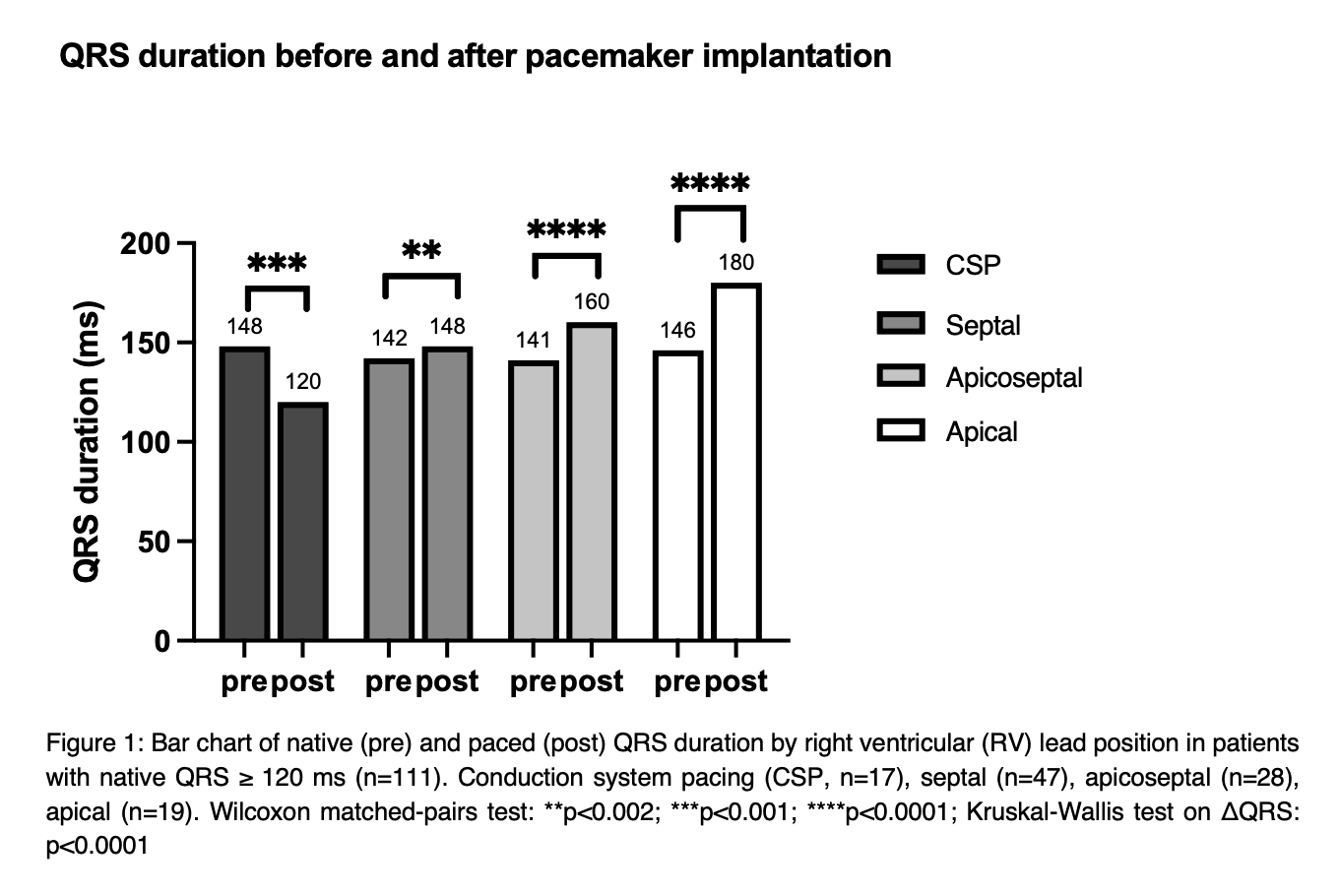
Results: CSP was the only position that shortened the paced QRS (Δ −28 ms, from median 148 → 120 ms), whereas all RV positions widened it: septal +10 ms, apicoseptal +16 ms, apical +32 ms. True QRS shortening occurred in 82.4 % of CSP patients, versus 29.8 % septal, 10.7 % apicoseptal and 0 % apical (x² p<0.0001). Median sQRS values of the entire cohort: CSP 120 ms, septal 146 ms, apicoseptal 160 ms, apical 178 ms ( p<0.0001). In the HFpEF cohort, NYHA class improved by ≥1 class in 64.8 % of patients (n=145) and only 5.5 % worsened (Wilcoxon p<0.0001). The position-dependent comparison showed: Hospitalization was the highest in the apical group (12.5 %) and the lowest in CSP (0%) (apicoseptal 5.7 %, septal 4.3%).
DD improved by ≥1 grade in 47.6 % of HFpEF patients (n=21; Wilcoxon p=0.017); an NT-proBNP reduction occurred in 61.3 %. Overall, 21 of 222 HFpEF patients (9.5 %) experienced an adverse outcome, with risk increasing from septal (5.7 %) to apical position (21.9 %), 9.4% under apicoseptal and 0 % under CSP ( p=0.007).
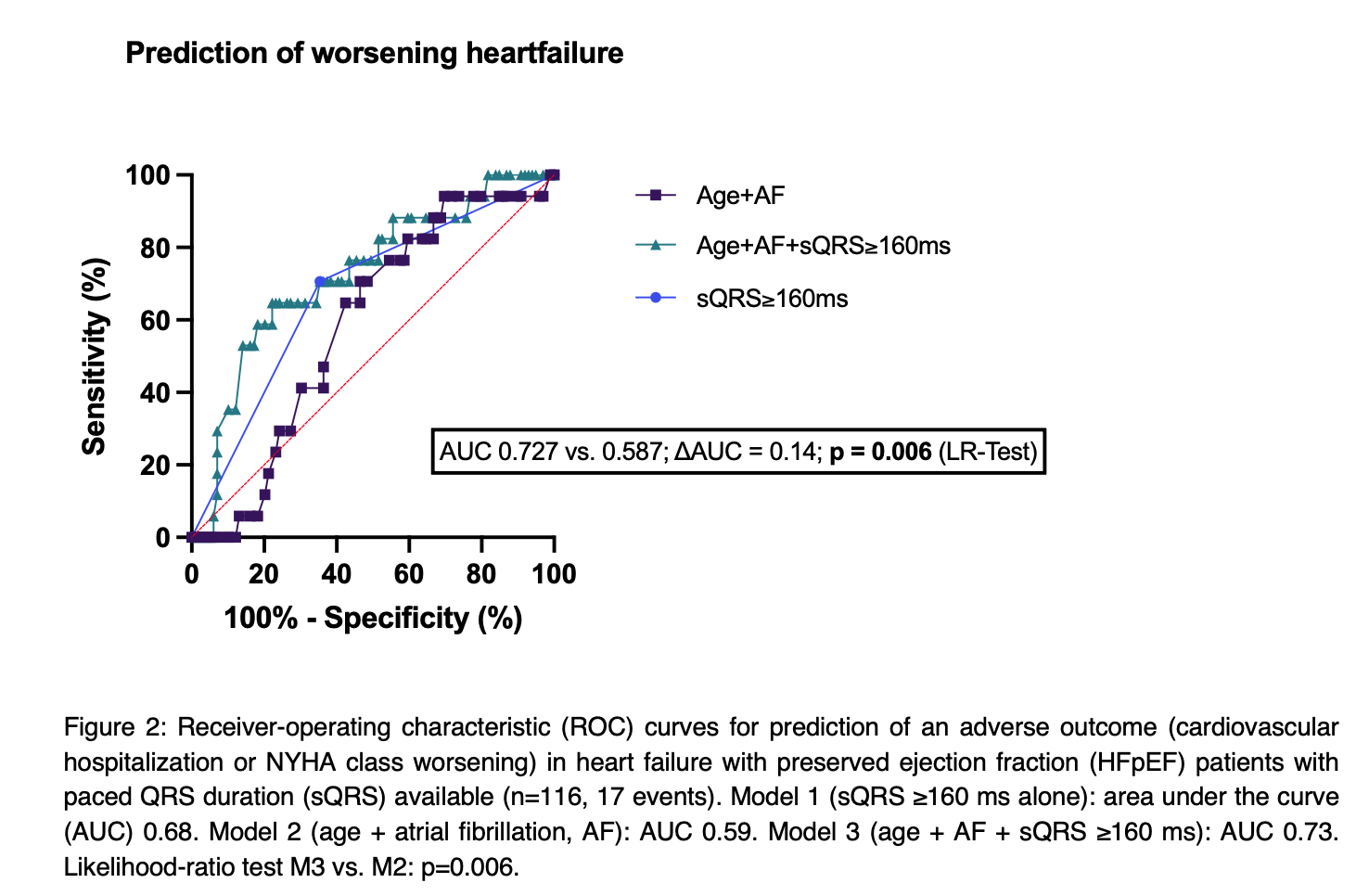
In HFpEF patients with documented sQRS duration, 14.7 % (17/116) experienced an adverse outcome. A paced QRS duration≥160 ms was strongly and independently associated with adverse outcome: event rate 25.5 %(sQRS ≥160) vs. 7.2 % (sQRS <160); x² p=0.028; univariate OR 4.39 (95 % CI 1.43–13.47;p=0.010); adj. OR 4.83 (95 % CI 1.49–15.69; p=0.009) after adjustment for age, sex and atrial fibrillation. Discriminative performance was moderate but clinically relevant: adding sQRS≥160ms to a clinical baseline model (age, AF), increased the ROC AUC from 0.59 to 0.73 (∆AUC = +0.14); sQRS ≥ 160ms alone reached AUC 0.68
Conclusions: In this retrospective registry, ventricular lead position determines both electrical resynchronization and the clinical course of pacing therapy in HFpEF . CSP yields the most favorable clinical course, showing sQRS ≥160 ms identifies HFpEF patients with an approximately four-fold increased risk of an adverse outcome.