A 56-year-old woman was admitted with persistent complete atrioventricular block. Despite isoprenaline therapy, complete AV block persisted, while the patient remained haemodynamically stable with a junctional escape rhythm of approximately 60 bpm. Her medical history was remarkable for diffuse large B-cell lymphoma (DLBCL), initially diagnosed in 2022, with multiple subsequent relapses despite systemic therapy, autologous stem cell transplantation, and antibody-drug conjugate-based treatment.
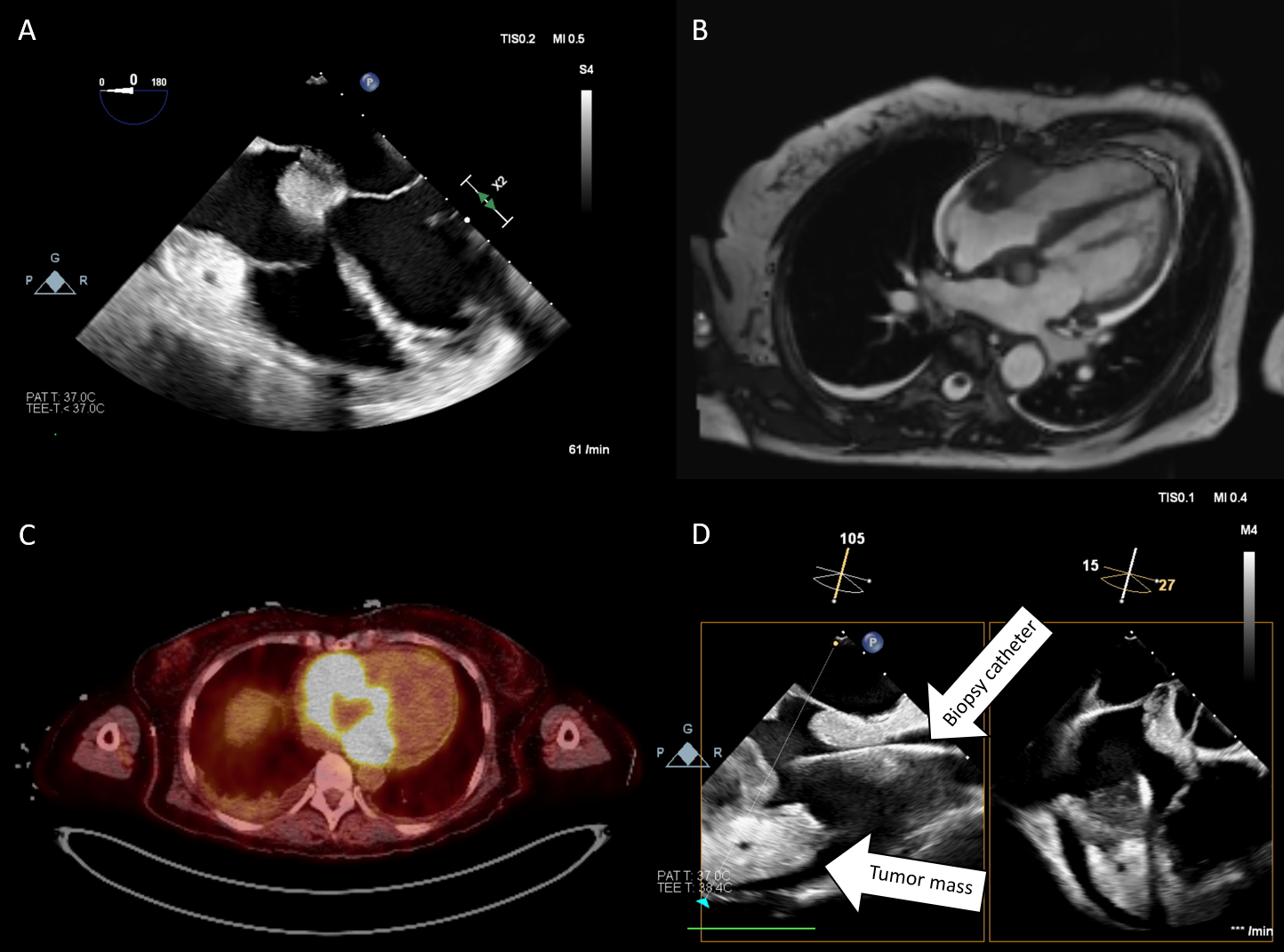
Transthoracic and transoesophageal echocardiography (TTE/ TOE) revealed suspicious intracardiac masses involving the interatrial septum, the free right atrial wall, and the right atrial/right ventricular junction, causing mild flow acceleration into the right ventricle without relevant obstruction (Figure 1A). The involvement of the interatrial septum and the right atrial/right ventricular junction, in close anatomical proximity to the atrioventricular conduction system, provided a plausible explanation for the persistent complete AV block. Cardiac magnetic resonance imaging confirmed an extensive right-sided intracardiac mass with suspected extension toward the inferoseptal left ventricular myocardium (Figure 1B). FDG-PET/CT demonstrated intense metabolic activity of the cardiac lesion, as well as additional nodal and extranodal manifestations, raising strong suspicion of recurrent lymphoma with cardiac involvement (Figure 1C).
For definitive diagnosis, TOE- and angiography-guided transvenous biopsy of the intracardiac mass was performed via a right heart catheter approach, yielding five tissue samples (Figure 1D). Histopathological analysis confirmed relapsed DLBCL. As complete AV block persisted without recovery during diagnostic evaluation and oncological treatment could not be expected to result in immediate restoration of atrioventricular conduction, permanent pacemaker implantation was performed. Systemic chemotherapy was subsequently re-initiated in close interdisciplinary collaboration between cardiology, haemato-oncology, cardiac imaging, and electrophysiology.
Conclusion
This case illustrates a rare but clinically important presentation of relapsed DLBCL manifesting as persistent complete AV block due to cardiac involvement in close proximity to the atrioventricular conduction system. Multimodality imaging enabled precise characterisation of the intracardiac tumor burden, while TOE- and angiography-guided transvenous biopsy provided definitive histological confirmation. In patients with a history of lymphoma and new-onset high-grade conduction abnormalities, cardiac relapse should be considered early as timely diagnosis directly affects both rhythm management and oncological treatment.