Introduction
The Society for Cardiovascular Angiography and Interventions (SCAI) shock classification is widely used for risk stratification in cardiogenic shock (CS), but its discriminative performance remains moderate. The glycaemic gap (GG), defined as admission blood glucose minus HbA1c-derived estimated average glucose, reflects acute stress hyperglycaemia relative to chronic glycaemic status. Elevated GG has been associated with adverse outcomes in CS. We evaluated whether GG improves prognostic performance beyond SCAI shock stage for 30-day mortality in patients with all-cause CS.
Methods
The ongoing, national, multicentre MIRACLE (multimodal phenotyping in patients referred with acute cardiac failure) cohort includes prospectively and retrospectively enrolled patients with CS across all aetiologies. For this interim analysis, patients with SCAI stage B or higher at ICU admission were included. Patients with SCAI stage A or unavailable admission glucose or HbA1c values were excluded. The final cohort comprised 527 patients, including 344 prospectively and 183 retrospectively enrolled patients. Associations between GG and 30-day mortality were assessed using Cox regression adjusted for age, age squared, sex, and SCAI shock stage at ICU admission. Incremental prognostic value beyond SCAI shock stage was evaluated using likelihood-ratio testing and time-dependent area under the receiver operating characteristic curve (tAUC).
Results
Overall, 173 patients died within 30 days (32.8%). Higher GG was associated with increased 30-day mortality. Per 1-SD increase in GG, the adjusted hazard ratio was 1.19 (95% CI, 1.03–1.38; p=0.022). Restricted cubic spline analysis showed a graded increase in mortality risk across rising GG values, supporting a continuous relationship between stress hyperglycaemia and adverse outcome. The association was consistent across clinically relevant subgroups, including diabetes status, shock severity, age, sex, lactate level, prior cardiac arrest, CS aetiology, and prospective versus retrospective enrolment, with no significant interactions.
Adding GG to SCAI shock stage significantly improved model fit (likelihood-ratio test p=0.024). However, discrimination improved only numerically. For 30-day mortality, tAUC increased from 0.62 (95% CI, 0.57–0.67) for SCAI shock stage alone to 0.64 (95% CI, 0.59–0.69) after addition of GG, corresponding to a non-significant tAUC difference of 0.017 (p=0.144; Fig. 1).
Conclusions
In patients with all-cause cardiogenic shock, the glycaemic gap was independently associated with 30-day mortality and showed a graded relationship with risk. Although GG improved model fit beyond SCAI shock stage, it did not materially improve discrimination. These findings support GG as a simple marker of risk, but not as a standalone tool for refining prognostication beyond SCAI shock stage. Additional markers or multimarker approaches are needed to improve clinically useful risk stratification in CS.
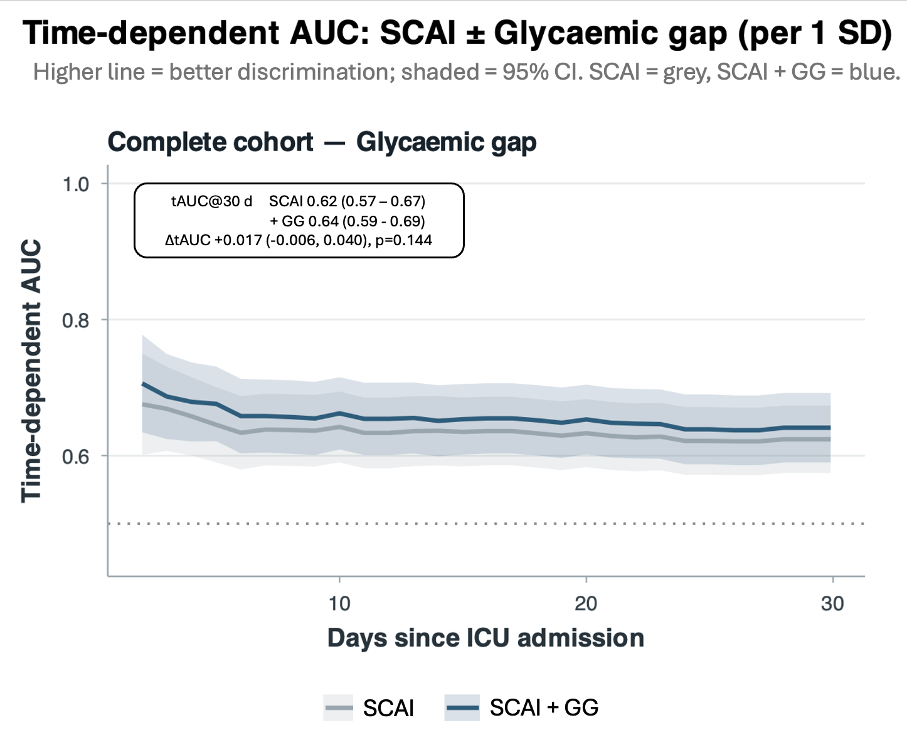
Fig. 1: Time-dependent discrimination of SCAI shock stage with and without glycaemic gap for 30-day mortality.
Time-dependent area under the receiver operating characteristic curve (AUC) for SCAI shock stage at ICU admission alone and after addition of the glycaemic gap, modelled per 1-SD increase. Lines indicate point estimates and shaded areas represent 95% confidence intervals. The dotted horizontal line indicates an AUC of 0.50.



