Background:
Radial arterial access to treat acute myocardial infarction (AMI) has been shown to reduce bleeding and mortality compared to traditional femoral access in randomized trials. Published data on implementation of radial access and risk association over time in real world AMI treatment are scarce.
Purpose:
To characterize the implementation of radial vs. femoral arterial access in AMI and the evolution of the related risk of bleeding and mortality in large longitudinal metropolitan MI registry data.
Methods:
Patients from hospitals participating in the prospective monitored registry during 2 study periods (2011 – 2014 and 2021 - 2024) were included. The sub-cohorts with radial vs. femoral arterial access were identified and compared within the study periods regarding multiple baseline characteristics. Multivariate logistic regression models were developed to estimate adjusted associations of the arterial access route, GUSTO-classified moderate or severe bleeding events, and in-hospital mortality for both study periods, including variables with significant baseline differences as well as clinically relevant covariates identified a priori. A sensitivity analysis was performed including all registry member hospitals, whether or not participating during both study periods.
Results:
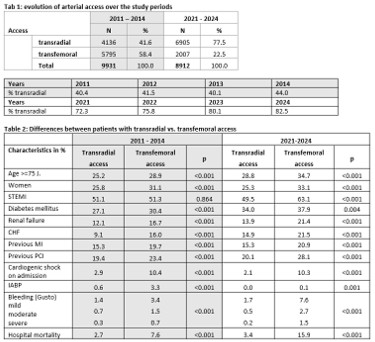
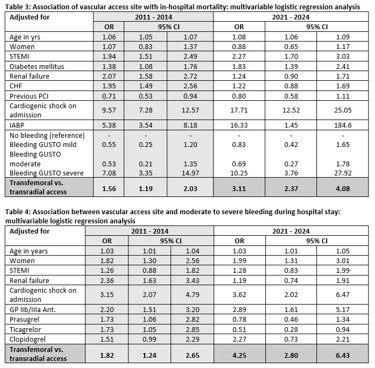
We included 18.843 patients with AMI from 19 hospitals over two separate time periods of 4 years each (2011 – 2014: n = 9931 and 2021 – 2024: n = 8912), and 25629 patients (2011 – 2014: n = 10146 and 2021 – 2024: n = 15483) for the sensitivity analysis. Radial access increased from 41,6% to 77,5% between the study periods, and femoral access diminished accordingly from 58,4% to 22,5% (Tab. 1). Over all analyses, patients with femoral vs. radial access differed in numerous variables (Tab. 2). Multivariate models comparing bleeding events comprised age, sex, STEMI, renal failure, cardiogenic shock, GPIIb/IIIa use, and Prasugrel, Ticagrelor, or Clopidogrel administration. During both time periods, overall bleeding occurred significantly less frequently with transradial compared with transfemoral access (Tab. 2, p<0.001). Across both study periods, after multivariable adjustment, transfemoral access remained independently associated with higher odds of moderate to severe bleeding (2011 – 2014: OR 1.82; 95% CI 1.24-2.65; 2021 – 2024: OR 4.25; 95% CI 2.80 - 6.43, Tab. 3). Similarly, hospital mortality was higher for patients with transfemoral (2011 – 2014: OR 1.56; 95% CI 1.19 - 2.03; 2021 – 2024: OR 3.11; 95% CI 2.37 - 4.08, Tab. 4). Results were consistent in the sensitivity analysis including all hospitals.
Conclusion:
Radial artery access has been widely implemented over the last 15 years in participating hospitals. Femoral artery access remains independently and importantly associated with moderate to severe bleeding events and with in-hospital mortality.