Background
Transcatheter Tricuspid Valve Replacement (TTVR) has emerged as a treatment option for patients with severe or higher-grade tricuspid regurgitation (TR) who are deemed inoperable by heart team consensus and whose anatomy is sub-optimal for tricuspid transcatheter edge-to-edge repair (T-TEER).
Objectives
This study aims to compare procedural and short-term clinical and echocardiographic outcomes of two different TTVR devices: the Cardiovalve (Venus MedTech) and the EVOQUE (Edwards Lifesciences) prosthesis.
Methods
We performed a retrospective, single-center cohort analysis including all consecutive patients who were treated with TTVR at our center between July 2021 and June 2025. All Cardiovalve procedures were performed within the TARGET study or as compassionate use cases. The EVOQUE prosthesis was implanted after CE mark approval. Primary endpoints included TR reduction, NYHA functional class and safety events according to the Tricuspid Valve Academic Research Consortium (TVARC) criteria.
Results
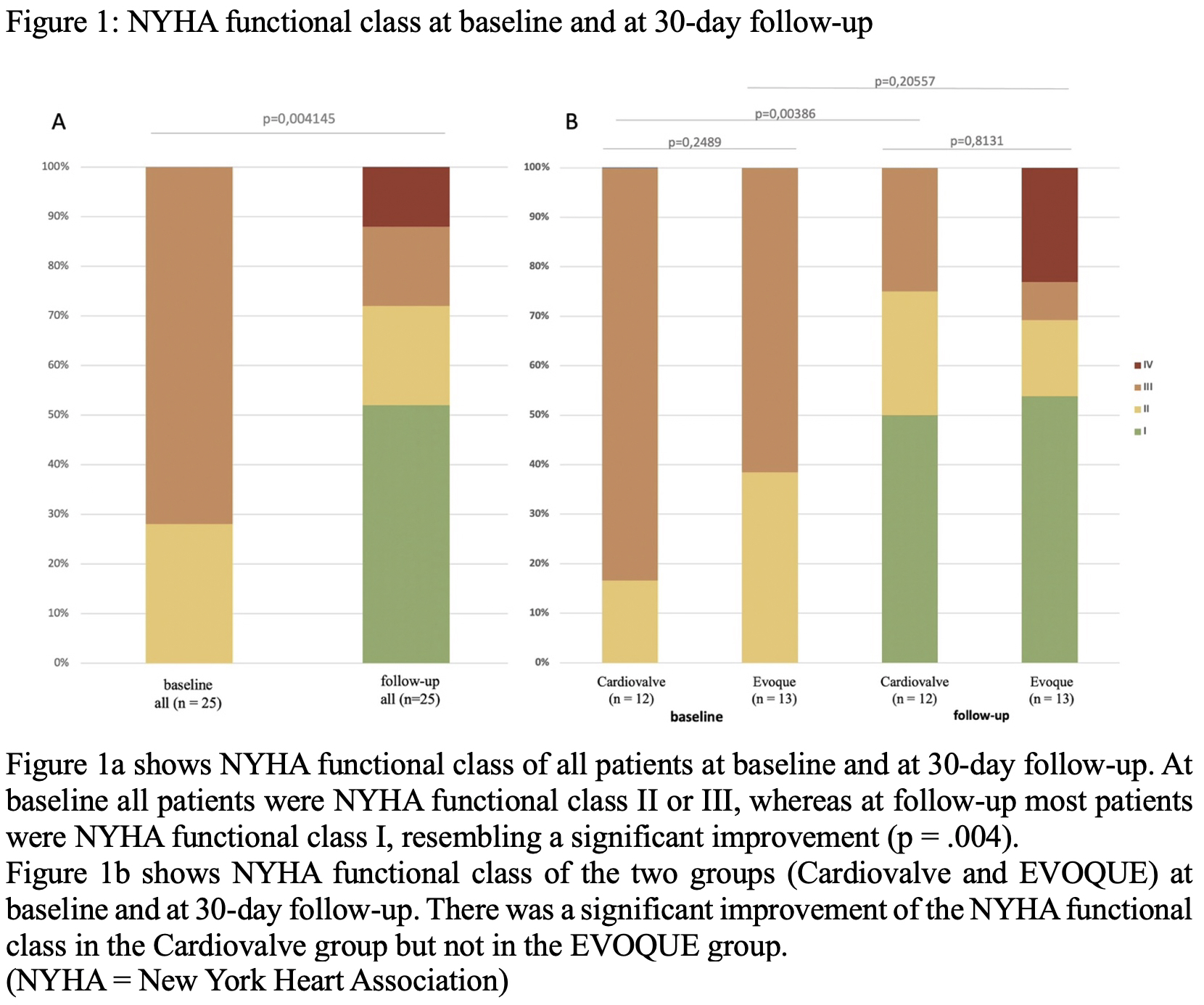
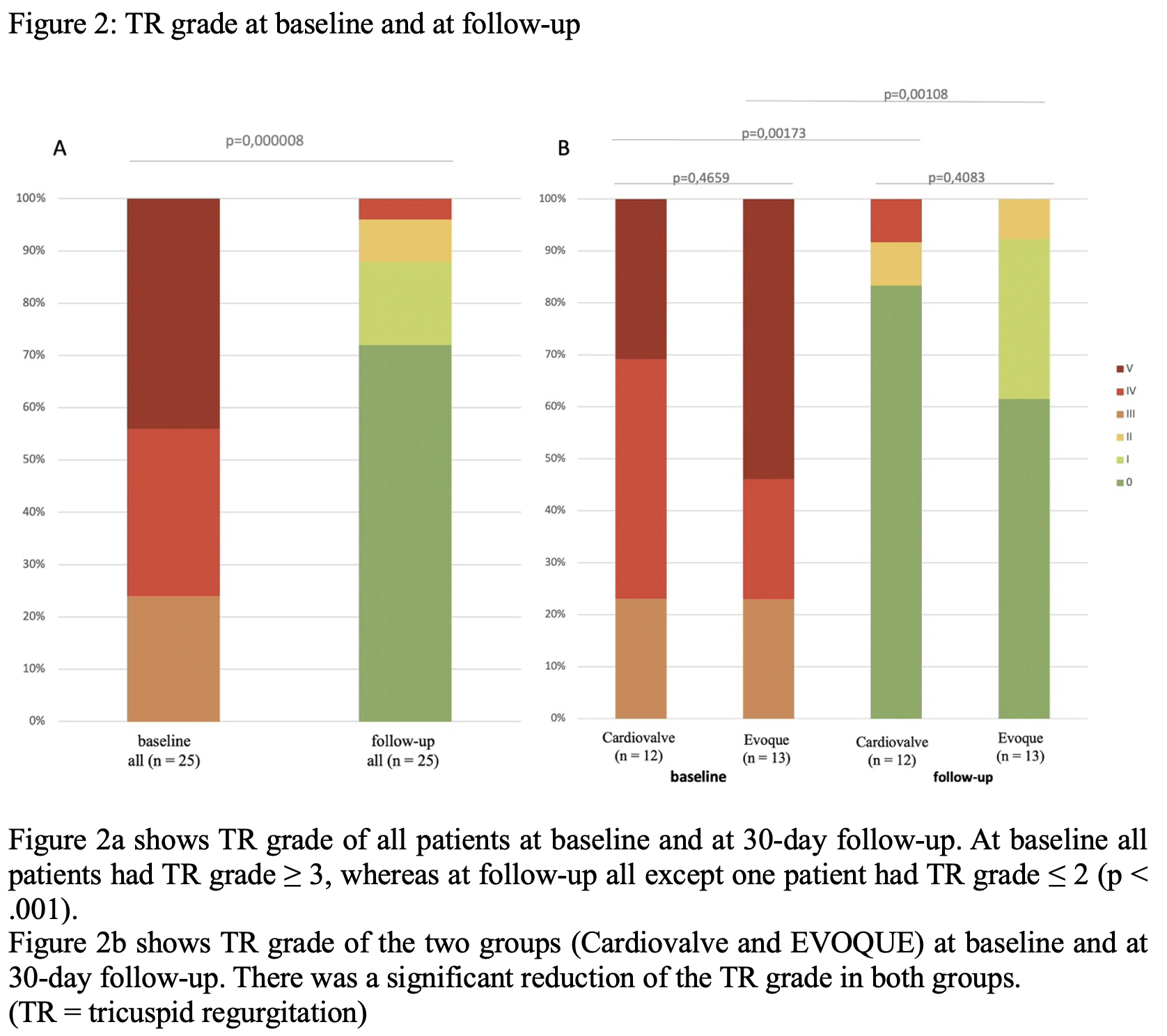
Overall, 25 consecutive patients were included in the analysis. The Cardiovalve prosthesis was implanted in 12 patients and the EVOQUE prosthesis in 13 patients. The perioperative risk scores (EuroScore II, STS-Score and TRI-SCORE) showed an intermediate-risk patient profile with no significant differences between the two groups. Most patients (72%) presented with NYHA class III and all patients (100%) had TR grade III or higher.
Intraprocedural success according to the TVARC criteria was 100% and clinical success was 84%. There was a significant reduction in TR grade (4.20 vs. 0.48; p < 0.001) and average NYHA class (2.72 vs. 1.88; p = 0.004) for the overall cohort at 30-day follow-up, but no differences between the two devices (TR grade 0.50 vs. 0.46; p = 0.408 and average NYHA class 1.75 vs. 2.00; p = 0.813; Cardiovalve and EVOQUE respectively). At least one complication occurred in 7 out of the 25 patients (28%) with no difference between the two prostheses (Cardiovalve: 4 [33.3%] vs. EVOQUE: 3 [23.1%]; p = 0.67, OR = 1.67). One patient in each group (8.0%) required implantation of a new pacemaker. Mortality rate at 30 days was 0% in both groups.
Conclusion
Our single-center retrospective analysis is the first to compare intraprocedural and clinical results of 25 consecutive patients who underwent TTVR with either the Cardiovalve or the EVOQUE prosthesis. We were able to show that implantation of either device led to a significant reduction of TR grade severity, thereby providing a highly effective treatment option of severe or higher-grade TR for selected patients. Intraprocedural success was 100% in both groups, showing that both prostheses can be safely and effectively implanted. The two landmark studies TRISCEND and TRISCEND II showed a slightly better rate of TR reduction, but they were prospective randomized controlled trials. We, however, describe a retrospective real world patient cohort, thereby supporting the generalizability of data derived from selected clinical trial patients to routine clinical practice. Whether the indication will be expanded requires further research. More research is also needed to further examine the difference between the available TTVR prosthesis and to determine specific patient subgroups who benefit from prosthesis selection. As the presence of cardiac implantable devices remains one of the major challenges in TTVR this also needs to be the focus of future studies.