Background
The LAmbre™ device is a dual-component left atrial appendage occluder (LAAO) designed for stable anchoring and effective ostial sealing. Data on anatomical predictors and mechanisms of residual leaks after LAmbre™ implantation remain limited. We therefore analyzed residual leaks in a high-volume single-center LAmbre™ registry.
Methods
A total of 208 patients undergoing LAAO with the LAmbre™ device between February 2020 and November 2025 were retrospectively analyzed. Residual leaks were classified by follow-up transesophageal echocardiography (TEE) as no leak, <3 mm, 3–5 mm, or >5 mm. Minor leaks (<3 mm) were assigned to Group 1, while clinically relevant leaks (≥3 mm) constituted Group 2. Left atrial appendage (LAA) morphology was categorized as chicken wing, windsock, cactus, broccoli or bilobed based on preprocedural imaging. Baseline characteristics, leak mechanisms, LAA morphology and clinical outcomes were compared between groups. A composite endpoint of all-cause mortality, stroke, systemic embolism, device-related thrombosis, and major bleeding was assessed.
Results
No residual leak was observed in 117 patients (57.3%), whereas 88 patients (42.7%) showed residual leaks. Most leaks were <3 mm (64.8%), followed by 3–5 mm (20.5%) and >5 mm (14.8%). The most common leak mechanism was leakage between disc and lobe (51.9%), followed by leaks into the LAA (48,1%) (See Figure 1A und 1B). Patients with clinically relevant leaks (Group 2: 14,9%, n=31/208) had significantly larger LAA diameters (21.0 ± 3.4 mm [Group2] vs. 19.1 ± 3.3 mm [Group 1]; p=0.004) and more frequently showed incomplete or no LAA isolation before implantation (63.3% [Group2] vs. 12.1% [Group1]; p<0.001). Broccoli and bilobed morphologies showed a non-significant trend toward higher leak rates (p=0.096). Follow-up duration was comparable between groups. The composite endpoint occurred numerically more often in patients with clinically relevant leaks (9.7% vs. 4.6%) without reaching statistical significance (p=0.21).
Conclusions
Residual leaks after LAmbre™ implantation were predominantly small (<3mm); however, clinically relevant leaks (≥3 mm) were observed in a considerable proportion of patients. Larger anatomical diameters and incomplete LAA isolation were significantly associated with clinically relevant leaks. In addition, complex LAA morphologies, particularly broccoli and bilobed anatomies, may increase the risk of clinically relevant residual leaks and warrant further investigation.
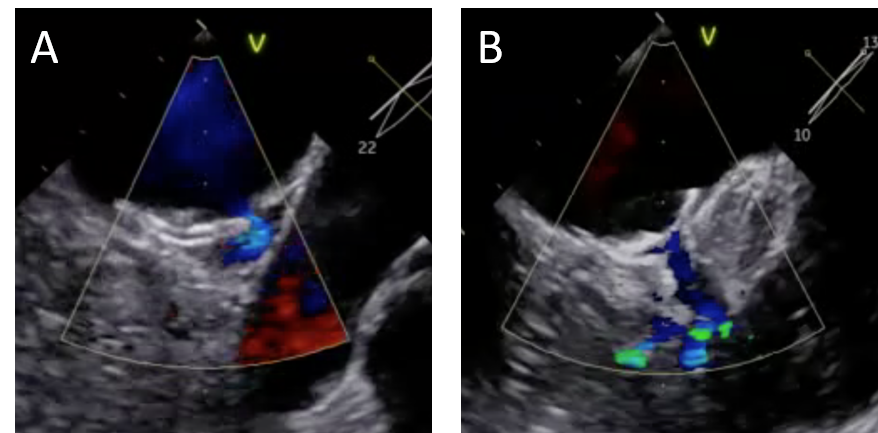
Fig. 1: Panel A: The leak is located between the cover membrane and the umbrella component of the device, allowing residual blood flow through the gap. Panel B: The leak passes over the umbrella part of the device and extends into the distal portion of the LAA, indicating persistent flow deeper within the appendage.



