Background
Coronary artery disease (CAD) remains the leading cause of death among women, with cardiovascular risk increasing disproportionately after menopause. The relationship between lipoprotein(a) [Lp(a)], systemic inflammation, and CAD severity in postmenopausal women remains incompletely understood. This study aimed to investigate the association of Lp(a) and high-sensitivity C-reactive protein (hs-CRP) with angiographic coronary disease burden in a homogeneous cohort of postmenopausal women.
Methods
Within the prospective WHHCF cohort study consecutive women undergoing invasive coronary angiography and standardized blood sampling for biobanking were enrolled. Postmenopausal status was defined by follicle-stimulating hormone (FSH) levels >25 IU/L. Lp(a), hs-CRP, lipid parameters, and hormone profiles were assessed. Coronary disease burden was quantified according to the number of diseased coronary vessels.
Results
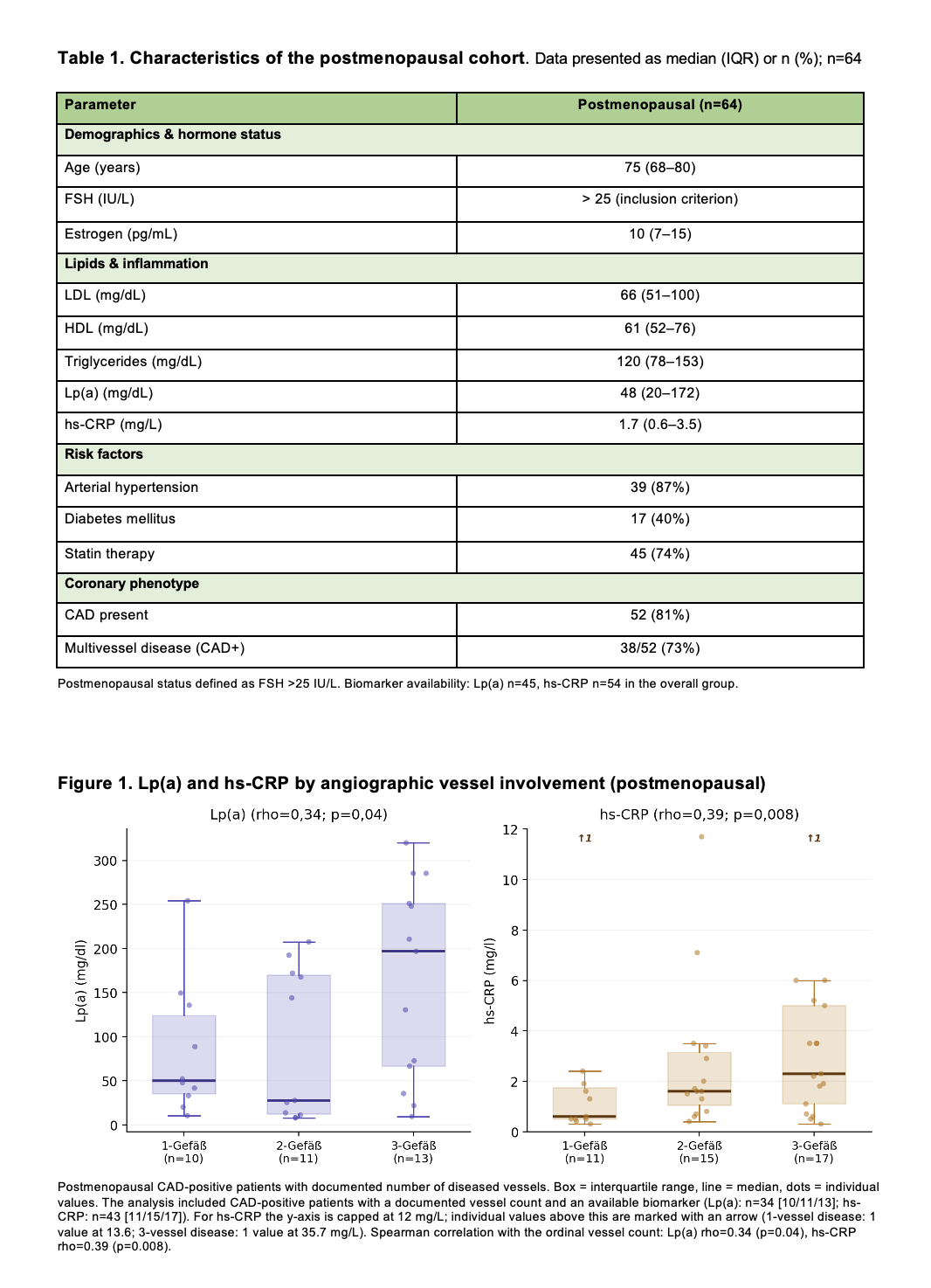
A total of 64 postmenopausal women were included (median age 75 years, IQR 68–80), representing a cohort with a substantial cardiovascular risk burden (arterial hypertension 87%, diabetes mellitus 40%, statin therapy 74%). CAD was present in 81% (n=52), of whom 73% had multivessel disease. Both Lp(a) and hs-CRP demonstrated significant positive correlations with the number of diseased coronary vessels (Lp(a): rho=0.34, p=0.04; hs-CRP: rho=0.39, p=0.008). Higher concentrations of both biomarkers were associated with more extensive angiographic disease burden. Median Lp(a) levels were 50, 28, and 197 mg/dL, while median hs-CRP levels were 0.6, 1.6, and 2.3 mg/L in patients with one-, two-, and three-vessel disease, respectively. Notably, chronological age was not associated with coronary disease burden (rho=−0.01, p=n.s.), indicating that the observed relationships between Lp(a), hs-CRP, and CAD severity were not explained by age.
Conclusions
In this homogeneous cohort of postmenopausal women undergoing invasive coronary evaluation, both Lp(a) and hs-CRP were significantly associated with angiographic coronary disease burden, independent of age. These findings emphasize the potential relevance of lipoprotein-mediated and inflammatory pathways in determining CAD severity among postmenopausal women and support consideration of Lp(a) and hs-CRP in sex-specific cardiovascular risk assessment strategies.