Background
Clinical practice guidelines contain complex conditional recommendations that are difficult to apply consistently in routine care. To support transparent and reproducible clinical decision support, we previously transformed all recommendation tables of the 2024 ESC Guidelines for Chronic Coronary Syndromes (CCS) into an executable knowledge graph capable of deterministic recommendation generation. This study investigated whether guideline-derived medication recommendations can be systematically generated from real-world cardiology discharge letters and compared with documented discharge medication.
Methods
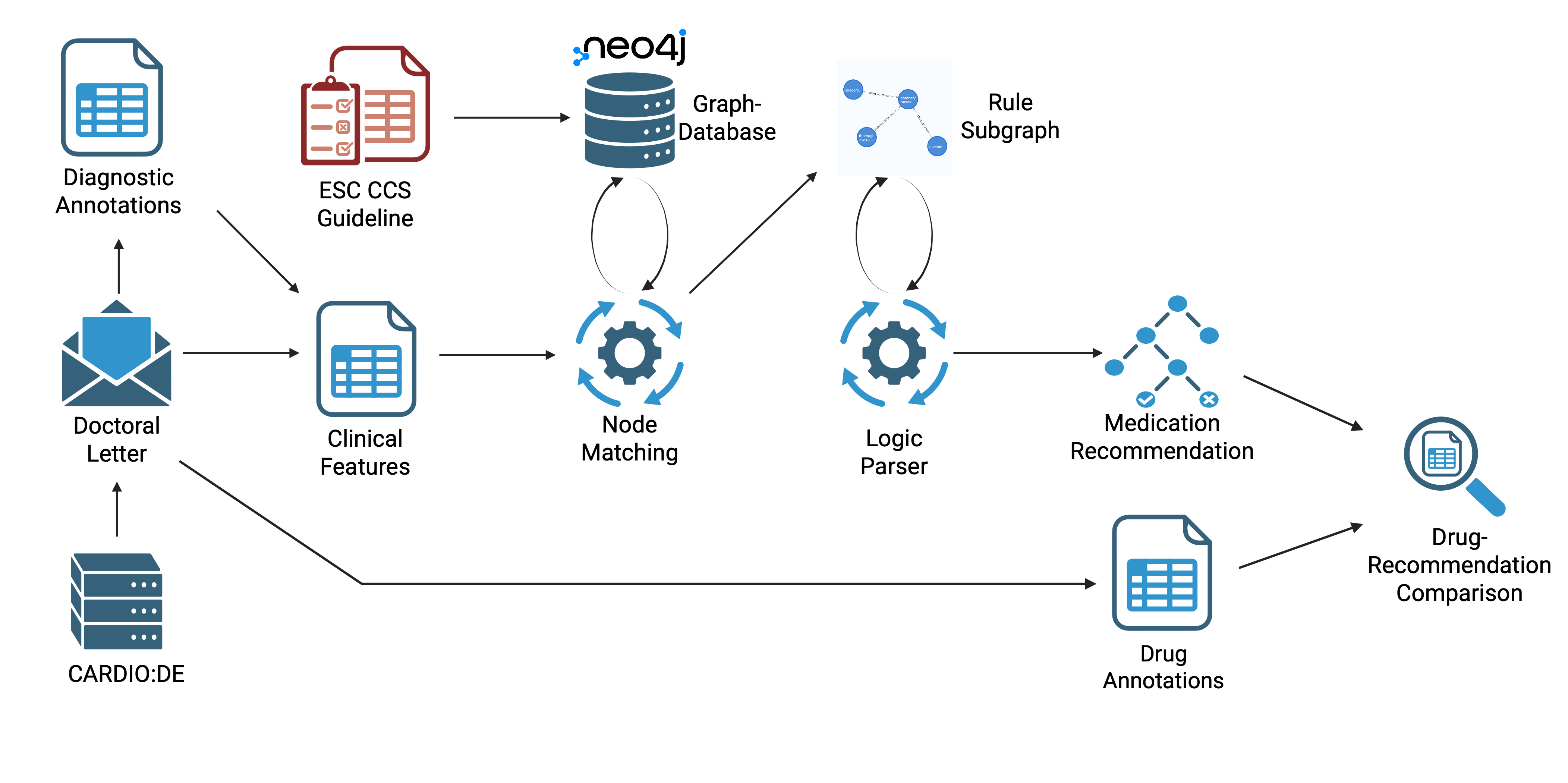
All medication-related recommendations from the 2024 ESC CCS Guidelines were transformed into an executable guideline graph comprising 56 medication-related rules, 84 unique clinical input constellations, and 77 therapeutic actions. A subset of the CARDIO:DE corpus containing patients with chronic coronary syndromes was selected for analysis. Already annotated clinical diagnoses were manually reviewed and enhanced with missing contextual status annotations (e.g., current, suspected, previous, excluded). Patient-specific guideline-relevant clinical features , including diagnoses, comorbidities, symptoms, previous interventions and relevant contextual factors were manually extracted from each letter and provided as structured inputs to the graph search. An executable logic parser subsequently generated patient-specific medication recommendations, which were compared with documented discharge medication. Recommendation-medication pairs were classified as either fulfilled or not fulfilled according to the documented discharge medication.
Results
Experiments were conducted on 98 discharge letters. All patients had at least one directly assessable Class I medication recommendation. After collapsing guideline outputs into patient–medication-class units, 324 Class I recommendations were evaluated. Of these, 249/324 recommendations (76.9%) were fulfilled and 75/324 (23.1%) were not fulfilled. Overall, 48/98 patients (49.0%) had at least one Class I recommendation that was not fulfilled.
Fulfillment rates were highest for beta-blockers (11/11, 100%), antiplatelet therapy among directly assessable cases (36/36, 100%), statins (88/98, 89.8%), oral anticoagulation (22/25, 88.0%), and ACE-I/ARB/ARNI therapy (73/85, 85.9%). Lower fulfillment rates were observed for mineralocorticoid receptor antagonists (7/11, 63.6%), SGLT2 inhibitors (12/32, 37.5%), and GLP-1 receptor agonists (0/26, 0%). In a separate analysis of the broad Class IIa recommendation, low-dose colchicine was not fulfilled in any of 98 applicable cases.
Conclusion
In conclusion, the executable ESC CCS guideline graph enables systematic and reproducible comparison between patient-specific recommendations and real-world discharge medication. While most Class I recommendations were documented, nearly half of patients showed at least one gap, particularly for newer therapies such as SGLT2 inhibitors and GLP-1 receptor agonists. As contemporary guidelines were applied to historical data, findings reflect alignment with current standards rather than past practice. Despite the need for clinical adjudication, this approach offers a scalable framework for automated guideline auditing and explainable decision support to improve care quality.
Figure