Background: Heart failure (HF) is a leading cause of hospitalization and mortality, but it is not a uniform disease entity. Left ventricular HF (LVHF), right ventricular HF (RVHF), and biventricular HF (BVHF) may differ in clinical profile, prognosis, and vulnerability to temporal changes in healthcare delivery and population ageing. We examined nationwide trends in HF hospitalizations by phenotype in Germany.
Methods: We analyzed nationwide inpatient data from the Research Data Centre of the Federal Statistical Office and the Statistical Offices of the Federal States (DESTATIS) from 2015 to 2024. Hospitalizations with a primary diagnosis of HF were classified as RVHF (ICD-10-GM I50.00), BVHF (I50.01), or LVHF (I50.1-). Outcomes included in-hospital mortality, complications, and age-stratified temporal trends. Major adverse cardiovascular events (MACE) were defined as acute myocardial infarction (MI), ischemic stroke, or in-hospital death.
Results: Overall, 4,567,335 HF hospitalizations were identified; after exclusion of cases with unclear HF subtype, 4,542,178 hospitalizations remained. Of these, 36,230 (0.8%) were classified as RVHF, 1,540,275 (33.9%) as BVHF, and 2,965,673 (65.3%) as LVHF. RVHF represented a rare phenotype with a distinct non-coronary comorbidity profile, including higher rates of pulmonary, vascular, and hepatic comorbidities, whereas LVHF and BVHF showed a more typical cardiovascular high-risk profile. In-hospital mortality was broadly comparable across subtypes, but highest in BVHF (BVHF: 9.2%; RVHF: 8.5%; LVHF: 8.2%; Figure 1A). BVHF also showed the highest rates of acute kidney injury and MACE, while LVHF had the highest rates of acute MI, and mechanical ventilation (Figure 1A). Patients aged ≥80 years accounted for more than half of hospitalizations in all subtypes and for most in-hospital deaths (LVHF: 72.9%; BVHF: 72.2%; RVHF: 65.0%). From 2015 to 2024, the proportion of cases aged ≥90 years increased in all HF subtypes (Figure 1B), while the proportion aged 70–79 years declined. Annual case numbers decreased markedly in 2020, whereas crude mortality peaked in 2022 for LVHF and BVHF and in 2023 for RVHF (Figure 1C).
Conclusion: In this nationwide analysis of more than 4.5 million HF hospitalizations, HF phenotypes showed distinct clinical profiles, complication patterns, and temporal trajectories. BVHF emerged as the phenotype with the highest mortality and renal complication burden, whereas LVHF was characterized by more acute cardiac complications and advanced support procedures. Across all subtypes, the inpatient HF population shifted towards older age strata, with deaths increasingly concentrated among patients aged ≥80 years. These findings highlight phenotype-specific vulnerabilities and the growing impact of demographic ageing on HF hospital care in Germany.
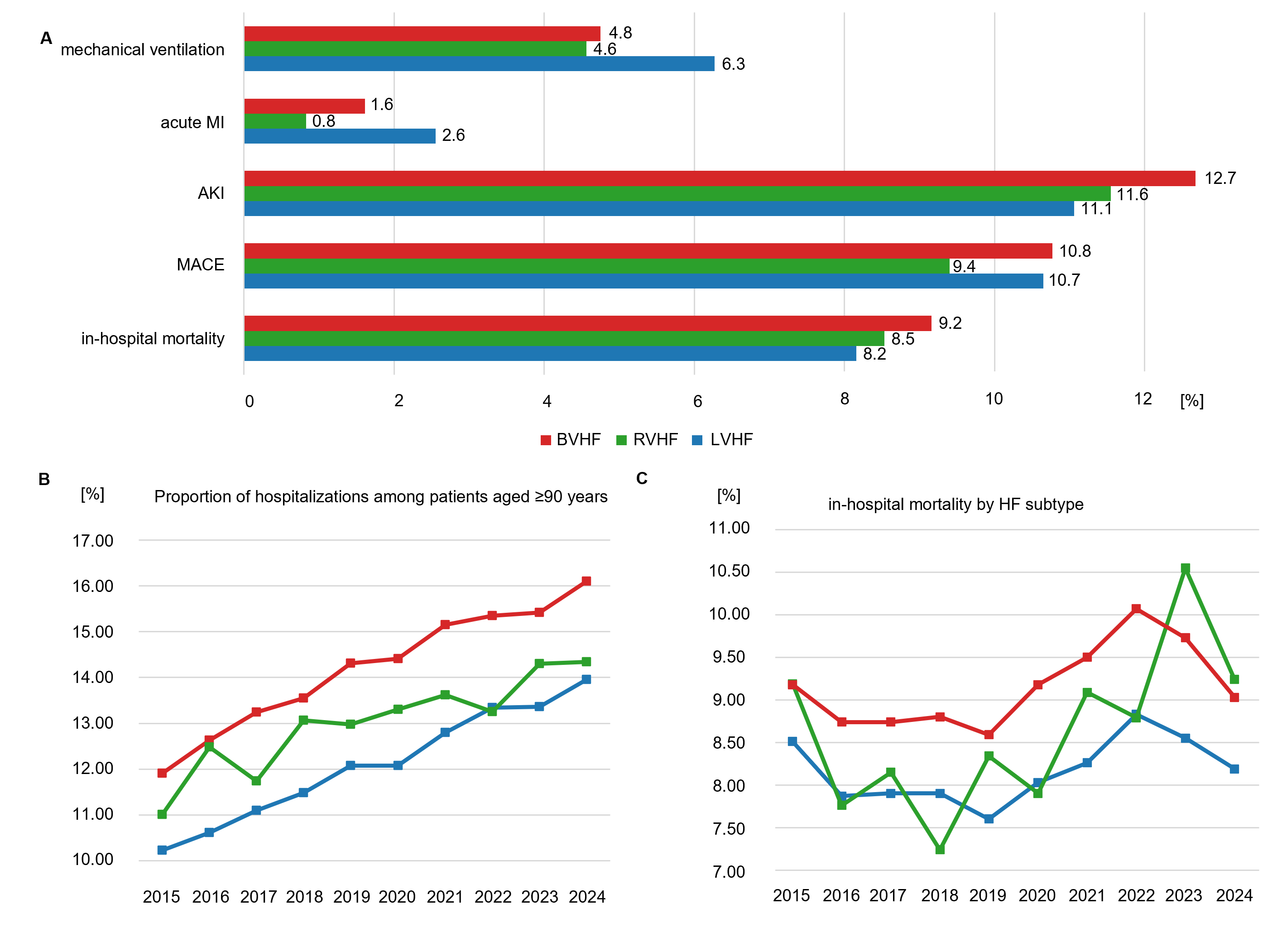
Figure 1: Cased-based temporal trends in-hospital outcome, age distribution, and crude in-hospital mortality grouped by HF subtype.
A: In-hospital mortality and complication profile by HF subtype.
B: Annual proportion of hospitalizations among patients aged ≥90 years by HF subtype.
C: Annual crude in-hospital mortality by HF subtype.
MACE was defined as a composite of acute MI, ischemic stroke, or all-cause in-hospital death. AKI, acute kidney injury; BVHF, biventricular heart failure; HF, heart failure; LVHF, left ventricular heart failure; MI, myocardial infarction; RVHF, right ventricular heart failure.



