Background and Aims
Catheter ablation of ventricular tachycardia (VT) in patients with structural heart disease carries significant risk of haemodynamic compromise, particularly in those with severely reduced left ventricular function. Percutaneous microaxial pump-based mechanical circulatory support (MCS) has emerged as a strategy to maintain perfusion and enable completion of complex procedures, yet data on its safety and efficacy remain limited.
This study evaluates outcomes of VT ablation performed under prophylactic microaxial pump-based MCS.
Methods
This prospective, single-centre observational study included all consecutive patients undergoing VT ablation with percutaneous microaxial pump-based MCS up to February 13, 2026. Device implantation was performed electively based on preprocedural risk stratification, defined by a left ventricular ejection fraction <35% or a high PAINESD score. Vascular closure was achieved using a combined suture- and collagen plug-based vascular closure system. Baseline clinical characteristics, procedural parameters, acute efficacy outcomes, and periprocedural complications were prospectively collected through hospital discharge and analysed descriptively.
Results
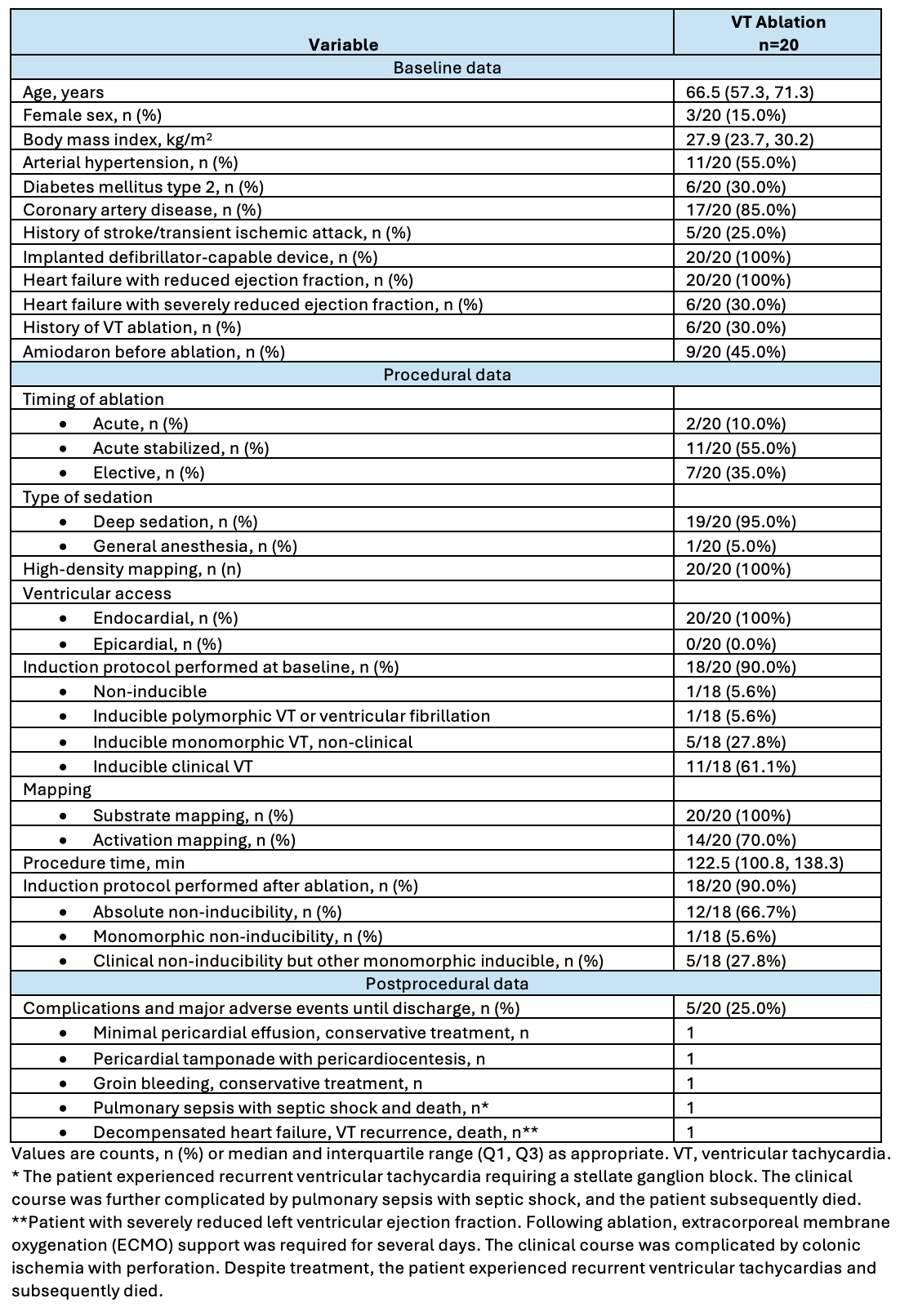
Between March 2025 and February 13, 2026, a total of 20 patients underwent catheter ablation for VT with percutaneous microaxial pump-based mechanical circulatory support (median age 66.5 [IQR 57.3–71.3] years; 15.0% female). All patients had structural heart disease; coronary artery disease was present in 17 (85.0%) and heart failure with reduced ejection fraction in all patients, including severe left ventricular dysfunction in 6 (30.0%). A defibrillator-capable device was present in all patients prior to ablation, and 6 (30.0%) had previously undergone VT ablation.
Most procedures (55.0%) were performed as acute stabilized ablation. All procedures targeted the left ventricle and were performed via an endocardial approach. Substrate mapping was performed in all patients; activation mapping was additionally employed in 14 (70.0%). Nineteen (95.0%) procedures were performed under deep sedation and one under general anaesthesia.
Of 18 patients in whom post-ablation programmed stimulation was performed, 12 (66.7%) achieved absolute VT non-inducibility, 1 (5.6%) non-inducibility of any monomorphic VT, and 5 (27.8%) non-inducibility of the clinical VT with residual inducibility of other monomorphic VTs. No patient had inducible clinical VT at the end of the procedure.
Three periprocedural complications were recorded: one pericardial tamponade requiring pericardiocentesis, one minimal pericardial effusion managed conservatively, and one minor access-site bleeding requiring a compression bandage. Two patients died during the index hospitalisation, one from septic shock and one from decompensated heart failure, neither of which was considered procedure related.
Conclusions
VT ablation under percutaneous microaxial pump-based MCS was feasible and safe in this high-risk cohort. Haemodynamic stabilisation enabled activation mapping of otherwise non-tolerated tachycardias and was associated with high rates of acute procedural success, supporting a prophylactic MCS strategy in patients at elevated risk of haemodynamic compromise.