Background:
Catheter ablation has emerged as the cornerstone of rhythm control therapy for atrial tachycardia (AT). However, determining the indication for ablation in elderly and multimorbid patients remains challenging, and objective tools for individualized risk stratification and prediction of acute and long-term outcomes are lacking.
Aim:
To identify predictors of acute and long-term outcomes after AT catheter ablation and to develop a simple clinical frailty score.
Methods:
SATELLITE is a multicenter observational registry including patients undergoing AT rhythm control. Predictors of three clinically relevant endpoints were evaluated: (1) acute periprocedural complications, (2) cardiovascular hospitalization, stroke, or death, and (3) stroke or death. Multivariable models were developed for each endpoint. Given its prognostic relevance, the endpoint of stroke or death during follow-up was used to derive a clinical frailty score. Internal validation was performed using bootstrap analysis (n=2000).
Results: Among 831 patients undergoing AT catheter ablation (67.1±11.6 years, 56.8% male, prior ablation in 78.0%), acute periprocedural complications occurred in 65 patients (7.8%). Age, heart failure with reduced ejection fraction, antiarrhythmic drug therapy, and oral anticoagulation were identified as predictors, yielding moderate discrimination (AUC 0.65). During a follow-up of 14.3 [6.3–29.0] months, 516 patients (62.1%) experienced cardiovascular hospitalization, stroke, or death. For this endpoint, age, heart failure with reduced ejection fraction, structural heart disease, and antiarrhythmic drug therapy were identified as predictors, also demonstrating moderate discrimination (AUC 0.64). In contrast, stroke or death occurred in only 33 patients (4.0%) after 15.9 [7.0–30.8] months (stroke in 6, death in 27 cases), yet their prediction demonstrated a substantially stronger performance (AUC 0.80, C-index 0.81). Age 65–74 years (1 point) and ≥75 years (2 points), body mass index <25 kg/m² (1 point), cardiomyopathy (2 points) and diabetes mellitus (1 point) were incorporated into the ABCD-AT Frailty Score. Patients were stratified into low- (0–1 points, n=363), intermediate- (2–3 points, n=394), and high-risk groups (≥4 points, n=74), with progressively increasing event rates of 0.6%, 4.6%, and 17.6%, respectively (log-rank p<0.0001). Compared with the low-risk category, intermediate- and high-risk patients exhibited a 7.4-fold (95% CI 2.1–38.7, p=0.0033) and 32.5-fold increased risk (95% CI 7.2–150.6, p<0.0001). Internal validation confirmed stable model performance (bootstrap AUC 0.80, 95% CI 0.73–0.87; optimism -0.0007).
Conclusion:
Predictors of acute and long-term outcomes after AT ablation differ across clinical endpoints. While acute periprocedural complications and the combined endpoint of cardiovascular hospitalization, stroke, or death were predicted with moderate accuracy, prediction of stroke or death showed substantially stronger performance. The ABCD-AT Frailty Score may support individualized risk stratification and patient selection before AT catheter ablation.
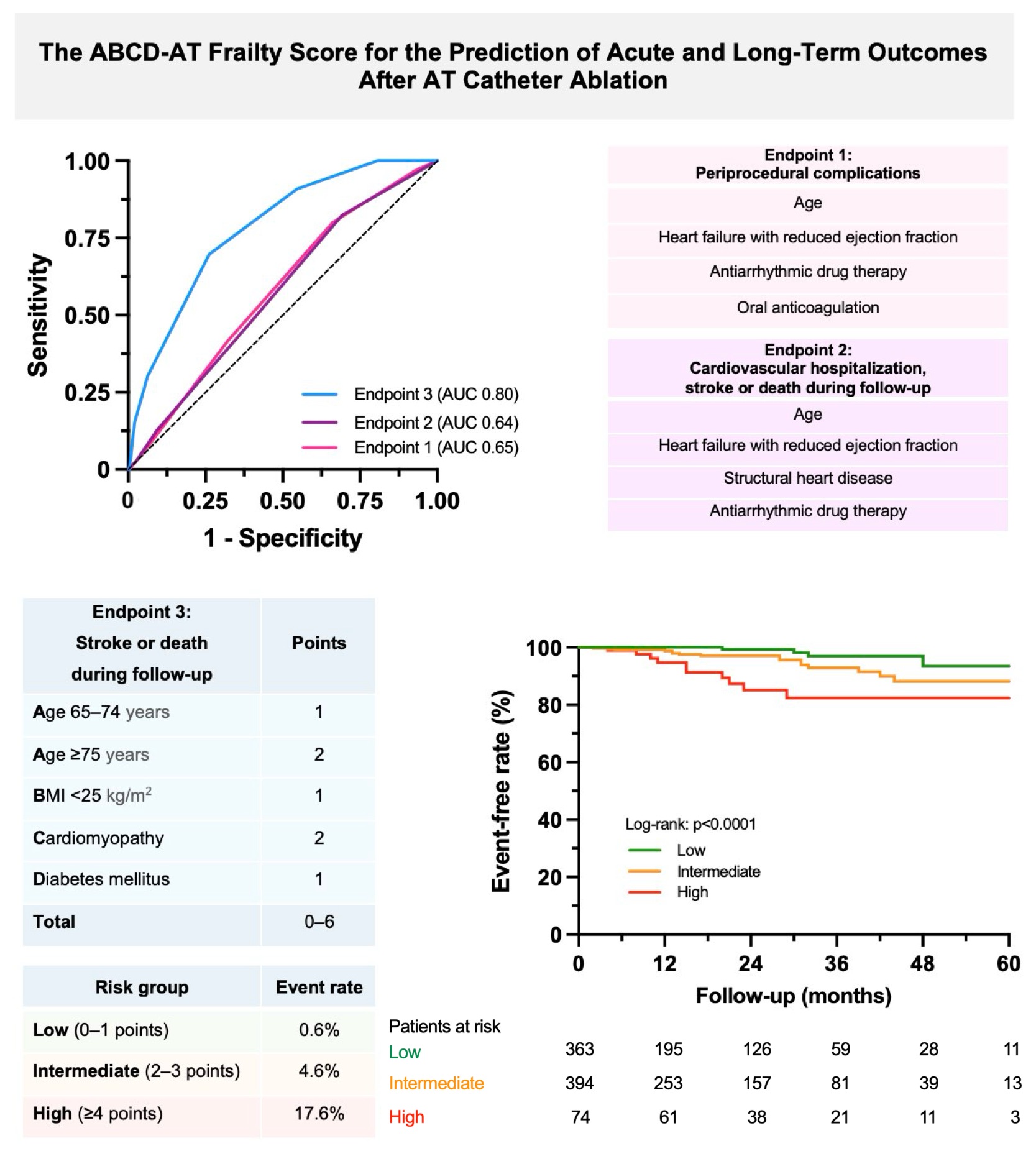 Figure:
 The ABCD-AT Frailty Score for the Prediction of Acute and Long-Term Outcomes After AT Catheter Ablation



