Background: Atrial fibrillation/flutter (AF/AFl) is closely linked to modifiable cardiovascular risk factors, but prevention-oriented phenotypes integrating lifestyle, psychosocial, and inflammatory domains are incompletely characterized.
Hypothesis: A patient-reported modifiable risk-burden score is associated with contemporaneous ECG-documented AF/AFl and with systemic inflammation.
Methods: In a cross-sectional German prevention survey, six binary AF-relevant risk domains were derived: obesity, unfavorable smoking status, higher alcohol consumption, low physical activity, poor sleep, and higher mental stress. Domains were summed to a 0–6 risk-burden score, requiring ≥5 available domains. Among participants with ECG data, AF/AFl versus sinus rhythm was analyzed using logistic regression with robust standard errors. The primary model adjusted for age, sex, and education. A secondary model additionally included self-reported cardiovascular disease, which contained self-reported AF and was therefore considered potentially overlapping with the outcome. In a biomarker subset, an inflammation score was derived from log-transformed CRP values <50 mg/L, platelet count, and neutrophil-to-lymphocyte ratio; components were z-standardized, summed, and rescaled from 0 to 1 using capped 1st–99th percentile scaling.
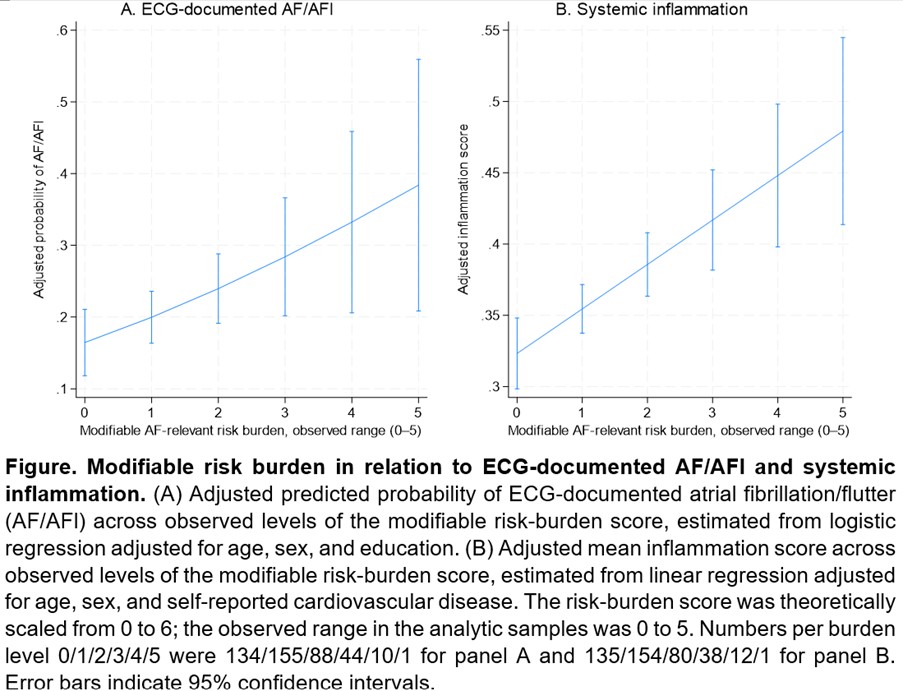
Results: Of 1,228 participants, 519 had ECG data; AF/AFl was documented in 113 participants (21.8%). Compared with participants without ECG data, the ECG subgroup was older, more often male, had higher BMI, more frequent self-reported cardiovascular disease, and higher risk burden. Higher risk burden was associated with ECG-documented AF/AFl after adjustment for age, sex, and education (OR 1.30 per burden point, 95% CI 1.04–1.63; p=0.024). Results were similar after additional adjustment for self-reported cardiovascular disease (OR 1.29, 95% CI 1.02–1.64; p=0.034). A sensitivity score excluding mental stress showed a stronger association with AF/AFl (OR 1.51, 95% CI 1.13–2.02; p=0.006). In the biomarker subset, risk burden correlated with inflammation (Spearman ρ=0.176; p=0.0003) and remained associated after adjustment for age, sex, and self-reported cardiovascular disease (β=0.031 per burden point, 95% CI 0.015–0.047; p<0.001). Inflammation itself was not independently associated with AF/AFl in multivariable analysis.
Conclusions: In this prevention-focused survey, a simple patient-reported modifiable risk-burden score identified participants with higher probability of ECG-documented AF/AFl and was mirrored by higher systemic inflammation. These findings support integrated prevention phenotyping that combines lifestyle, psychosocial, and inflammatory risk signals. Because ECG acquisition was enriched for higher-risk participants and the design was cross-sectional, the results should be interpreted as hypothesis-generating.