Background:
Pulsed field ablation (PFA) is an emerging technology for pulmonary vein isolation (PVI) in patients with paroxysmal and persistent atrial fibrillation (AF). While PFA demonstrates high efficacy and safety, the impact of time from first AF diagnosis to PFA ablation on long-term rhythm outcomes remains unclear, particularly in the context of first-line ablation strategies.
Objective:
To evaluate whether early ablation (<12 months from first AF diagnosis) is associated with improved 1-year arrhythmia-free survival compared with later ablation (≥12 months) in a real-world PFA cohort.
Methods:
We analyzed consecutive patients undergoing PVI between November 2023 and November 2024 using different PFA systems (circular and pentaspline PFA catheters). Patients were stratified according to time from first AF diagnosis (<12 months vs ≥12 months) into early and late ablation groups. A subgroup analysis was performed in patients undergoing first-line ablation without prior antiarrhythmic drug (AAD) therapy. The primary endpoint was freedom from atrial arrhythmia after a 3-month blanking period.
Results:
The study included 200 patients (mean age 66 years, 44% persistent AF), with 91 in the early ablation group and 109 in the late ablation group. Baseline characteristics and procedural parameters were similar between both groups without significant differences. Device distribution was similar between groups (circular PFA catheter: 54% vs 47%, p=0.349). PVI was achieved in all patients, with similar rates of adjunctive ablation (roof line: 33% vs 29%, p=0.649; cavo-tricuspid isthmus ablation: 4% vs 4%, p=1.000). Complication rates were low and comparable (3% vs 5%, p=0.857).
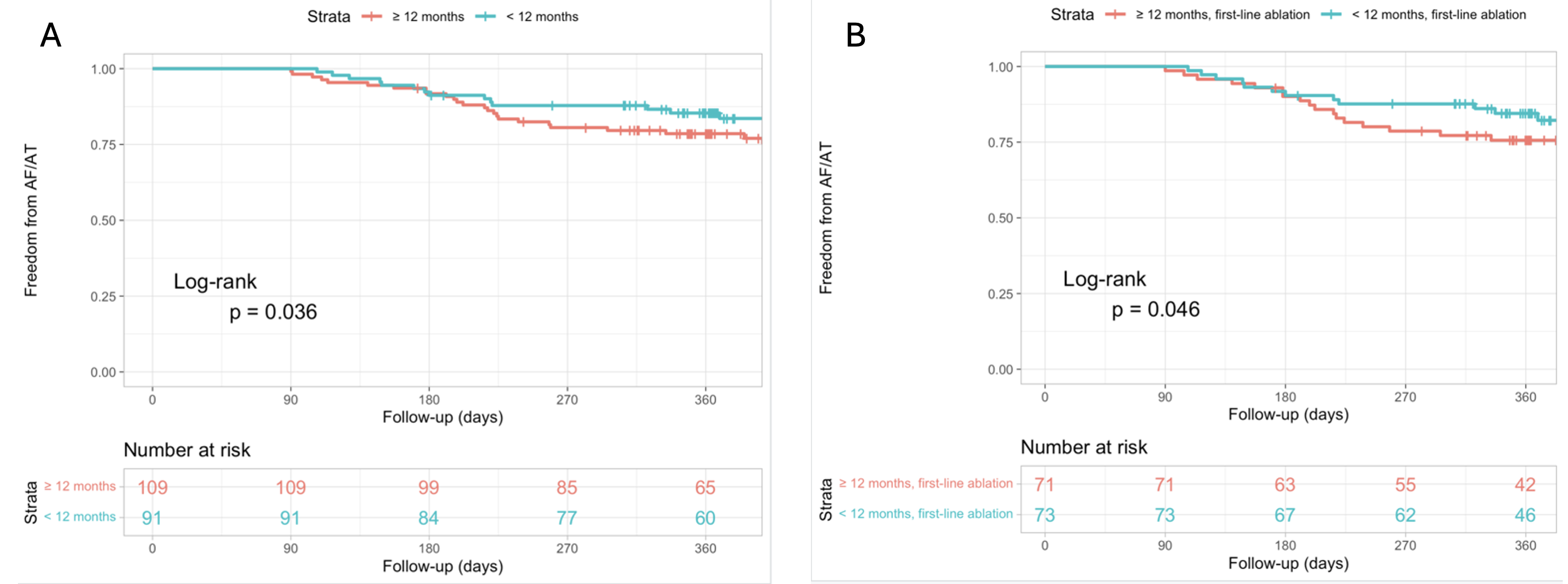
Early recurrence during the 3-month blanking period occurred less frequently in the early ablation group (14% vs 25%), although this did not reach statistical significance (p=0.095). Median follow-up was 386 [IQR 349–486] days. At 1 year, Kaplan–Meier estimated arrhythmia-free survival was significantly higher in the early ablation group compared with the late group (85% vs 78%, log-rank p=0.036; Figure 1A). In the subgroup undergoing first-line ablation without prior AAD therapy, early ablation was also associated with improved arrhythmia-free survival (84.5% vs. 75.6%, p = 0.046; Figure 1B).
In an exploratory analysis using a 6-month threshold from first AF diagnosis, early ablation was associated with a more pronounced separation in arrhythmia-free survival (79% vs. 89%; p=0.015).
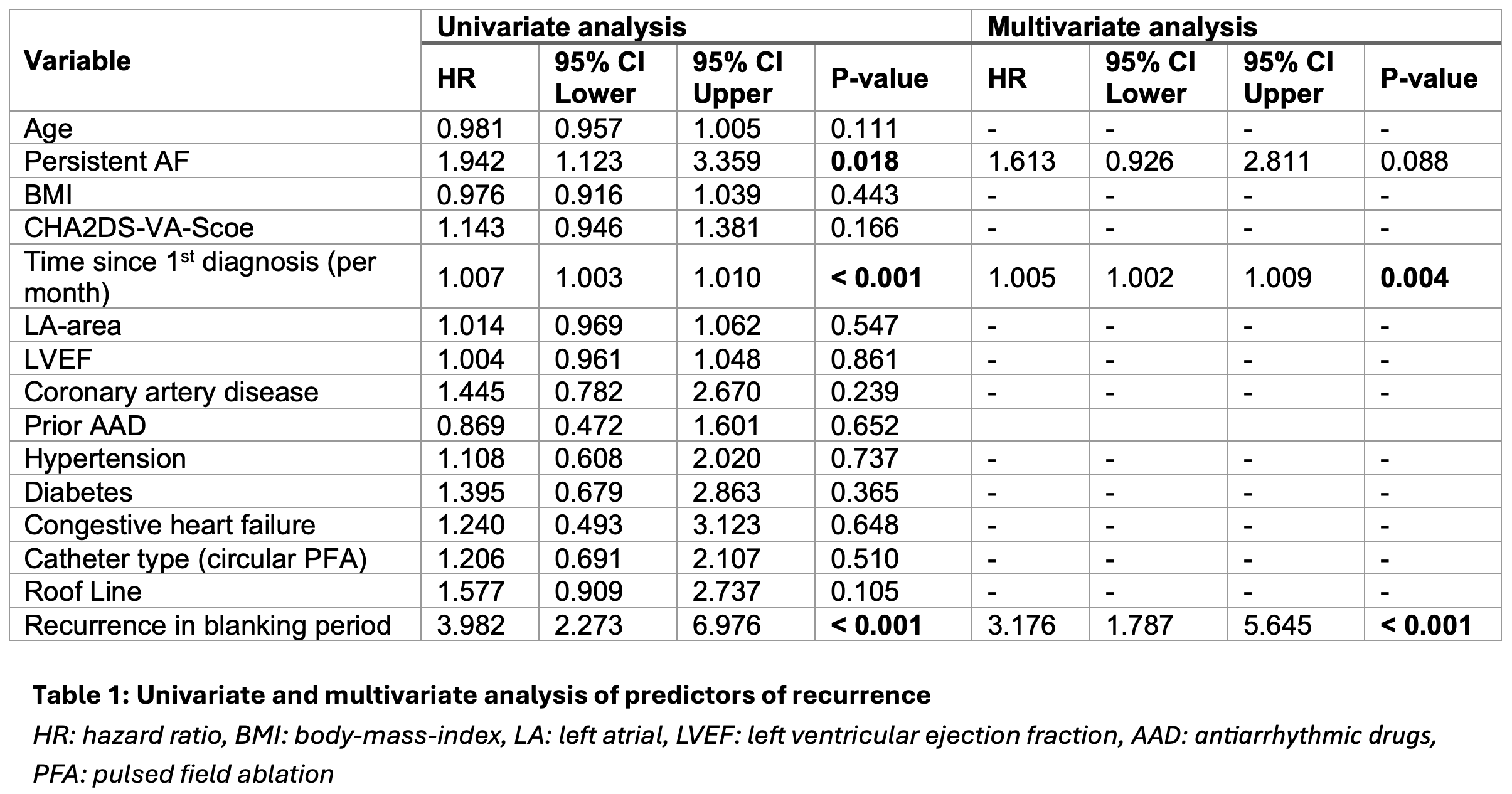
After univariate and multivariate Cox regression analysis, early recurrence during the blanking period (HR 3.18, 95% CI 1.79–5.65, p<0.001) and longer time since AF diagnosis (per month: HR 1.005, 95% CI 1.002–1.009, p=0.004) were independent predictors of late recurrence.
Conclusions:
In this real-world cohort, early PFA ablation (<12 months from AF diagnosis) was associated with improved 1-year arrhythmia-free survival, including in patients undergoing first-line ablation without prior AAD therapy. These findings support earlier rhythm control strategies and suggest a potential role for PFA as first-line therapy in AF. Larger and prospective randomized studies are warranted.