Background
The expanding indications for catheter ablation (CA) of atrial fibrillation (AF) are increasing procedural volumes and necessitate streamlined workflows without compromising patient safety. Pulsed-field ablation (PFA) is a promising non-thermal modality for pulmonary vein isolation (PVI), offering shorter procedure durations and an improved safety profile compared to conventional energy sources. However, intraprocedural bradycardia and asystole remain concerns, particularly with single-catheter approaches without the ability for intracardiac pacing via a coronary sinus catheter. We hypothesized that routine atropine administration prior to PFA with a variable loop circular catheter (VLCC, VARIPULSE, Johnson & Johnson MedTech) minimizes the occurrence of intraprocedural bradycardia or asystole requiring temporary, intracardiac or transcutaneous pacing.
Methods
Consecutive patients undergoing CA with PFA for paroxysmal or persistent AF using a variable loop circular catheter (VARIPULSE, Johnson & Johnson MedTech) were included in this analysis. Antiarrhythmic medications were continued periprocedurally. CA was performed under deep intravenous sedation. Transfemoral access was obtained through a single ultrasound guided venous access. Following a transesophageal echocardiograpic guided transseptal puncture, 1 mg of atropine sulfate was administered intravenously. After a mapping phase, ablation was performed according to a standardized protocol. The primary endpoint was the occurrence of intraprocedural bradycardia or asystole requiring temporary intracardiac or transcutaneous pacing. Secondary endpoints included the need for repeated atropine administration, the abortion or delay of the procedure due to bradycardia, additional venous femoral puncture and adverse events associated with the atropine administration.
Results
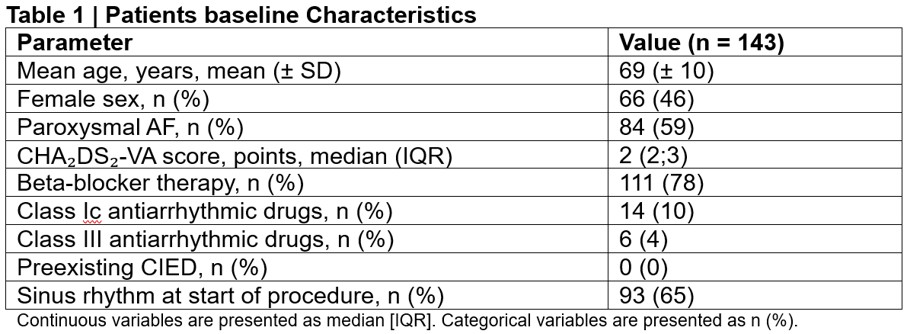
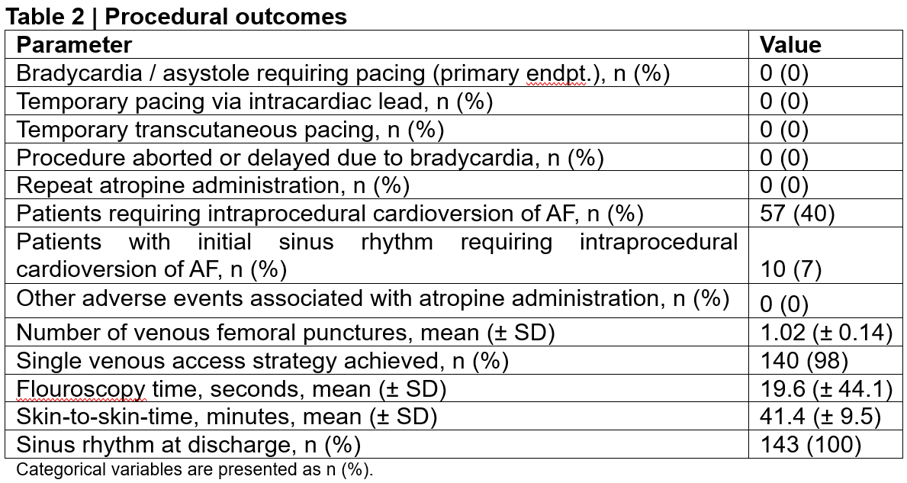
A total of 143 patients (mean age 69 ±10 years, 66 [64 %] female, median CHA₂DS₂-VA score 2 points [IQR 2;3 points]) were included. 84 (59 %) presented with paroxysmal AF, and 93 (65 %) underwent ablation in sinus rhythm. Beta-blockers (111 [78 %]) and other antiarrhythmic agents (14 [10 %] class Ic, 6 [4 %] class III) were continued in all patients. The primary endpoint occurred in 0 (0 %) cases. Repeated atropine administration was required in 0 (0 %) patients, and 0 (0 %) procedures were aborted or delayed due to bradycardia. A single venous access strategy was achieved in 140 (98%) patients, resulting in a mean number of femoral venous punctures of 1.02 ± 0.14. Additional venous femoral punctures were needed soley for intravenous sedation. Despite 10 (7 %) patients initially presented in sinus rhythm but required intraprocedural cardioversion of atrial fibrillation there were no other adverse events associated with the atropine administration. 143 (100 %) patients were discharged in sinus rhythm. Mean skin-to-skin-time was 41 ± 9.5 minutes, and mean fluoroscopy time was 19.6 ± 44.1 seconds.
Conclusion
In this single center analysis routine atropine administration prior to PFA of AF with the VLCC effectively prevented intraprocedural bradycardia and asystole with need of pacing and facilitated a single access approach in most patients. This approach might help in further streamlining PFA of AF by single access protocols without increasing procedural risk.



