Introduction
Despite recent therapeutic advances, cardiac arrhythmias remain a major health burden, with effective treatment options still limited. CaMKIIδ is a key mediator of arrhythmogenesis by promoting sarcoplasmic reticulum (SR) Ca2+ leak (via RyR2 phosphorylation) and enhancing late Na+ current. CaMKIIδ hyperactivity is driven by autophosphorylation at threonine-287. We previously developed a CRISPR-Cas adenine base editing strategy to prevent CaMKIIδ autophosphorylation and generated a T287A knock-in mouse model harbouring a phospho-resistant CaMKIIδ in the germline. Here, we test whether elimination of CaMKIIδ autophosphorylation provides antiarrhythmic protection and whether this approach can be applied postnatally in vivo as a therapy for arrhythmias.
Methods
CaMKIIδ-dependent RyR2 phosphorylation was analysed by Western blot experiments with wildtype (WT) and T287A mouse hearts. We then studied isolated cardiomyocytes under control conditions and upon 100 nM isoprenaline (ISO). Diastolic SR Ca2+ leak was assessed in Fluo-4 AM-loaded cardiomyocytes with confocal laser scanning microscopy. Late Na+ current was measured using whole-cell voltage clamp technique. Ca2+ transients were stimulated at 1 Hz and analysed by epifluorescence microscopy in Fura-2 AM-loaded cardiomyocytes. We next developed a strategy to render CaMKIIδ phospho-resistant postnatally in adult mice. CRISPR-Cas adenine base editing components were packaged into a myotropic dual adeno-associated virus (MyoAAV4A) delivery system under control of a cardiomyocyte-specific troponin T promoter. Three weeks after injection of 3*1013 vg/kg body weight of AAV into the tail vein, we assessed arrhythmias in vivo by transjugular right heart catheterization and electrical burst stimulation. To score ventricular arrhythmias, we graded the arrhythmias from 0 (none) to 3 (persistent > 10s) and averaged five burst protocols.
Results
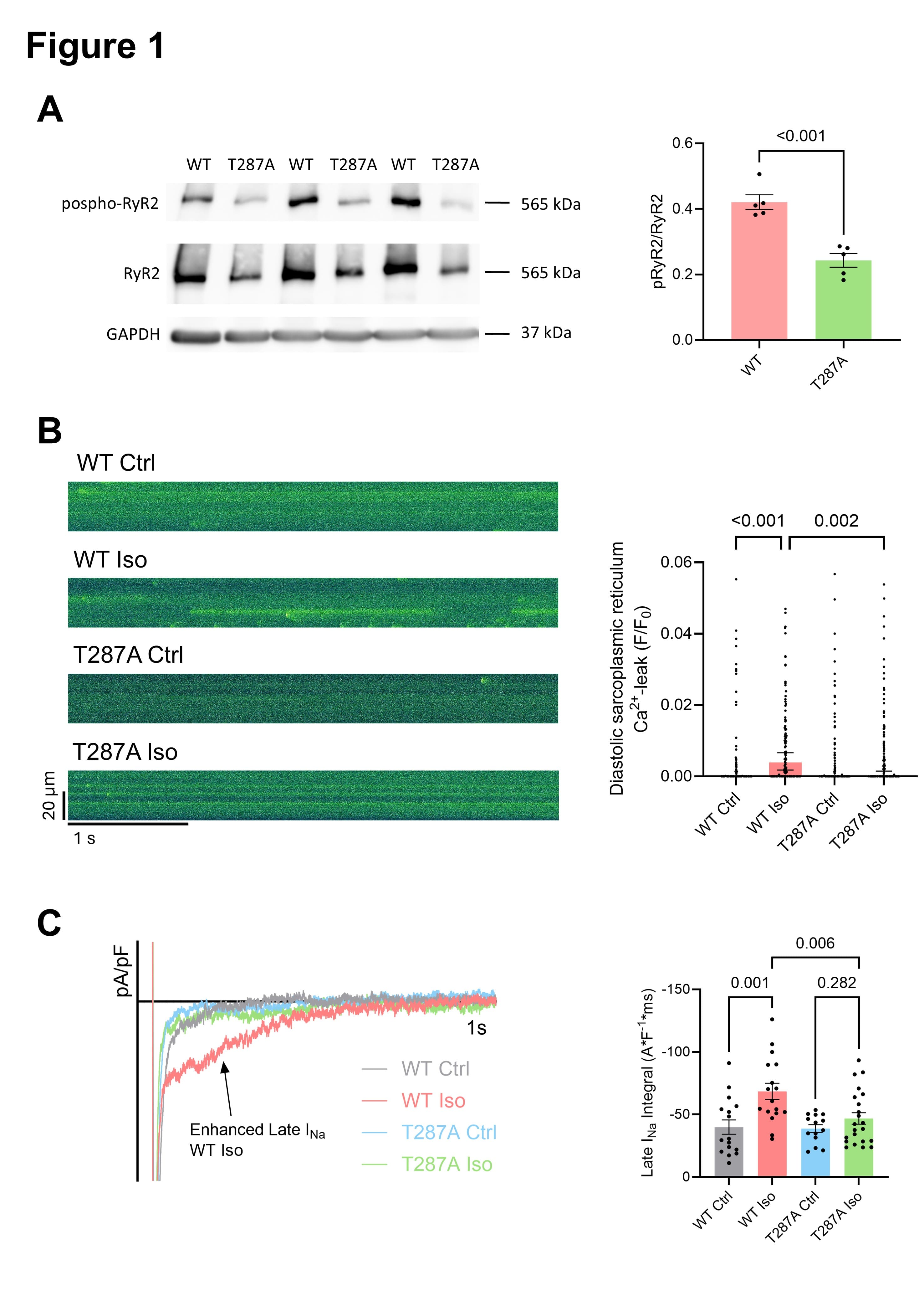
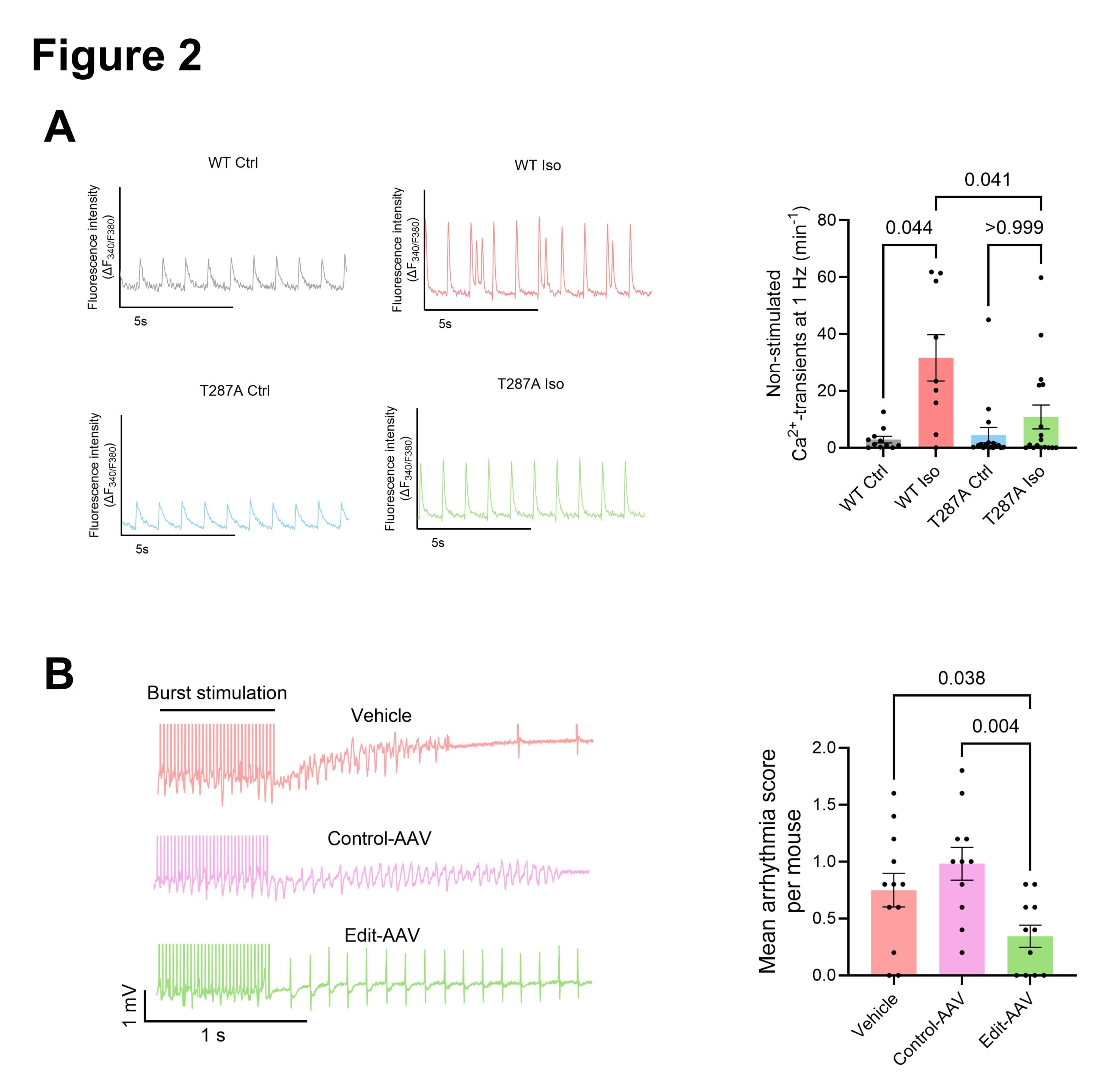
Western blot analysis revealed that CaMKIIδ-dependent RyR2 phosphorylation was significantly reduced by 1.7-fold in T287A compared with WT mice (Fig. 1A). ISO treatment markedly increased Ca2+ spark frequency and subsequent diastolic SR Ca2+ leak in WT cardiomyocytes, whereas T287A cardiomyocytes were protected from this pro-arrhythmic effect (Fig. 1B). Similarly, ISO significantly enhanced late Na+ current in WT but not T287A cardiomyocytes (Fig. 1C). ISO exposure also induced an 11-fold increase in pro-arrhythmic spontaneous Ca2+ transients in WT cardiomyocytes (from 2.8 to 31.6 min-1, Fig. 2A). This effect was attenuated in T287A cardiomyocytes, which showed significantly fewer pro-arrhythmic Ca2+ transients upon ISO compared with WT cells (10.8 vs. 31.6 min-1, Fig. 2A). Aiming toward translation, we next subjected adult WT mice to postnatal CRISPR-Cas adenine base editing. Consistent with our in vitro findings, edited mice showed a substantially reduced arrhythmia severity score compared with NaCl-treated mice and mice treated with a non-editing control AAV (Fig. 2B).
Conclusion
Rendering CaMKIIδ phospho-resistant protected cardiomyocytes from key pro-arrhythmic mechanisms, including diastolic SR Ca2+ leak, late Na+ current, and spontaneous Ca2+ transients. A gene editing strategy designed to postnatally eliminate CaMKIIδ autophosphorylation substantially reduced the arrhythmia susceptibility in adult mice in vivo, which highlights its translational potential as a therapeutic approach for cardiac arrhythmias.