Background: The secreted and atrial-specific growth factor bone morphogenetic protein 10 (BMP10) is associated with incident, prevalent and recurrent atrial fibrillation (AF), and with AF-related complications including stroke. BMP9/GDF2 is a closely related circulating BMP ligand, but whether cardiac tissue contributes to BMP9/GDF2 release remains incompletely understood. Recent clinical trials in device-detected AF and controlled trials of anticoagulation after AF ablation suggest that stroke risk is modulated by AF burden, indicating that quantifiable estimates of atrial high-rate burden may improve anticoagulation decisions and AF screening strategies. However, the mechanisms linking defined atrial high-rate burden to BMP10 release and broader atrial remodeling remain incompletely understood. We therefore used human atrial engineered heart tissues (aEHTs) to study functional, secretory and transcriptional consequences of intermittent and continuous high-rate pacing.
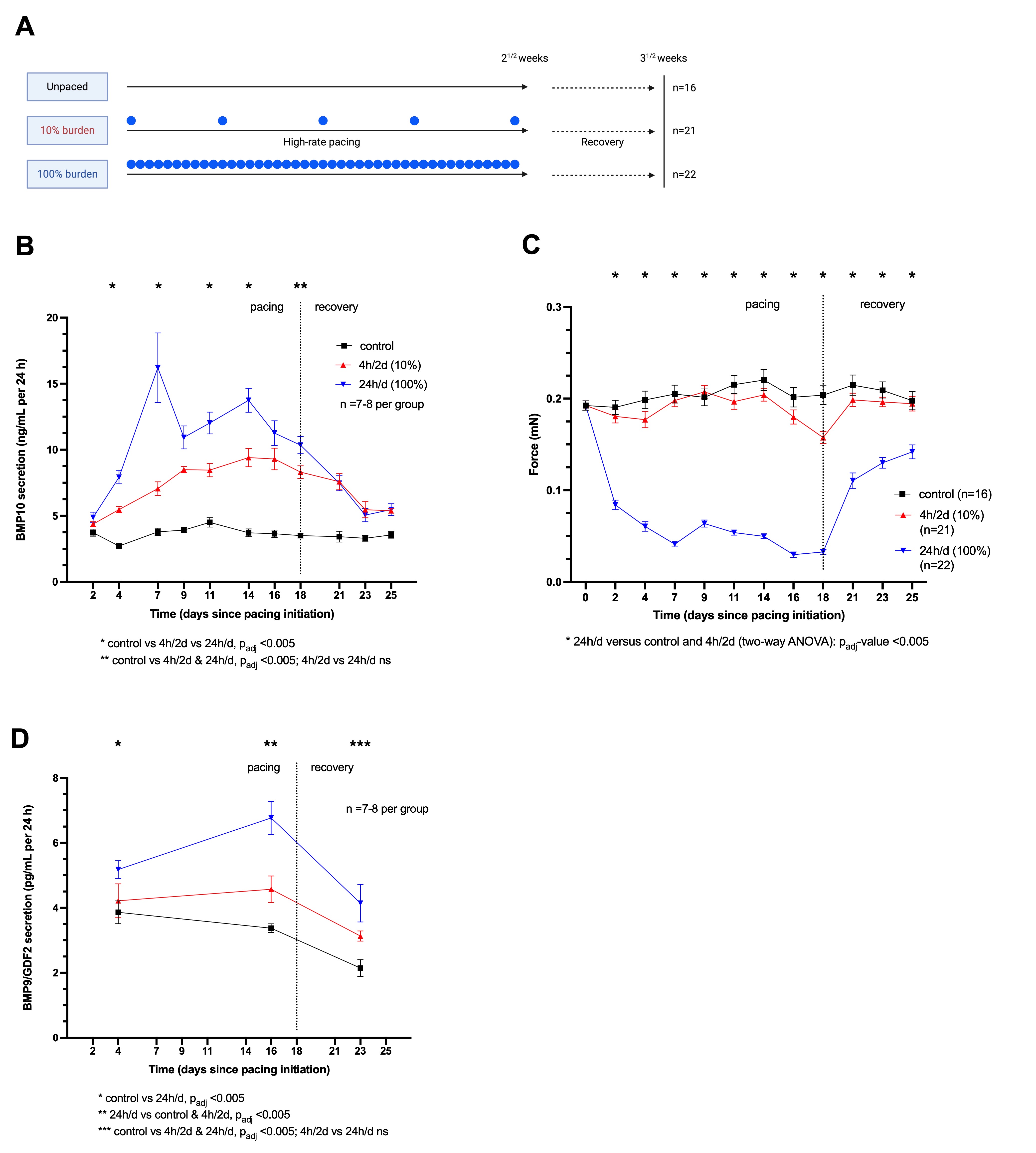
Methods: Atrial EHTs were generated from human iPSC-derived atrial cardiomyocytes embedded in a fibrin matrix and matured for 39 days. Mature aEHTs were optogenetically paced at 4 Hz using AAV-CheRiff2.0, corresponding to twice their intrinsic rate. aEHTs were either not paced (0% burden), paced intermittently for 4 h every 2 days (10% burden), or continuously paced (100% burden) for 2.5 weeks, followed by recovery without pacing. Every 48-72 h, contractile function was analyzed by video-based motion tracking (n=16-22/burden group) and conditioned media were collected for ELISA quantification of BMP10 and BMP9/GDF2 release (n=7-8/burden group). Bulk RNA sequencing was performed on aEHTs harvested directly after the pacing period.
Results: During maturation, BMP10 release increased in parallel with contractile force and strongly correlated with tissue development. High-rate pacing induced burden-dependent contractile dysfunction, with continuous pacing causing an early and sustained reduction in force followed by partial recovery after pacing cessation. BMP10 release increased dynamically in response to high-rate pacing, with highest concentrations observed under continuous pacing (~24 ng/mL vs control ~5 ng/mL). After pacing cessation, BMP10 levels declined toward control levels, indicating a reversible release response. In parallel, bulk RNA sequencing revealed distinct burden-dependent transcriptional states. Intermittent pacing was associated with enrichment of mitochondrial and metabolic pathways, whereas continuous pacing induced a different remodeling profile with downregulation of signaling-related processes. Selected transcripts related to BMP/TGFβ signaling, atrial identity, calcium handling, contractile phenotype and electrophysiological remodeling were regulated by pacing burden, including increased BMP10 and GDF2/BMP9 expression after continuous pacing. In line with the RNA-seq data, aEHTs also showed dynamic BMP9/GDF2 release, with burden-associated regulation and the strongest increase under continuous high-rate pacing (~7 pg/mL vs control ~3 pg/mL).
Conclusion: Defined atrial high-rate burden dynamically regulates BMP10 release and induces burden-dependent functional and transcriptional remodeling in human aEHTs. Additional regulation of BMP9/GDF2 at transcript and protein level suggests that sustained atrial high-rate stress affects broader BMP/TGFβ ligand biology, while BMP10 release remains a dynamic and reversible readout of atrial high-rate burden.